

Song: Where the Shield Broke
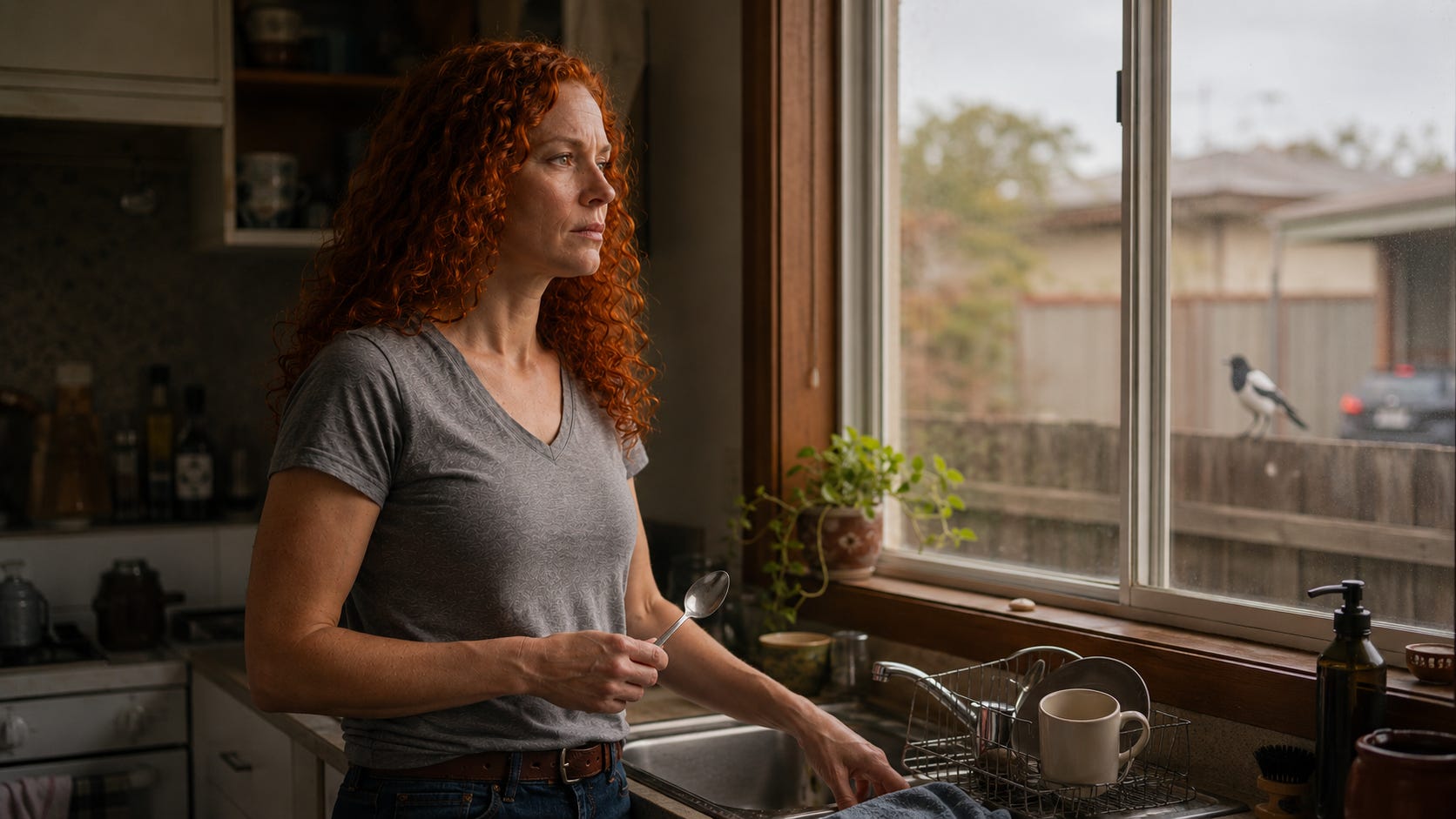
Naomi stood at the kitchen sink holding a spoon she had already washed.
Water had stopped running a minute ago, but she was still standing there with her hand in the bowl, as if the body had forgotten the next step. Outside the window, someone was reversing badly into a driveway. A magpie was making its usual metallic little commentary from the fence. The sky had that pale washed look it gets when the day can’t quite commit to brightness.
It should have been nothing.
Just a morning.
Just a spoon.
Just a sound outside.
But her chest had already tightened, and tears were already there.
That was what shocked her most lately — not that pain appeared, but how little it took now. A tone in someone’s voice. A message unanswered. A child crying in a supermarket. A look that might mean nothing. A door closing too hard. The whole body would open like an old wound and suddenly she was not only here in the kitchen. She was somewhere much earlier too.
Not in memory exactly.
In feeling.
The pain did not come as a story at first. It came as atmosphere. A drop in the belly. A hollowness under the ribs. That old instant knowledge:
not safe,
not held,
not wanted unless…
unless what?
Unless she was better.
Calmer.
More useful.
More pleasing.
Less difficult.
Less herself somehow.
She set the spoon down and leaned both hands on the bench.
It had become so easy to be triggered.
As if some long-used shield had cracked without warning and now everything came through — voices, expressions, silences, delays, disappointments — all of it arriving straight into the old exposed place.
There had been a time she would have called this regression.
A failure of progress.
Proof that she was getting worse.
But standing there now with the whole kitchen blurred softly by unshed tears, she could feel something simpler.
The shield had not been peace.
It had been protection.
And when protection breaks, what returns is not new pain, but old pain finally felt without armor.
That did not make it pleasant.
But it changed the meaning.
The first place it took her was always the same unnamed country:
separation.
The sense that life was happening elsewhere, to other people, and that she had somehow landed outside the circle.
The world over there.
Her over here.
Then came the other knowing, even older:
belonging must be earned.
Not a sentence she had been taught outright. More a law her body had absorbed.
Meet the standard.
Read the room.
Get it right.
Be who they need.
Then maybe.
Then perhaps.
Then if you are very careful,
you can come in.
No wonder the world had grown strange.
No wonder safety always felt conditional.
She dried her hands and went to sit by the window. A child’s bicycle lay on its side in the yard next door. A curtain moved in someone else’s house. A dog barked once and then gave up, as if even it had lost confidence in the urgency of its message.
Naomi could feel the old seriousness gathering around the feeling, trying to make a whole case out of it.
You see?
This is why life feels hard.
This is why you never fully relaxed.
This is why you have to understand it and heal it and finally fix—
But even that was just more weather around the original ache.
What was actually here was simpler.
Tightness in the chest.
A trembling under the skin.
A softness behind the eyes.
The feeling of being very small in a large uncertain world.
She let that be enough.
Not because she was suddenly wise.
Because she was tired of adding courtrooms to pain.
After a while the tears came properly, not dramatic, just steady. She cried for the child she had been — the one who learned too early that the world was unpredictable, that love had conditions, that safety could vanish, that acceptance depended on performance. She cried too for the woman she had become — so practiced at coping, at reading people, at earning her place, that she had almost forgotten how frightening life had once seemed.
And then, quietly, another thing showed itself.
Under all the fear and sadness and bracing, there was love.
Twisted up maybe. Hidden. Defensive. But love.
Because the whole reason this hurt so much was that she had always wanted to belong.
Always wanted the world to feel close, kind, safe enough to rest in.
Always wanted to come home.
The longing itself was innocent.
That softened her more than anything.
By afternoon she went for a walk. The streets were full of ordinary things carrying on without consulting her inner weather — bins out, someone mowing, jacaranda petals crushed into the footpath, a couple arguing quietly beside a parked car. She walked slowly, hands in her pockets, not trying to become present, not trying to get rid of the ache.
Just walking with it.
At the park, she sat on a bench and watched two little girls on the swings. One was laughing too hard to keep pumping her legs properly. The other was very serious about height.
Naomi smiled despite herself.
The sadness was still there.
So was the tenderness.
So was the old bodily knowledge of danger.
But here too was this:
air on the face,
children laughing,
the bench holding her without asking anything in return.
For a few seconds, that was enough.
Not enough to erase the old separation.
Not enough to make the world suddenly safe forever.
Just enough to show that even now, with all the old pain close to the surface, life still kept offering these tiny places to land.
Not the end of hurt.
A place to sit with it.
By the time she rose to walk home, the tears had dried. The body was still tender, still more permeable than she would have chosen, but the tenderness no longer felt like failure.
It felt like something real had come back online.
And real, for all its ache, was better than numb.
Investigation: When the shield breaks
What you describe is deeply understandable.
When someone says, “it’s so easy to be triggered now,” it can sound like things are getting worse. But often what has changed is not that life has become more dangerous — it is that the old protective structures are thinner, so the original pain is more directly felt.
1. The shield was not the same as healing
A shield can look like:
numbness
distance
competence
control
self-management
not feeling too much
functioning well enough
When that shield weakens, it can feel frightening because everything gets through:
tone of voice
rejection cues
conflict
disappointment
uncertainty
ordinary human roughness
This does not necessarily mean you are less okay.
It may mean you are less defended.
2. Triggers often point to early themes
The present-day trigger may be small, but what it touches is old.
And the old themes are often exactly what you named:
safety
security
separation
not belonging
conditional acceptance
having to meet standards
earning love
the world as strange or unsafe
So the reaction today is not only about today.
It is about the body remembering an earlier world.
3. “Nowhere is safe”
That feeling is very important.
Not because it is objectively true in every moment, but because it may be how the nervous system learned reality.
If early life taught:
love is conditional
belonging is unstable
approval must be earned
safety can vanish suddenly
being yourself is risky
then the body may still organize experience around those assumptions long after the original conditions are gone.
4. Why it feels so raw now
When protection thins, the old pain may no longer stay buried in story or coping.
Then a present event can bring:
immediate tears
bodily memory
smallness
fear
the old ache of exclusion
the old bargain: “If I do this right, maybe I can belong”
This can feel unbearable because it is pre-verbal in places.
It is not just an idea.
It is a whole body-world.
5. What matters most
The deepest move may not be “how do I stop getting triggered?”
It may be:
Can this pain be recognized for what it is actually pointing to?
Not weakness.
Not failure.
Not overreaction.
But an old system built around surviving conditional safety.
6. Clean summary
A concise version would be:
When the old shield of protection breaks, triggers can feel more frequent and intense because experience reaches the original wound more directly. What gets touched is often not just the present event, but the early bodily world of not feeling safe, not belonging, and believing love or acceptance must be earned. The pain is real, but it is not proof of failure. It may be the return of something long defended against — an old vulnerability finally felt without so much armor.
Sometimes reactions to the fear, sometimes reactions, sometimes withdrawal for days - feeling whatever is present. Not really knowing what is appropriate, yet wanting it to be in a certain way towards safety.
'The feeling of being very small in a large uncertain world.' is real. Feels like danger - something really at stake.