
When the Homework Forgot It Was Homework
A story & investigation about When seeking stops being a job

Song: When the Work Turned Into Play
A central thread here is the moment when the whole project stops feeling like grim self-improvement and starts feeling like alive, curious, ongoing discovery — where seriousness loosens, the need to “get somewhere” softens, and even the strange ordinariness of life becomes part of the wonder. There is no finish line, no stable badge, no final role to wear. The work turns into play, and the play is not trivial — it is full of humor, love, awe, and a deepening ease with what simply happens.
Story: When the Homework Forgot It Was Homework
Song: When the Work Turned Into Play
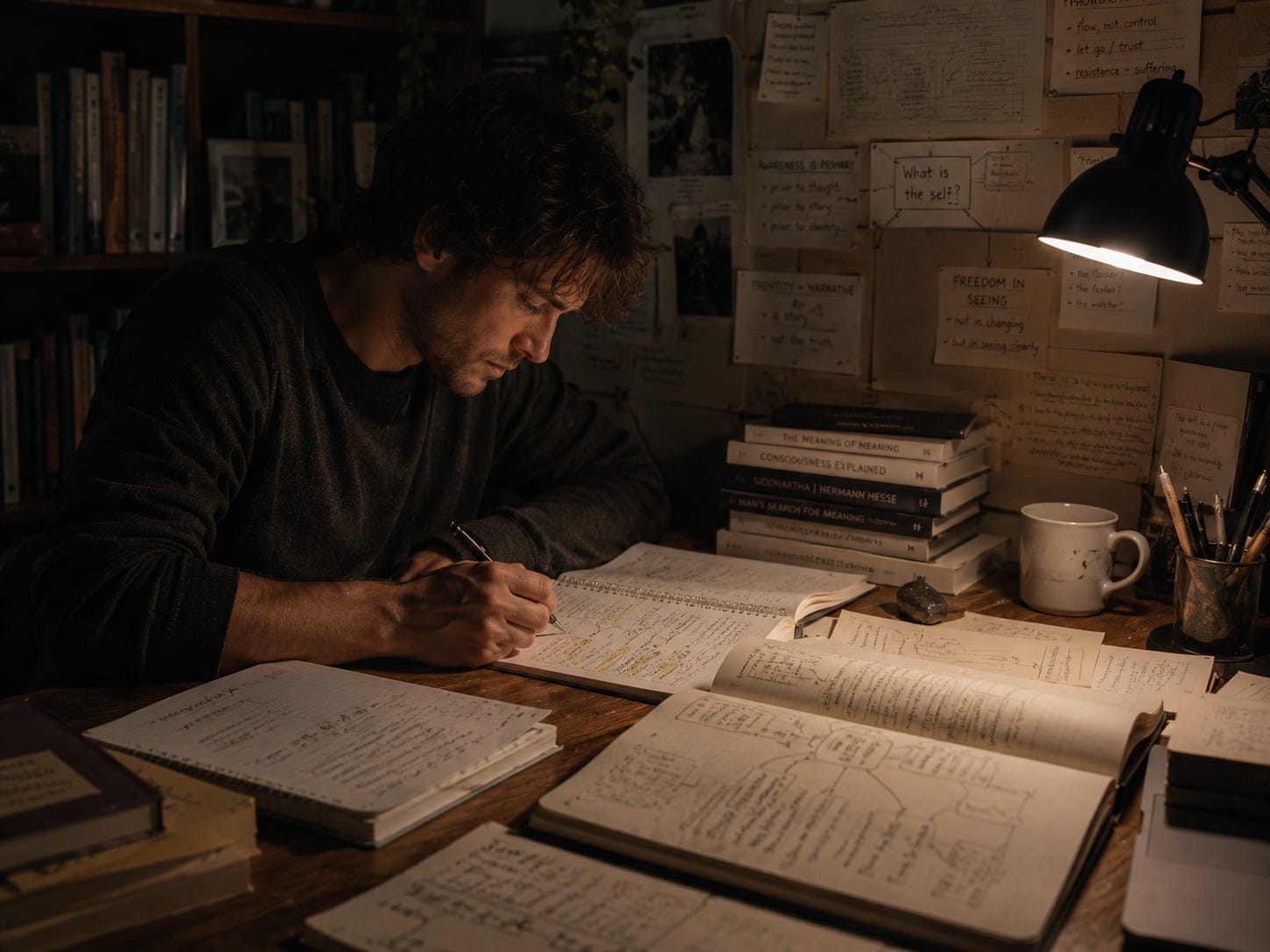
Daniel had once treated all of this as if he were trying to pass an exam that never announced its questions.
He did not tell anyone that, of course. Outwardly he sounded thoughtful enough. He used good words. Spacious words. Sincere words. He said things like “Inquiry,” and “what is actual,” and “the structure of identity,” and “deconstructing the mechanism.” He spoke as if he were engaged in something subtle and beautiful.
Which he was.
But underneath it all was the old smell of effort.
Get this right.
Don’t stop too soon.
Don’t fool yourself.
Don’t miss the point.
Look harder.
Stay with it.
Find the crux.
Dissolve the thing that keeps reforming.
He had taken the whole mystery and turned it into very serious homework.
There were notebooks.
Underlined phrases.
Arrows connecting one insight to another.
Questions that generated more questions.
Occasional bright openings followed by long grey stretches of trying to recreate what had happened.
And beneath that, though he barely admitted it even to himself, a very ordinary hope:
that one day all this effort would pay off, and life would finally stop feeling so much like a room he had to keep tidying with his mind.
Then one evening he was sitting with a few people after a meeting, not in some sacred space, just in the loose, warm afterglow of conversation when no one is performing quite as hard anymore.
The kind of conversation where someone says something simple and it lands like a bell.
One person was talking about how nothing had really finished, how things still moved and shifted and went on revealing themselves. Another was talking about how models were useful until they became cages. Someone else laughed about how seriousness had eased, how there was still sadness, still life, still ordinary mess — but less of the old drive to make it all add up into a final spiritual shape.
And then someone said it.
Almost in passing.
“The work turned into play.”
The room changed.
Not outwardly. Nobody levitated. No halo descended over the fruit bowl. Someone still had a blank square for a screen. Someone else was half-eating a late dinner. A dog barked somewhere in the background of someone’s microphone. Life remained gloriously uncurated.
But for Daniel, something opened.
The work turned into play.
He felt it in the body before he understood it.
A loosening under the sternum.
The sort of quiet laugh that rises from the chest rather than the throat.
The unmistakable feeling of a sentence finding the exact lock it was made for.
Because yes.
That was it.
For years he had thought the whole thing was work. Hard work. Worthwhile, noble, even beautiful work, but still work in the old sense: effort toward a result, discipline in service of an outcome, labor performed by someone hoping to become someone freer.
And now, all at once, he could see the hidden sadness in that.
He had taken wonder and put it on a schedule.
Taken awe and made it answer to progress reports.
Taken the sheer strangeness of being alive and tried to turn it into an assignment.
No wonder it had become heavy.
No wonder joy went missing.
No wonder every glimpse had so quickly become another item on the list:
understand this,
stabilize that,
don’t regress,
watch the mind,
see the story,
don’t identify,
stay present,
repeat.
He laughed again, softly this time.
It was not that the looking had been wrong.
It was that it had been recruited into the same old machinery.
The same one that used to try to fix his career.
Fix his relationships.
Fix his moods.
Fix his face in social situations.
Fix his whole existence.
And now that same machinery had tried to fix awakening.
What a joke.
Not a cruel joke.
A divine one, perhaps.
The kind where the setup is existence itself, and the punchline is that nothing needed to be forced into being what it already was.
That night, after the meeting ended and the house had gone quiet, Daniel stood in the kitchen rinsing a cup and noticed thoughts moving through him in the old familiar way.
A thought about whether he had understood something correctly.
A thought about whether that line — the work turned into play — was now going to become yet another concept to perform.
A thought about whether perhaps he was “further along” than he had been.
Then immediately the counter-thought:
How ridiculous. Who would be further along?
Each thought arrived like a bird landing on the fence and lifting off again.
And for the first time in a long while, he did not feel obliged to make a project out of them.
Instead there was curiosity.
Not disciplined inquiry.
Not therapeutic scrutiny.
Not “What does this mean about my conditioning?”
Just simple curiosity.
Look at that.
There goes the mind again.
There goes the old urge to convert everything into a ladder.
Curiosity had a completely different flavor than effort.
Effort tightened.
Curiosity opened.
Effort wanted to win.
Curiosity wanted to see.
Effort carried time in its pockets.
Curiosity lived where it stood.
That difference was immense.
The next day he went for a walk and it was as if the whole world had been quietly waiting for him to stop turning it into coursework.
A crow on a powerline.
A woman laughing into her phone.
The smell of cut grass.
A little knot of shame rising at the memory of something awkward from yesterday.
A dog sniffing a tree with total commitment.
The thought [i]you should use this moment well.[/i]
The immediate delight of catching that thought and not needing to obey it.
Everything had become interesting again.
Not important.
Interesting.
The contractions were interesting.
The stories were interesting.
The moments of sudden openness were interesting.
The strange eruptions of laughter, the sweetness in sadness, the way the mind built seriousness and then tripped over its own construction — all of it fascinating.
And once it became fascinating, it became playful.
Not because suffering had vanished.
Because suffering was no longer the only thing in the room.
There was humor now.
That mattered more than he had realized.
He had once thought awakening would make him solemn in a luminous sort of way. Still, profound, very clear, probably quite quiet. Someone who spoke in careful tones and never got caught in anything too ordinary.
Instead he found himself more available to laughter than ever.
Not loud cheerful performance laughter.
Something subtler.
A kind of cosmic cackle.
The nonverbal recognition of the joke at the heart of the setup.
The mind says: [i]This is serious.[/i]
And then — oh.
That too is part of the show.
The self says: [i]I am making progress.[/i]
And then — really?
Who is keeping score?
A thought appears dressed as reality.
Another thought comes in and bows to it.
Then seeing notices the whole pantomime and something inside goes [i]ha.[/i]
Not dismissively.
Lovingly.
That was part of the play too: love.
The softer he got, the stranger love became.
Less like attachment.
Less like demand.
Less like transaction.
More like a kind of open weather that did not need a reason.
Love for the person talking.
Love for the empty screen with a name on it.
Love for the fool mind.
Love for the body doing its thing.
Love for sadness.
Love for the awkwardness of all these people trying to speak a wordless thing with these clumsy miraculous words.
None of it made sense.
That was part of the beauty.
And slowly, Daniel began to understand something he had never quite understood before:
Play is not the opposite of seriousness because it is shallow.
Play is the opposite of seriousness because it is free.
Work had been a seeker trying to arrive.
Play was life exploring itself without demanding a conclusion.
That evening, sitting with his notebook open, he did not tear up the old pages. He did not condemn the years of effort. He felt tenderness for all of it.
The striving had not been a mistake.
It had simply ripened.
The labor had carried him to the edge of something that labor itself could not enter.
And then, when it could go no further, it had tipped over into something lighter.
He picked up his pen and wrote one sentence:
[i]Stop treating wonder like employment.[/i]
Then, after a moment, he added:
[i]The joke is that nothing was ever not included.[/i]
He closed the book and smiled.
Outside, a breeze moved through the trees.
Inside, the thoughts kept appearing.
The body kept living.
The ordinary evening kept unfolding without needing to be turned into anything more.
And because he was no longer trying quite so hard to wake up, the whole thing seemed somehow more awake than before.
Investigation: When seeking stops being a job
A strong shift happens here: what had felt like “the work” begins to lose its laboring quality and take on the feel of discovery, humor, and play. This does not mean the looking stops. It means the pressure around the looking softens.
1. The seeker-mood is heavy
Early on, even useful inquiry can be organized around becoming:
I must get somewhere
I must stabilize this
I must understand it properly
I must not fool myself
I must keep going until something final happens
That mood turns even beautiful recognition into employment for the imagined self. The result is seriousness, strain, and subtle self-improvement.
2. The content may stay similar, but the flavor changes
Thoughts still arise.
Identities still float in.
Sadness may still happen.
Ordinary life continues.
What changes is the conviction behind it all. The mental structuring loses some of its authority. There is less obligation to be consistent, less need to preserve a continuity-story, less reverence for every thought that turns up.
3. Play is not superficial
When Vince says “the work turned into play,” he is not talking about becoming casual or careless. He is pointing to a different relationship:
less getting somewhere
more discovering what is here
less force
more humor
less “I must fix this”
more “oh, look what’s happening”
Play here means freedom from the demand that every moment produce progress.
4. Humor and awakening are deeply linked
Several people point to the humor in awakening: the setup, the reversal, the punchline, the way the mind builds a reality and then suddenly the whole thing is seen differently. This is not merely comic. It is structural. When conviction relaxes, what remains is often wonder mixed with laughter.
5. No finish line, ongoing adventure
Another crucial strand here: there is no clean final category. No stable identity called “awake” that one can wear honestly. Life remains ordinary. Discoveries continue. Things deepen, soften, shift. The “fraud” feeling is partly a reaction to the idea that one would have to become something special or guru-like. That whole construction is artificial.
6. The householder path matters
A powerful point in the exchange is that one does not need a cave, a monastery, or total withdrawal from ordinary life. The unfolding can happen in the world, in work, in relationships, in the midst of triggers and dishes and Zoom calls and dogs barking. That is part of why the metaphor of play fits so well: life itself becomes the field of discovery.
7. Clean formulation
A concise version would be:
The work of seeking becomes the play of discovery when the pressure to arrive softens and the whole movement is no longer organized around becoming something. Thoughts still arise and life remains ordinary, but seriousness loosens, humor returns, and curiosity replaces labor. What once felt like spiritual work becomes the open-ended delight of discovering what is already happening.
Very familiar - "The “fraud” feeling is partly a reaction to the idea that one would have to become something special "