
When It Let Go
A story & investigation about A brief experiential shift matters more than a good explanation

Song: For a Second
Elias had not come to the meeting for transformation.
He had come because he was tired.
Tired of the same inner weather. Tired of the way one difficult mood could become an entire afternoon. Tired of thinking about himself thinking about himself. Tired of feeling that every painful state needed to be solved, understood, worked through, or redeemed.
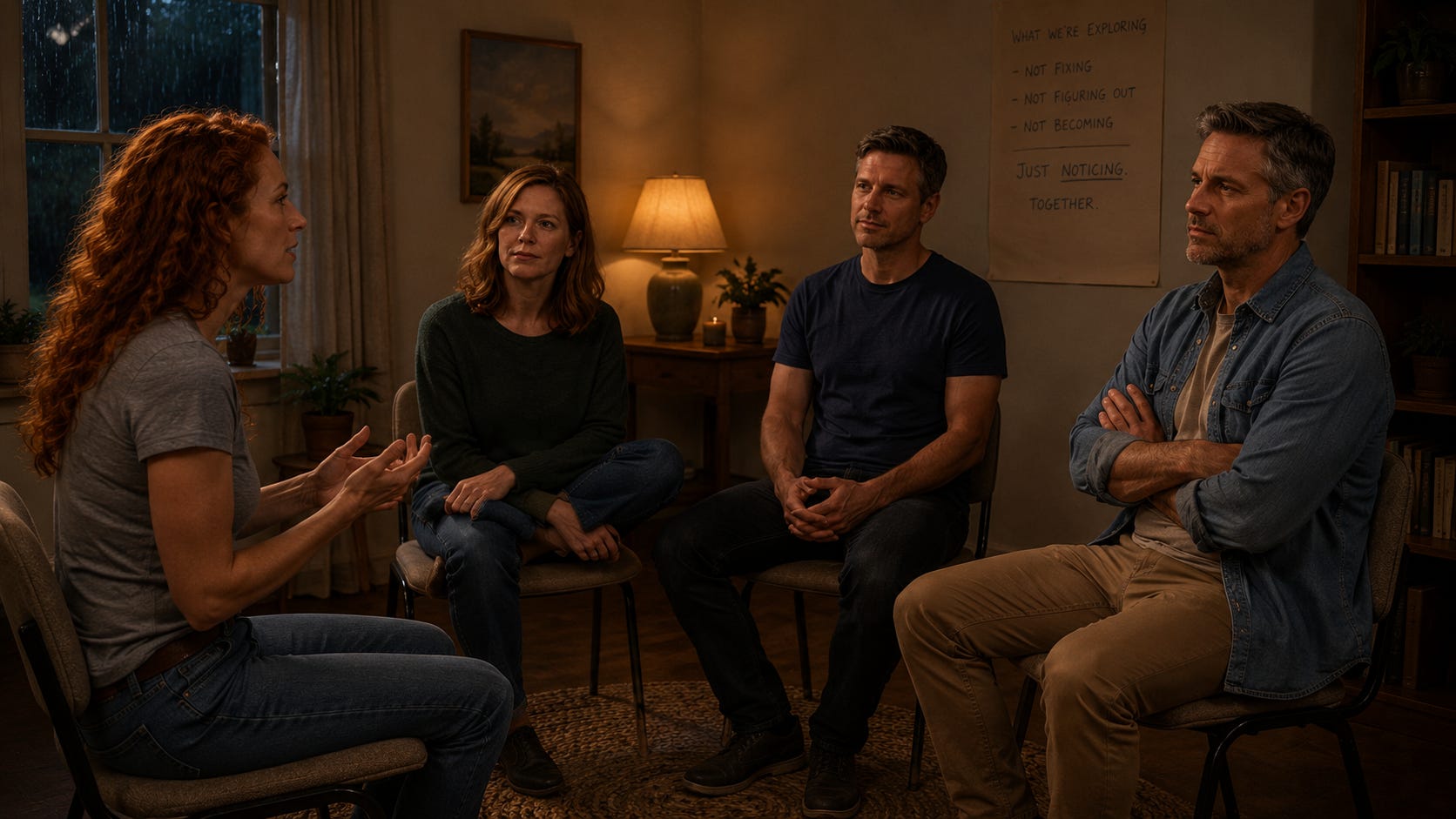
So when Naomi said, early in the evening, “The point isn’t to understand your suffering better. The point is to see whether, even for a second, there can be a shift out of being completely caught in it,” something in him tightened.
It sounded too simple.
Or worse, like one of those slippery spiritual lines that sound profound until you try to live them.
He sat back in the chair and crossed his arms.
The room was quiet. A lamp in the corner cast a soft amber light. Clara was sitting with one foot tucked under her, listening closely. Daniel had his hands folded loosely in his lap. Outside, rain moved softly against the windows.
Elias could feel the familiar pressure already building in his chest.
Not dramatic suffering. Nothing cinematic. Just the ordinary thing that had shadowed him for years: the sense of being hemmed in by himself. Trapped in loops of doubt, judgment, heaviness. A low-grade conviction that something was wrong, and that he was responsible for fixing it.
Naomi looked at him gently.
“Don’t try to do anything with that feeling,” she said. “Just notice what is here before the story starts explaining it.”
He almost rolled his eyes.
Before the story. Right.
There was always a story.
Or if not a story, then a mood.
Or if not a mood, then a body-state already pushing thought in a certain direction.
Still, because he had no better ideas, he looked.
Pressure in the chest.
A slight pull inward behind the eyes.
Tension in the throat.
Sound of rain.
Hum of the heater.
Someone shifting in their chair.
Then almost instantly:
This is me again.
I’m stuck in this.
Nothing really changes.
I’m the kind of person who gets trapped in this.
Naomi spoke again, quietly.
“Yes. That. Notice the commentary. But don’t fight it. Don’t try to shut it up. Just see whether the suffering is in the sensations themselves, or in the whole package — sensation plus the story that says, ‘This is mine, this is me, this will last.’”
Something in him softened, just slightly.
Not because he understood.
Because the instruction had removed the pressure to succeed.
He looked again.
Chest pressure.
Tight jaw.
Warmth in the hands.
A kind of sinking sensation in the belly.
And then the thoughts.
But this time, for one second — maybe less — the thoughts did not quite seal around the sensations the way they usually did.
There was pressure, yes.
But not yet my despair.
Not yet my problem.
Not yet the same old thing that proves something about me.
Just pressure.
Then the mind rushed in to claim it again.
But he had already felt it:
a tiny, almost laughably brief moment in which the suffering had not fully formed.
He opened his eyes and looked up.
Naomi was smiling, not triumphantly, just as if she recognized the expression on his face.
“What was that?” he said.
“What was what?”
He frowned.
“For a second it was just…” He searched for language and failed. “It was just there. But I wasn’t as inside it.”
Naomi nodded. “Good.”
“That’s it?”
“That’s it.”
He almost laughed.
“That was nothing.”
“It was not nothing. It was brief.”
The room stayed quiet.
Daniel leaned forward a little. “The mind always wants to make these things bigger or more permanent than they are. But a small moment of not being fully identified with the suffering matters. It shows the structure isn’t solid.”
Elias looked back down at his hands.
The old heaviness was still there, or something like it. This was not some magical freedom. The body still felt dense. The mind still wanted to narrate. But the certainty had been punctured.
He had seen, however briefly, that suffering was not only the raw sensation. It was also the rapid fastening of identity around sensation. The instant conversion of feeling into self.
And that fastening could loosen.
Only for a second.
Still.
After the meeting, he walked home in light rain without an umbrella.
Streetlights blurred softly on the pavement. Cars hissed past. His jacket darkened at the shoulders. He could feel the mind trying to reproduce what had happened.
How did I do that?
Was I supposed to focus differently?
Maybe if I relax more—
Maybe if I stop trying—
Maybe if I—
Then he stopped walking and laughed aloud on the empty footpath.
There it was again.
The old move.
Trying to turn grace into technique.
Trying to manufacture what had only appeared when he had briefly stopped interfering.
So he kept walking.
Rain on face.
Footsteps.
Cold fingers.
Breath.
Passing headlights.
Thinking.
Hearing.
A flicker of sadness moved through, then some anxiety about tomorrow, then an image from childhood, then the familiar heaviness again. But now it all seemed a little less final. A little less absolute.
Not because he had mastered anything.
Because he had glimpsed that identification was not constant. It could drop.
Not by force.
Not by improvement.
Not by becoming more spiritual.
Just sometimes, when there was enough openness and a little less struggle, the knot loosened by itself.
Over the next few weeks, he noticed it happening in odd places.
Standing in line for coffee, irritation rising — then suddenly just heat in the chest, shifting weight, ambient sound, no owner.
Lying awake at 2 a.m. with the old ache in the stomach — then one clear second where it was simply sensation in darkness, not yet the beginning of a ruined tomorrow.
Reading an email that triggered shame — then a tiny pause before the story completed itself.
These moments were never dramatic.
Never reliable.
Never on command.
But they began to matter.
Because each one left behind the same quiet trace:
the suffering was not all one thing.
There was raw experiencing.
And there was identification.
The first could hurt.
The second made a world.
And one evening, months later, sitting on a park bench with the wind moving through the trees above him, Elias realized something else:
He had spent years trying to understand himself into freedom.
Trying to think clearly enough, analyze deeply enough, trace each pattern carefully enough that someday the whole structure would unlock.
But the shift had never arrived through understanding alone.
Understanding could prepare the ground, perhaps.
It could expose the mechanism.
It could stop some confusion.
But the actual shift — that little miracle of not being fully inside the suffering — came more like weather. Spontaneous. Unowned. Unforced.
It did not obey effort.
And oddly, that made him trust it more.
Because what could not be manufactured also did not depend on his performance.
He sat there a long time.
A dog barked somewhere beyond the oval. Children shouted in the fading light. Wind moved through leaves in loose silver waves.
A thought came:
You should remember this.
Another followed:
No. Just this.
And for a brief, bright instant, there was no one trapped in suffering and no one escaping it.
Just life, unstuck from the story of itself.
Then thought returned, as it always did.
But softer now.
Less convincing.
And because of that, even the return of heaviness was no longer quite the same.
Something had been seen.
Not once and for all.
But enough.
Enough to know that the door was real, even if it only opened for a moment.
Investigation: A brief experiential shift matters more than a good explanation
What is being pointed to here is subtle but extremely important.
The aim is not primarily:
better theory
better spiritual language
deeper self-analysis
a more convincing explanation of suffering
The aim is a brief experiential shift in which there is a moment of dis-identification from the suffering.
That means:
the sensation may still be present
the emotion may still be present
the thoughts may still be present
But for a moment, the usual fusion breaks.
Instead of:
I am trapped in this
there is:
This is happening
That is a very different structure.
1. Why intellectual understanding is not enough
Intellectual understanding can be useful. It can help a person:
recognize patterns
distinguish sensation from story
see how identity forms around pain
stop reinforcing confusion
But understanding alone does not necessarily shift identification.
Someone can explain their suffering beautifully and still be completely inside it.
They may know:
why they react
where it comes from
what belief is active
what the nervous system is doing
And still feel fully fused with the experience.
So explanation is not the same as freedom.
2. What the brief shift is
The shift is usually tiny.
It may be:
one second of seeing that the emotion is present but not personal in the usual way
one moment where sensation is just sensation before narrative claims it
one glimpse that the suffering is being constructed, not merely endured
one opening in which identity loosens
This can feel insignificant because it is brief.
But it is not insignificant.
It reveals that what felt total is not total.
3. Why fleeting moments matter
A brief shift matters because it gives direct evidence.
Not a belief.
Not hope.
Not theory.
Evidence.
It shows that:
identification is not constant
suffering is not a seamless block
there is a difference between pain and the selfing around pain
the structure can loosen
Once this is glimpsed, even fleetingly, the whole system becomes a little less solid.
And over time, these moments may become:
more frequent
easier to notice
less dramatic
more trusted
more available in the middle of real difficulty
4. Why forcing it does not work
This is crucial.
The mind hears about a shift and immediately tries to produce one.
It says:
how do I get there again?
what did I do last time?
how do I relax correctly?
how do I stop identifying?
how do I let go?
That effort usually tightens the whole structure.
Why?
Because the one trying to manufacture the shift is often the very mechanism of control and identification that needs to relax.
So the shift is not something “you” achieve in the usual sense.
It tends to appear when:
there is openness
there is curiosity
there is less struggle
there is enough space for experience to be seen rather than managed
5. The paradox
You cannot force the shift.
But you can be available to it.
That availability may involve:
slowing down
noticing sensations directly
not rushing to conclude
allowing thoughts without obeying them
becoming interested in the raw experience rather than the interpretation
This does not guarantee anything.
It just stops getting in the way as much.
6. What grows over time
The shift itself may stay brief for a long time.
That is fine.
What often grows is not intensity, but familiarity.
A person begins to notice:
“Ah, this is the moment the story seals around the sensation.”
“Ah, here is the instant the pain becomes ‘me.’”
“Ah, there can be a pause here.”
The deepening is often quiet.
Not fireworks.
Not permanent freedom.
Just less total capture.
7. Questions for inquiry
Right now, what is raw sensation and what is commentary?
Does the suffering exist in the body sensation alone, or in the identity wrapped around it?
Can there be one second in which this is simply noticed?
What happens when there is no attempt to fix or remove it?
Is the urge to force a shift itself part of the suffering structure?
What changes when the experience is allowed to be present without immediate ownership?
8. Clean formulation
Here is the essence:
The aim is not to understand suffering better as an idea, but to glimpse directly — even for a moment — that suffering and identification are not the same. Such moments of dis-identification may be brief, but they matter because they reveal that the structure is not fixed. These shifts cannot be forced or manufactured; they tend to arise naturally in conditions of openness, relaxation, and non-interference. Over time, they may become more familiar and accessible.
9. Blunt version
You do not think your way out.
You glimpse your way out.
And the glimpse usually comes when you stop trying to force it.