

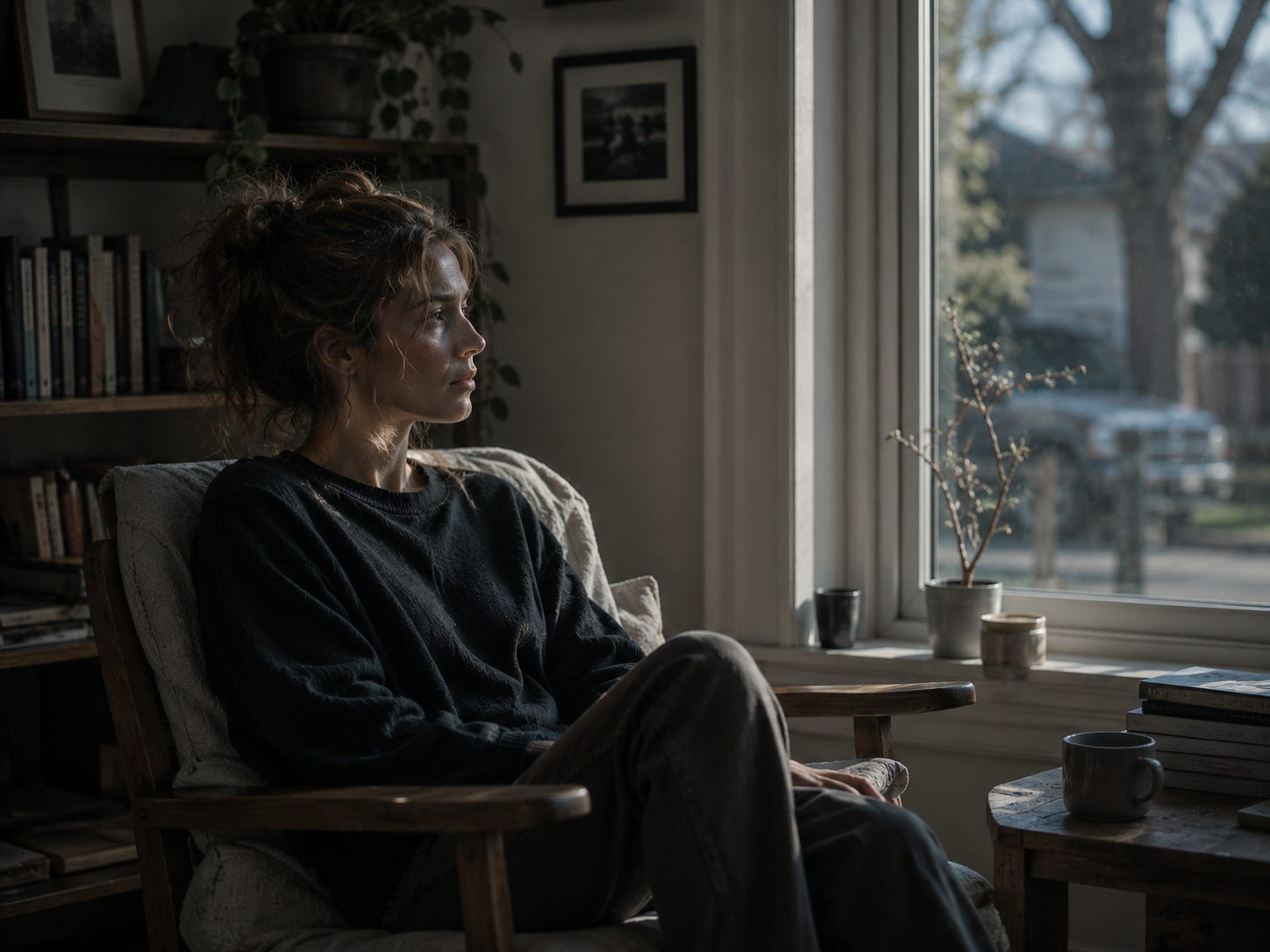
A central theme here is the unsettling, beautiful shift from a solid familiar identity into something fluid, undefined, and strangely alive — the sense that what once felt fixed is now moving too quickly to grasp, and that this can feel like confusion, loss of ground, overstimulation, even a return to that early terrifying taste of vastness. And yet inside that, there is also laughter, wonder, home, and the beginning of a much gentler way of being with what cannot be pinned down.
Story: Warm Mud
Song: Warm Chocolate Mystery
She had been in a cranky mood all day.
Not dramatically cranky. Not throwing things, not slamming doors, not storming out of shops. Just off. Rubbed the wrong way by existence. And what made it stranger was that she could feel the old reflex wanting to smooth it over — the old trained smile, the old performance of being fine, the old rule that said discomfort should be hidden quickly before it inconveniences anyone.
But the smile wasn’t coming.
And because it wasn’t coming, something else was being seen.
She sat in the chair by the window that afternoon, the one with the cushion that never quite held its shape, and watched the room go in and out of focus the way rooms do when thought loosens its grip a little. A truck passed. A bird hit the gutter with two awkward hops. Somewhere in the kitchen, the fridge made its little throat-clearing noise.
There was this mood.
This discomfort.
This not-fitting.
Then the mirror caught her face for a second and there was another jolt:
I don’t like what’s appearing.
That sentence would once have passed unnoticed. Just one more private cruelty among the usual furniture. But now it caught.
Not because she had become better.
Because language had started to show its tricks.
“I don’t like what’s appearing.”
Who didn’t like it?
What exactly was appearing?
Where was the one who disliked?
Where was the one being disliked?
The sentence fell apart a little under its own weight.
What was actual was simpler:
contraction,
sensation,
a story about not liking,
another thought wanting to explain it,
the body sitting in the chair,
light changing on the wall.
That was all.
And then, because life was not content to stop there, another whole wave of weirdness rolled through.
It had been like this for days now. One moment she was smiling, open, easy. Ten hours later she was some other arrangement entirely: irritated, raw, inward, confused. It almost felt like multiple personalities taking turns at the wheel, though even that was too dramatic and too clumsy a phrase for what was actually happening. More like different weather systems passing through the same sky, and some old part of her kept asking:
Who was that one? And who is this one now?
No answer came.
That was part of the beauty and part of the terror.
For years she had lived with the sense that, underneath all the changing moods and reactions, there must be some center. Some fixed identity. Some owner of the whole display. But now that center was becoming harder to locate. What she used to call “me” felt more like a balloon floating around with its string trailing behind it somewhere — not anchored, not exactly lost, just not attached to what she had always assumed it must be attached to.
And the mind hated that.
The mind wanted definitions.
A stable noun.
A proper explanation.
A why.
Instead there was movement, and then more movement, and under that something wordless and impossible to frame.
She remembered, suddenly, being eighteen.
Not the details of the room or the day or what she had been wearing — those had dissolved long ago — but the essential fact of it: the sudden opening into something so vast, so unbounded, so nothing and everything at once, that terror had flooded the whole system. It had felt like infinity without a handrail. Annihilation maybe. Or the loss of all the edges that kept the world manageable. Whatever it was, it had been enough to make some young part of her slam the door and vow: Never again.
And yet here she was.
Decades later, circling back without planning to.
Following little pointers she had not understood at the time.
Every heartbreak, every longing, every strange homesick ache in a movie when someone came home, all of it now looking less random than it once had.
Something had been calling her here all along.
Not to death.
To home.
That was the word that softened everything.
Home.
Not a house.
Not a role.
Not being understood by the world.
Not finally getting society to make sense.
Home as the mystery itself.
Home as the place where nothing could be defined, and nothing needed to be.
That afternoon, though, it did not feel like home yet.
It felt like no-man’s-land.
Her granddaughter’s anxiety had cracked open the old filters even more. Weeks of being needed as a kind of living security blanket — don’t go to the bathroom too long, stay while I take the medication, sit here and watch what happens, don’t leave, don’t disappear — had stretched her into a shape she could not hold for long without fraying. There was love there, yes. But also irritation. Rawness. Overstimulation. The body feeling too exposed to every signal and too porous to every need.
Someone had said she seemed overstimulated.
True.
But underneath that was something more interesting:
without the old suppressions, life was getting through much more directly.
That was both painful and strangely magnificent.
She stood up, paced the room once, then laughed at herself for pacing as if pacing had ever solved metaphysical confusion.
By evening the cranky mood was still there, but something about it had changed.
Not fixed.
Not explained.
Just held more lightly.
That was the real shift, she could feel it now.
The discomfort still came.
The irritation still came.
The shapeshifting of identities still came.
The mind still demanded a center, a self, an answer, a reason, a plan.
But the whole thing had become more curious than tragic.
More like warm mud than a cliff edge.
That phrase made her smile.
Warm mud.
Chocolate, someone had said.
Warm chocolate.
And it was ridiculous enough, human enough, true enough, to help.
Because what if confusion didn’t actually mean danger?
What if it only meant that questions were floating by without needing answers?
What if not knowing was not failure, but the end of pretending to know?
She sat back down by the window.
A strange sensation rose again — the one she had been calling confusion — but when she looked closely, even that word felt too heavy. The sensation itself did not say “confusion.” It did not say “bad.” It did not say “good.” It did not say “small” or “big.” It just was.
Nowhere.
Everywhere.
Without center.
The label came later.
She let the label come and go.
Outside, the sky had turned the color of wet stone. Someone nearby was laughing. A television flickered blue in the house across the road. The world, insane and beautiful and vomiting up its toxins in public, carried on.
She placed one hand lightly on her chest.
Not to calm herself down.
Not to do anything.
Just because it happened.
And in that moment, with the mood still off and the questions still floating and the self still unfixed and everything still far too alive, something inside her felt very close to tears and very close to laughter at the same time.
Which, she thought, might be the closest description yet.
Investigation: When solidity dissolves
What stands out here is not a problem to solve, but a phase of real destabilization: the familiar sense of self is no longer holding together in the old way, yet no new stable center has replaced it. That can feel disorienting, even frightening, especially when older protective structures have thinned and the body is more raw, more permeable, more easily overstimulated.
1. The discomfort of not performing the old self
She notices that not smiling and not performing her usual social brightness feels uncomfortable, almost like transgressing a rule. This is important. Much of what feels like “who I am” is often a learned performance organized around belonging, avoiding conflict, and staying socially synchronized. When that performance drops, there can be a sense of doing something wrong even though nothing is wrong.
2. Language creates entities that are not actually found
A major thread in the conversation is the way language lies. To say “there’s someone in here that doesn’t like what is appearing” feels natural, but it installs an entity — a someone — where what may actually be happening is simply:
contraction
sensation
a story about not liking
more thought
This matters because language keeps trying to make tangibility out of what is not actually tangible. It turns concepts into things and then asks how to manage them.
3. Confusion may just be unanswered questions
Another beautiful point: what is being called “confusion” may not be confusion in the old sense at all. It may simply be a field of open questions without the old compulsion for answers. The mind interprets that as instability because it is accustomed to needing definitions, centers, and explanations. But what is actually present may be far more neutral — even rich.
4. Direct experience has no obvious qualities
When looking in detail at the raw sensation she has labeled “confusion,” what becomes clear is that the sensation itself does not actually say:
this is confusion
this is bad
this is good
this is large
this is small
this has a center
Those are all added later by thought. This is a deep pointer into non-dual seeing: direct experience often has far fewer qualities than the mind assigns to it.
5. The early terror of nothingness
Her memory of touching something vast and terrifying at 18 or 19 is especially significant. Many people do have some early contact with boundlessness, no-self, or infinity that is interpreted by the nervous system as annihilation. Later, after decades of conditioning and softening, that same territory can be approached differently — not as terror, but as home. The fact that she is here now suggests that something deeper than fear has always been at work.
6. Rawness is not regression
The overstimulated, exposed feeling may not be a sign that things are going wrong. It may indicate that old suppressions and filters are loosening, allowing more direct contact with life. This can feel intense, but it may also be a profoundly alive discovery-place.
7. Clean summary
A concise version would be:
The familiar sense of self may loosen before anything more stable seems to replace it, which can feel confusing, raw, and ungrounded. Much of this discomfort comes from language trying to force tangibility and definition onto what is actually fluid, centerless, and inexpressible. What is called confusion may simply be open experience without answers. The early terror of vastness can later be rediscovered as home, and the present overstimulation may be less a regression than the result of fewer old filters suppressing what is already here.