

Song — It Still Looks That Way
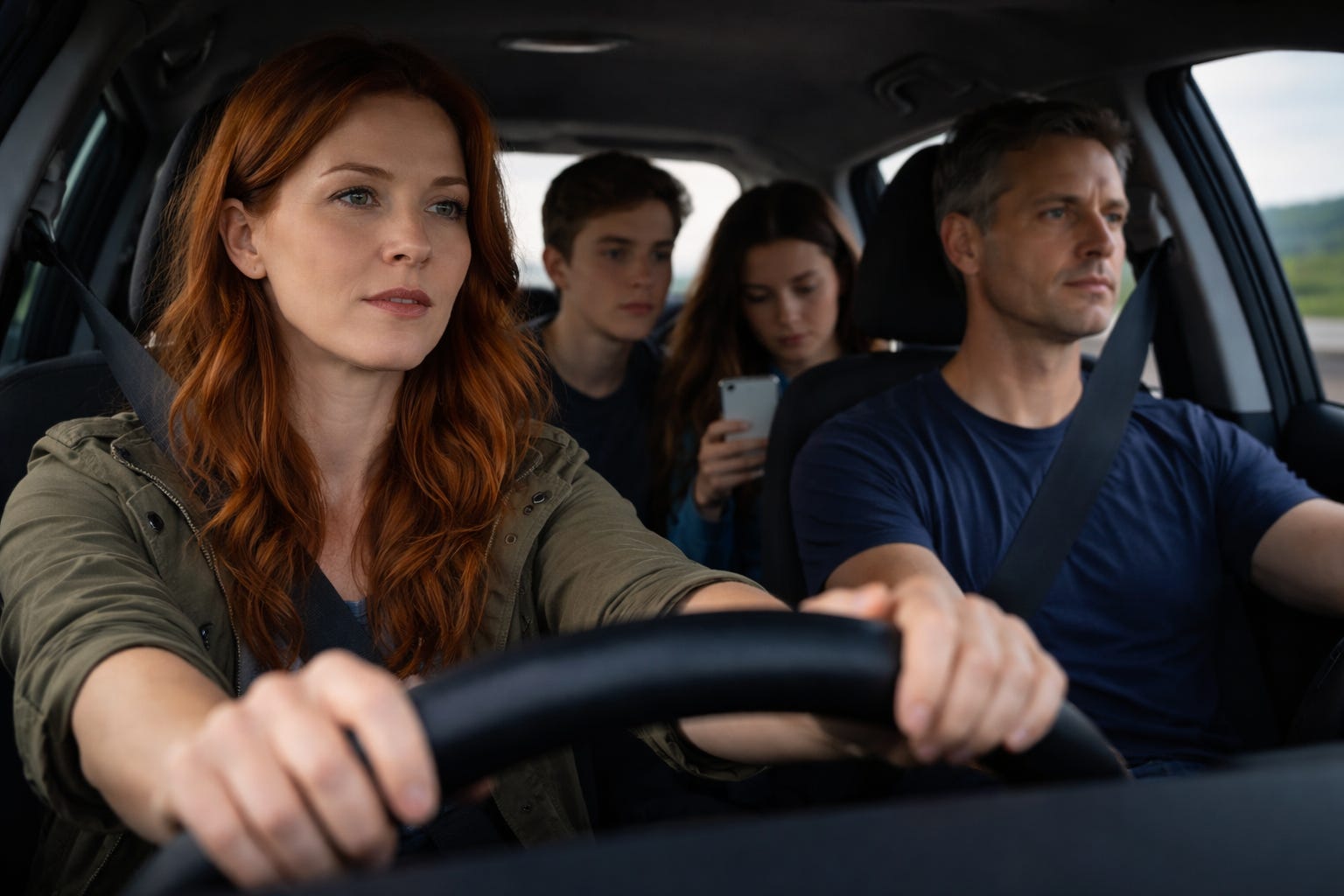
Naomi was driving.
Daniel sat in the passenger seat, Elias in the back, Clara scrolling directions on her phone.
“Next turn in 300 metres,” Clara said.
Naomi nodded, eyes on the road.
The road stretched ahead.
Wide near the car.
Narrow in the distance.
It looked like it was tapering off.
Daniel smiled slightly.
“Still narrowing?”
Naomi laughed.
“Yeah… still looks like that.”
She didn’t correct it.
Didn’t need to.
Her hands moved on the wheel.
Foot adjusted pressure on the pedal.
The car turned exactly where it needed to.
No confusion.
Even though the illusion remained.
Elias leaned forward.
“So the illusion doesn’t go away.”
Naomi shook her head.
“No. It’s useful.”
Clara added:
“If I waited to see ‘no distance’ before giving directions, we’d never get anywhere.”
They laughed.
The GPS voice continued:
“Turn left.”
Naomi followed it.
In that moment, everything was functioning:
distance (as a useful construct)
location
direction
coordination
All based on interpretation.
All based on illusion.
And yet—
nothing was wrong.
Naomi spoke quietly:
“The problem was never the illusion.”
Daniel nodded.
“It was believing it as absolute.”
She glanced in the rear-view mirror.
Caught her own reflection.
For a second, the old sense appeared:
👉 “me in here”
👉 “world out there”
It still showed up.
But now it was recognised.
Not as truth.
As a tool.
The same with everything:
identity
language
distance
control
relationship
All still functioning.
All still appearing.
But no longer heavy.
No longer something to defend.
They arrived.
Parked.
Stepped out.
The world still looked exactly the same.
But the quiet shift:
Nothing needed to be corrected.
Only understood.
Investigation — Illusions Are Not the Problem
This is an important integration point.
1. Illusions remain
After clear seeing:
distance still appears
separation still appears
identity still appears
thoughts still label
the body still reacts
Nothing is removed.
2. What changes
Not the illusion.
But:
👉 recognition of the illusion
3. Why illusions are useful
They support:
navigation (distance, space)
communication (language, identity)
coordination (time, planning)
survival (body mapping, threat detection)
Without them:
👉 functioning would collapse
4. The original problem
Not illusion itself.
But:
👉 taking the interpretation as absolute reality
5. The shift
From:
👉 “this is how it is”
To:
👉 “this is how it appears / is constructed”
6. Reaction vs response
When illusion is believed:
reactions are rigid
defensive
automatic
When illusion is recognised:
responses become flexible
adaptive
less personal
7. Example
Neck tension appears.
Old pattern:
👉 “this is a problem” → resistance → amplification
Clear seeing:
👉 “sensation + interpretation” → space → adaptability
8. Identity
Identity still functions:
name
role
personality
But now seen as:
👉 a working model, not a fixed self
9. Control
Control still appears:
decisions
actions
corrections
But no longer assumed to be:
👉 owned by a central “me”
10. The key integration
You don’t remove illusions.
You:
👉 stop mistaking them for reality
11. What this allows
less friction
less resistance
more fluid interaction
more appropriate responses
Core line
Illusions are tools for navigation.
Confusion comes from believing they are reality.