

Theme: language does not merely describe experience; it quietly shapes what experience seems to be.
Song: The Words Build Walls
Daniel did not notice the wall until Elias asked about the word.
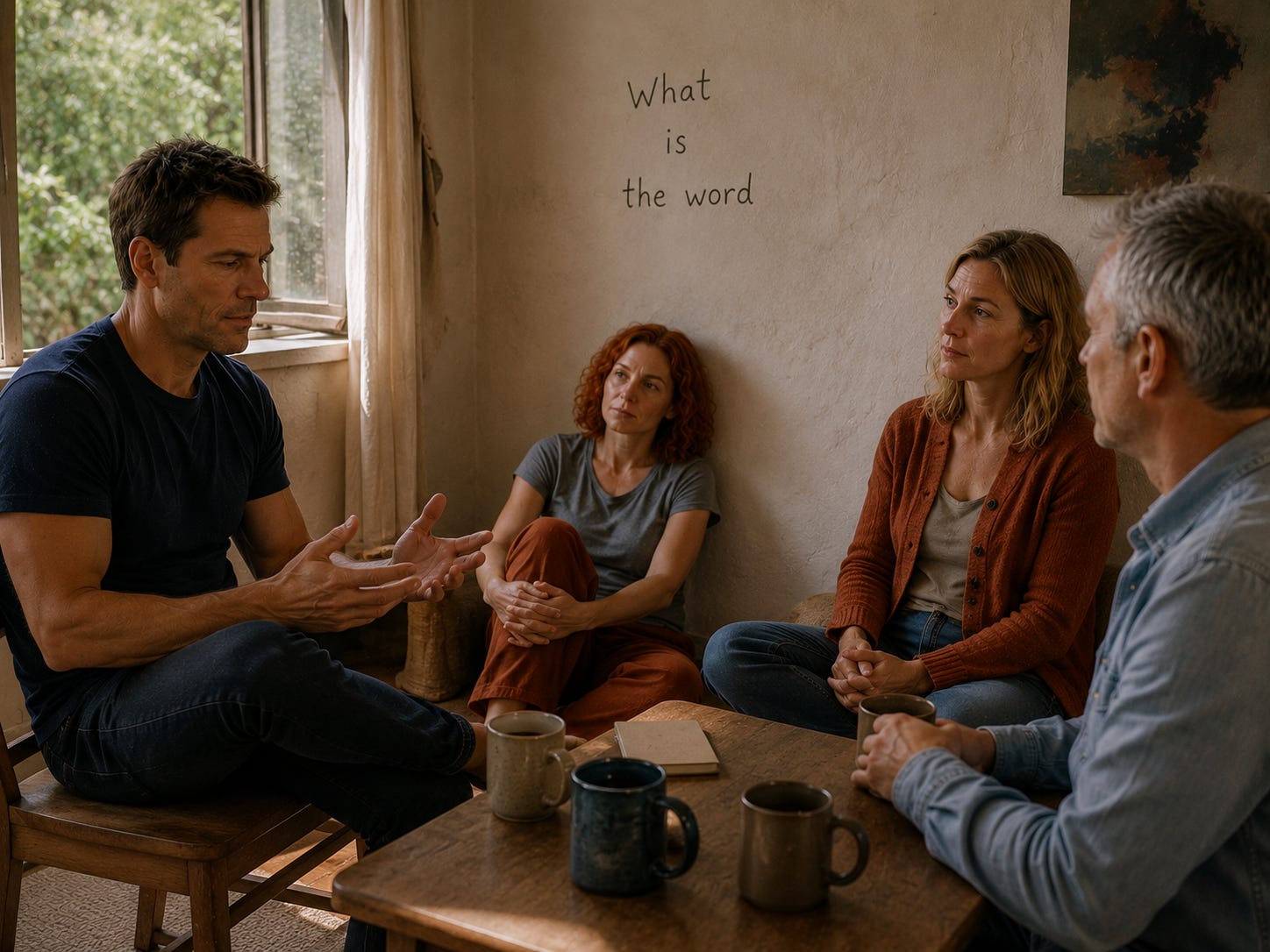
They were sitting in the small back room where the afternoon light came in sideways. Clara had opened the window because the room had become too warm. Naomi sat on the floor with her back against the wall, quietly listening.
Daniel was describing something that had happened that morning.
“I woke up with my anxiety again,” he said.
Elias lifted one finger.
“Say that again.”
Daniel sighed. “I woke up with my anxiety.”
“There,” Elias said. “That word.”
“What word?”
“My?”
Daniel laughed. “That’s a small word.”
“Yes,” Elias said. “A very strong small word.”
Daniel leaned back.
He could feel the familiar impatience. He wanted to talk about the actual anxiety, the tightness in the chest, the restless thought-stream, the old feeling that something was wrong and had to be solved.
But Elias was looking at the word as though it were a stone in the road.
“What happens if you say, ‘anxiety was here this morning’?”
Daniel repeated it.
“Anxiety was here this morning.”
The room was quiet.
Something changed.
Not much.
But something.
The anxiety was still remembered. The body still had a faint echo of it. But without “my,” the thing seemed less glued to him.
It became an event.
Weather.
Not identity.
Elias nodded.
“Again. Say, ‘the body woke with tightness.’”
Daniel said it.
“The body woke with tightness.”
This time the shift was stronger.
The morning no longer appeared as Daniel being anxious. It appeared as a body waking, tightness present, thoughts moving.
Not impersonal in a cold way.
Just less owned.
Clara smiled.
“Language is a little magician,” she said.
Naomi said, “Or a builder.”
Daniel looked at her.
“A builder?”
“Yes. One word and suddenly there’s a room, a person in the room, and a problem belonging to the person.”
Elias laughed softly. “Exactly.”
Daniel could feel the truth of it.
The original event had been simple enough:
Eyes opened.
Morning light.
Chest tight.
Thoughts moving.
A sensation in the belly.
A memory of an unfinished email.
A mood.
But language had shaped it quickly:
I woke up anxious.
Then:
My anxiety is back.
Then:
I’m still not free.
Then:
Something is wrong with me.
In less than ten seconds, a weather pattern had become a biography.
Daniel rubbed his face.
“It happens so fast.”
“Yes,” Elias said. “Language is quick. It arrives like description, but often it is construction.”
That stayed in the room.
Description pretending to be construction.
No.
Construction pretending to be description.
Daniel closed his eyes.
He could see how the mind named things and then lived inside the names.
Pain became my pain.
Fear became my fear.
A preference became what I want.
A thought became what I think.
A passing contraction became my resistance.
A glimpse became my awakening.
A difficult day became my failure.
The words did not merely report.
They created ownership.
They created continuity.
They created a central figure.
Me.
The one to whom all this belonged.
Daniel opened his eyes.
“So should I stop using those words?”
Elias shook his head.
“No. That would become another project. Just become curious about what words are doing.”
Clara picked up her cup.
“That’s the trick, isn’t it? Not policing language, but seeing language.”
“Yes,” Elias said. “Language is useful. We are not trying to destroy it. We are trying not to be hypnotized by it.”
Daniel thought of the word “should.”
That one had built whole cities.
I should be better.
I should know by now.
I should be calmer.
I should not feel separate.
I should be more loving.
I should not be thinking so much.
Each “should” created a split.
What is.
What should be.
And in the middle, someone failing.
He said this aloud.
Elias nodded. “Good. Feel the difference between these two: ‘I should not feel separate’ and ‘a feeling of separateness is here.’”
Daniel said the first one.
“I should not feel separate.”
Immediately the body tightened.
There was a bad student in the room.
A spiritual failure.
Someone behind schedule.
Then he said the second.
“A feeling of separateness is here.”
The body did not exactly relax, but the accusation faded.
The feeling became available.
Not solved.
Available.
Naomi said, “It’s like the second sentence lets you look.”
Daniel nodded.
“Yes. The first one makes me defend.”
Elias smiled. “That’s a very good distinction.”
Daniel began to see whole families of words.
Some words made experience solid:
always,
never,
still,
again,
mine,
me,
I am,
I can’t,
I should,
I failed,
I’m stuck.
Other words opened space:
here,
appearing,
happening,
passing,
felt,
noticed,
seems,
a story says,
the body,
this.
Not magic words.
Not correct words.
Just less sticky words.
Clara said, “What about the word awake?”
They all laughed.
That word was trouble.
Useful, perhaps.
Dangerous, definitely.
Awake could point to a real shift.
It could also create a new identity in two syllables.
I am awake.
There it was again.
A person wearing a crown made of absence.
Elias said, “Maybe sometimes we say, ‘a shift happened.’ Or ‘the old belief loosened.’ Or ‘seeking quieted.’”
Daniel smiled.
“Less glamorous.”
“Much safer.”
The afternoon moved slowly around them.
Outside, someone started a lawnmower. The sound came through the open window, rude and ordinary. Naomi closed her eyes as if listening to music.
Daniel noticed irritation arise.
The old sentence began:
That noise is ruining the silence.
Then he paused.
Sound is here.
The lawnmower continued.
Still loud.
Still unpleasant.
But less insulting.
The silence had not been ruined.
Only the story of “my peaceful room” had been interrupted.
He laughed.
“What?” Clara asked.
“I just watched a lawnmower become a teacher.”
“That’s unfortunate,” Clara said.
“It didn’t ask for the job.”
Elias looked pleased.
“Language gave the sound a role. Then language removed it.”
Daniel listened again.
The sound was jagged and mechanical. The body did not like it. That was simple.
But without the sentence “it is ruining this,” the sound was just sound.
Not pleasant sound.
Just sound.
The mind reached for another label.
Lawnmower.
Then another.
Annoying.
Then another.
Outside.
Then another.
Not me.
Daniel felt that one.
Not me.
There it was.
Language did not only create ownership.
It also created division.
Inside.
Outside.
Self.
World.
Me.
Other.
Experience.
Observer.
Useful, yes.
But only useful.
Not necessarily true in the way they felt.
He looked at his hands.
“My hands,” the mind said.
Then:
Hands.
Then:
Sensation, colour, movement.
Then no need to reduce further.
The hands were allowed to be hands.
Language did not have to vanish.
It just did not need to be believed all the way down.
Elias said, “The point isn’t to speak in strange broken phrases forever.”
Daniel was relieved.
“You can still say, ‘I’m going to the shop.’ You can still say, ‘my shoes.’ You can still say, ‘I feel sad.’ Ordinary language is fine. The issue is whether perception gets trapped inside it.”
Clara said, “So language is a tool until it becomes a world.”
“Yes,” Elias said. “And then we suffer inside the world we unknowingly built.”
Daniel sat quietly.
A thought came:
I need to remember this.
Then he caught it.
Remembering may happen.
He smiled.
Another thought came:
That was clever.
Then:
Cleverness is here.
Then laughter.
The language game was endless.
Not because every word had to be purified.
Because every word could be seen as an invitation.
Some invitations led into contraction.
Some into openness.
Some into practical function.
Some into identity.
Some into story.
Some back to this.
The lawnmower stopped.
The room seemed suddenly wide.
Naomi opened her eyes.
“Listen,” she said.
They listened.
Birds.
A car passing.
The hum of a refrigerator.
A cup placed on a table.
Breath.
No one said anything for a while.
Then Daniel spoke softly.
“Silence is here.”
Elias raised an eyebrow.
Daniel corrected himself.
“This.”
And that was enough.
Investigation: How Language Shapes Perception
Language does not merely describe experience.
It organises experience.
It frames.
Divides.
Owns.
Blames.
Explains.
Solidifies.
Softens.
Opens.
Closes.
A raw sensation appears. Then language arrives and tells us what kind of world we are in.
1. Language creates ownership
A sensation appears in the chest.
Language says:
“My anxiety.”
That phrase creates an owner.
The same event can be framed differently:
“My anxiety is back.”
or:
“Anxiety is here.”
or:
“Tightness is being felt in the chest.”
or:
“This.”
Each phrase shapes perception differently.
“My anxiety” feels personal and continuous.
“Anxiety is here” feels more event-like.
“Tightness is being felt” moves closer to direct sensation.
“This” stops explaining.
None of these phrases is ultimately the truth.
But some are less sticky.
2. Language creates time
Language often ties present experience to past and future.
“My wound is back.”
That implies:
something happened before,
it damaged me,
it continues as my problem,
and I need to fix it later.
A more immediate phrase:
“Pain is here.”
Or:
“A memory and tightness are here.”
This does not deny history.
It simply stops converting the present moment into a repair project.
3. Language creates identity
“I am anxious.”
“I am broken.”
“I am awake.”
“I am not awake.”
“I am stuck.”
Each phrase turns a happening into identity.
Cleaner:
“Anxious sensations are here.”
“A story says something is broken.”
“A shift happened.”
“Seeking is active.”
“Stuckness is being felt.”
Again, this is not about using perfect language.
It is about seeing how identity is built.
4. Language creates division
Language divides life into:
me / world
inside / outside
subject / object
past / future
success / failure
self / other
awake / not awake
These divisions are useful for practical life.
But when believed too deeply, they shape perception into separateness.
For example:
“I am looking at the cup.”
Useful.
But in direct experiencing, there may simply be:
seeing,
colour,
shape,
thought saying cup,
sensation,
body,
orientation.
The language is practical, but not final.
5. Language can make experience unavailable
Some phrases make direct contact harder.
“I should not feel this.”
That creates resistance.
“I need to fix this.”
That turns experience into a project.
“I’m still like this.”
That creates a timeline and a failed self.
“This means I’m not awake.”
That turns a sensation into a verdict.
These phrases do not invite looking.
They invite defense, contraction, or self-judgment.
6. Language can make experience available
Other phrases soften the grip.
“A feeling is here.”
“A story says…”
“The body is tight.”
“Fear is appearing.”
“Separateness is being felt.”
“This is the current shape of experiencing.”
These phrases do not solve anything.
But they allow contact.
They move perception from identity toward event.
7. Do not turn language into another policing project
The point is not to ban normal speech.
Ordinary language is fine.
“I’m hungry.”
“My car.”
“I’m going to the shop.”
“I felt sad.”
No problem.
The issue is not grammar.
The issue is unconscious belief.
Useful inquiry:
What does this wording make experience seem to be?
Does it create an owner?
Does it create blame?
Does it create a timeline?
Does it create a problem?
Does it create a separate centre?
Does it invite looking?
Does it soften?
Does it tighten?
8. “This” as the least sticky pointer
“This” is useful because it does not explain much.
It does not divide experience into good and bad.
It does not assign ownership.
It does not create a path.
It does not insist on a meaning.
It simply points.
This sound.
This tightness.
This thought.
This mood.
This body.
This room.
This.
The word is not magic.
But it can interrupt the spell of more complicated language.
9. Clean formulation
Language shapes perception by turning raw happenings into owned, timed, meaningful, personal, and separate experiences. It can convert sensation into identity, discomfort into failure, and present experience into a repair project. But language can also loosen perception when it points back to immediacy. The task is not to speak perfectly, but to notice how words build the world we then seem to live inside.