

Song: You don’t know me yet
The first things we learn about someone are usually descriptions: age, history, temperament, beliefs, roles. The more revealing introduction comes later, through what startles them, irritates them, attracts them, embarrasses them, and what they do before they have time to explain themselves. A person is not a fixed identity waiting to be correctly described. Character becomes visible as life happens.
Short story: The second cup of tea
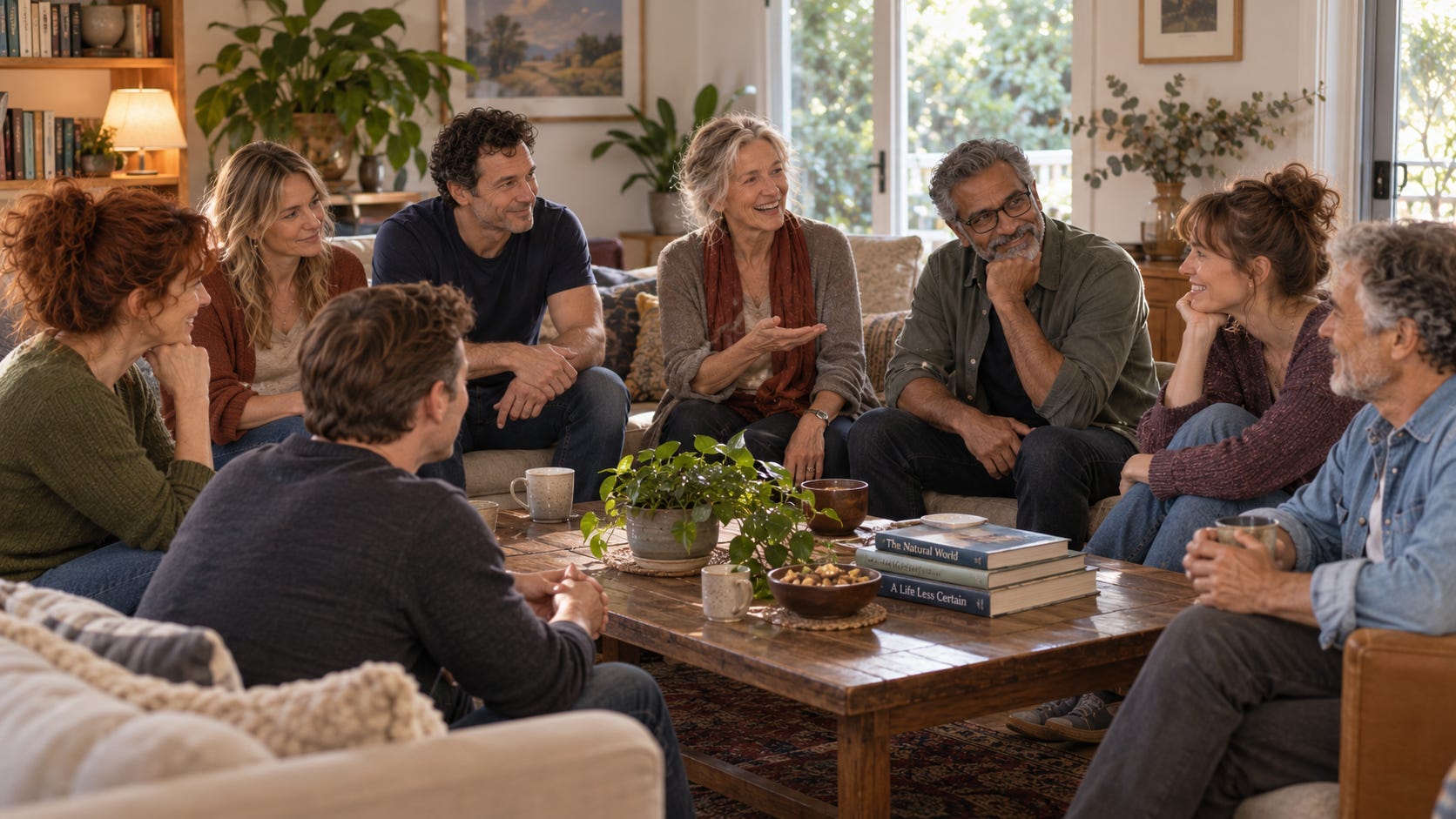
The second time the eight of them met, nobody introduced themselves.
That was progress.
Or perhaps simply forgetfulness.
They met at Maeve’s house.
This mattered because Maeve had spent the first meeting appearing almost suspiciously relaxed, and Ravi had privately wondered whether fifteen years after awakening perhaps one naturally developed excellent housekeeping.
He discovered the answer immediately.
“No,” Maeve said, opening the door.
Ravi hadn’t asked anything yet.
She pointed towards the hallway.
“Whatever you’re thinking about the shoes, the newspapers and the dead plant—no.”
The plant was not entirely dead.
It had one heroic green leaf.
Tess crouched beside it.
“What happened?”
“I loved it incorrectly.”
Naomi laughed.
Maeve hugged her.
“Red hair. Good. I remembered.”
“I’d be worried if you forgot.”
“At my age I’m delighted every time I remember my own kitchen.”
Jonah arrived carrying cake.
Clara noticed he was holding it with both hands.
“Careful?”
“Nervous.”
“About cake?”
“About bringing the wrong cake.”
Clara looked at the box.
“Is there a wrong cake?”
“My mother could explain.”
There it was.
A whole biography in six words.
Clara smiled.
“I think we’ll get along.”
Daniel and Ravi had already been exchanging messages since the first meeting.
This was obvious because they greeted each other like men who had begun a conversation three days earlier and resented reality for interrupting it.
“I thought more about what you said about intention,” Ravi began.
Daniel immediately said:
“Yes, but I’ve modified that.”
Maeve called from the kitchen:
“No philosophy until carbohydrates.”
Ravi looked genuinely uncertain.
“Is that a rule?”
“No. It’s a threat.”
Tess arrived last again.
This time not because she nearly stayed home.
She had missed the bus.
“I thought about running,” she said.
“Why didn’t you?” Jonah asked.
“I didn’t want to.”
Ravi smiled.
“Pure direct experience.”
Tess looked at him.
“I missed a bus.”
Maeve pointed at Ravi.
“You’re going to learn so much from her.”
They settled into the living room.
Eight people now knew each other just enough to make assumptions.
This was far more interesting than knowing nothing.
Naomi assumed Maeve would be cheerful.
Daniel assumed Ravi would want to analyse.
Clara assumed Jonah would understand emotional complexity.
Ravi assumed Tess’s simplicity came from inexperience.
Tess assumed Elias would eventually say something profound.
Jonah assumed awakening had made Maeve unembarrassable.
They were all wrong enough to make the afternoon useful.
Maeve brought tea.
Her hand shook slightly as she carried the tray.
Tess noticed.
Maeve noticed Tess noticing.
“Essential tremor,” Maeve said.
“Oh.”
“Nothing spiritual.”
“I wasn’t going to make it spiritual.”
“Good. Ravi might.”
“I heard that.”
Maeve put down the tray.
The cup rattled against the saucer.
For half a second something crossed her face.
Annoyance.
Gone quickly.
But Jonah saw it.
That interested him.
Maeve noticed him seeing that too.
“What?”
“You got annoyed.”
“Yes.”
“At your hand.”
“Yes.”
Jonah hesitated.
“I suppose I thought…”
“That fifteen years after awakening I’d be thrilled by every neurological development?”
Everyone laughed.
Jonah reddened.
Maeve softened immediately.
“There. That’s a better introduction to me than anything I said last week.”
Tess picked up the thread.
“So you don’t just accept everything?”
Maeve looked puzzled.
“Of course I accept everything.”
Jonah frowned.
“But you were annoyed.”
“Yes.”
“Isn’t that not accepting it?”
“No.”
Tess leaned forward.
This sounded important.
Maeve lifted her trembling hand.
“This is happening.”
She paused.
“I don’t particularly like it.”
Another pause.
“Both true.”
Naomi nodded.
“Acceptance isn’t approval.”
“Exactly.”
Tess looked at Maeve’s hand.
“So acceptance just means you’re not pretending it isn’t happening?”
Maeve smiled.
“That’ll do.”
Ravi’s eyes lit up.
“Would you say acceptance is the cessation of resistance to—”
“No,” Maeve said.
He stopped.
“Why?”
“Because Tess had already said it better.”
Cake was opened.
Jonah had brought lemon drizzle.
Naomi took a piece.
Maeve took two.
Ravi declined.
Daniel also declined.
They looked at each other.
“Sugar?” Ravi asked.
“Trying to cut down.”
“Same.”
Naomi whispered to Tess:
“They’ve formed a sect.”
As they ate, Clara asked Jonah:
“What changed six months ago?”
He looked at Maeve first.
She noticed.
“Don’t look at me. I wasn’t there.”
Jonah laughed.
Then tried.
“I’d been seeking for years. Not as long as Ravi.”
“Few have,” Tess said.
Ravi bowed slightly.
Jonah continued.
“I was sitting at home. Nothing dramatic. There was this thought—”
He stopped.
“What thought?” Clara asked.
“Something like: I can’t make this happen.”
“And?”
“And suddenly that wasn’t depressing.”
Ravi leaned forward.
Jonah noticed and smiled.
“I know how disappointing this will sound.”
“Try me.”
“There was just… no one left who could make it happen.”
Silence.
“And then?”
“That was it.”
Ravi waited.
Jonah waited.
Ravi waited more intensely.
Maeve started laughing.
Ravi finally said:
“But surely there was some shift in perception.”
“Yes.”
“Expansion?”
“No.”
“Loss of subject-object structure?”
“Not really.”
“Somatic release?”
“A bit later.”
“Clarity?”
“I suppose.”
“Bliss?”
“I made toast.”
Tess laughed so hard she nearly dropped her cake.
Jonah smiled, but his eyes were tired.
“The thing I didn’t expect was that afterwards I was still me.”
That quietened the room.
“Or,” he corrected, “whatever this personality is.”
Clara understood immediately.
“You thought the history would disappear.”
“Yes.”
“What did?”
“The belief that it belonged to someone in quite the same way.”
“But the patterns continued.”
“Yes.”
Clara nodded.
“That makes sense.”
Jonah looked relieved.
“It didn’t to me.”
Maeve leaned back.
“When I woke up, I spent about a year waiting to become the sort of person I thought an awakened person should be.”
“What sort?” Tess asked.
“Unflappable.”
Naomi smiled.
“Did it work?”
“No.”
“Good.”
“I became very flappable about being flappable.”
Jonah laughed.
Maeve pointed at him.
“That’s roughly where you are.”
“Thank you.”
“You’ll live.”
Ravi had been quiet.
This itself was noticeable.
Daniel looked at him.
“You okay?”
“Yes.”
“Thinking?”
“Yes.”
“What?”
Ravi looked around.
“I’m realising how much of my seeking has been based on descriptions from other people.”
Maeve nodded.
“Dangerous things, descriptions.”
“I’ve spent years comparing my experience with reports.”
“What reports?” Tess asked.
“Teachers. Books. Traditions. People describing shifts.”
“Why?”
“To recognise whether it had happened.”
Tess frowned.
“But if it happened differently, how would that help?”
Ravi opened his mouth.
Closed it.
Daniel smiled.
“That one hurt.”
“Yes.”
Tess looked pleased with herself for approximately three seconds.
Then Maeve asked:
“So why are you seeking?”
Tess froze.
“What?”
“You’ve asked everyone else questions.”
“I’m curious.”
“That’s not the same as seeking.”
Tess looked down at her plate.
“No.”
Something changed in her face.
“I think I’m scared that life is happening and I don’t understand what I am.”
Nobody laughed.
Maeve’s tone changed completely.
“That sounds closer.”
Tess looked up.
“I keep getting these moments where I realise I don’t know what thought is going to appear next. Or what mood. Or what I’ll want tomorrow.”
“Yes.”
“And everyone acts like they know themselves.”
Maeve nodded.
“And?”
“I think maybe I joined this because I wanted someone to explain me to me.”
Ravi’s face softened.
He recognised that.
So did Clara.
So did Daniel.
Possibly everyone in the room.
Elias finally spoke.
“Did anyone manage?”
Tess smiled.
“No.”
“Disappointing?”
“A bit.”
“And?”
“Also relieving.”
There it was again.
Another introduction.
Not:
Tess, thirty-one, new seeker.
But:
A woman discovering that not being able to explain herself might not be a failure.
Later they moved outside.
Maeve’s garden was chaotic in exactly the way her hallway had promised.
Herbs grew among flowers.
Tomatoes had escaped their stakes.
A hose lay across the path.
One corner had gone completely feral.
Ravi looked at it.
“You don’t organise this?”
“I do.”
He looked again.
“This is organised?”
“By many parties.”
Naomi pointed at a tomato plant growing sideways.
“Who’s responsible for that?”
“Management has declined comment.”
They divided naturally.
Not into old group and new.
Into curiosities.
Naomi and Jonah sat on the back step.
Daniel and Ravi stood beside the lemon tree.
Clara and Tess wandered through the garden.
Elias and Maeve carried cups back inside.
The new group had begun to become visible.
Not their roles.
Their textures.
Naomi asked Jonah:
“What are you most frightened of now?”
He answered too quickly.
“That it will go away.”
She nodded.
Then he corrected himself.
“No.”
“What?”
“That I’ll discover nothing really changed.”
Naomi waited.
“Those are different.”
“Yes.”
“Which one feels stronger?”
Jonah checked.
The question moved out of philosophy and into his chest.
“The second.”
Naomi nodded.
No advice.
That surprised him.
He had expected reassurance.
Instead she let the fear exist.
That was an introduction to Naomi.
And perhaps, Jonah thought, an introduction to fear.
By the lemon tree, Daniel asked Ravi:
“What are you actually hoping awakening will give you?”
Ravi had answered this question hundreds of times.
Freedom.
End of suffering.
Truth.
Peace.
No-self.
Liberation.
Those answers felt suddenly second-hand.
He took longer.
“I want to stop needing to know.”
Daniel stared at him.
“That’s interesting.”
“I know.”
“You want to know how to stop needing to know.”
Ravi closed his eyes.
“Yes.”
Daniel smiled.
“I like you.”
Clara and Tess stopped near the feral corner.
Tess pointed.
“That’s me.”
“The weeds?”
“The bit nobody knows what to do with.”
Clara looked at her.
“You say things before deciding whether they sound clever.”
“Is that bad?”
“No.”
“I think Ravi decides first.”
“Daniel too.”
“Does that get tiring?”
“For them or us?”
They laughed.
Then Tess asked:
“What are you looking for?”
Clara thought.
“I don’t think I’m looking for awakening.”
“What then?”
“Sometimes I want experience to confirm that everything is okay.”
Tess looked puzzled.
“Does it?”
“No.”
“Then what?”
“I’m learning that okay doesn’t always feel okay.”
Tess stared at her.
“That sounds important.”
“It might be.”
Inside, Maeve and Elias stood at the sink.
“You like them?” Elias asked.
“Very much.”
“Which one worries you?”
Maeve looked through the window.
Ravi was speaking with both hands.
Jonah was listening intently to Naomi.
Tess had crouched to inspect something in the garden while Clara watched.
“None.”
“Really?”
“Oh, they’ll suffer.”
“Yes.”
“They’ll get lost.”
“Yes.”
“They’ll turn discoveries into beliefs.”
“Probably.”
“Ravi will turn at least three of them into practices.”
“Definitely.”
“So?”
Elias smiled.
“Good.”
When everyone eventually left, Tess lingered by the gate.
Maeve came out.
“You forgot something?”
“No.”
Tess looked embarrassed.
“I just realised I know you better now.”
Maeve leaned against the gate.
“Terrible, isn’t it?”
“You’re less awakened than I thought.”
Maeve laughed loudly.
“That may be the nicest thing anyone has said to me this year.”
“I mean more…”
“Human?”
“Yes.”
“Good.”
“And Jonah seems more confused.”
“He is.”
“Ravi seems less confident.”
“Good.”
“And I think I’m more confused too.”
“Excellent.”
Tess shook her head.
“You have a strange grading system.”
Maeve looked back towards the house.
“Introductions are funny.”
“How?”
“The first time people meet, they try to become clear.”
“And later?”
“If things go well, they become complicated again.”
Tess smiled.
Then left.
Maeve stood at the gate for another moment.
Four new people had entered the story.
Not types anymore.
Not:
the awakened one,
the newly awakened one,
the seeker,
the beginner.
Already those descriptions were fraying.
Which was exactly what descriptions should do
when actual people begin to appear.
Long story: What the labels didn’t mention
The third gathering happened accidentally.
At least that was Tess’s version.
Ravi objected.
“There were eight separate chains of conditions that resulted in—”
Maeve held up a hand.
“Accidentally.”
They had all ended up at a weekend market by the harbour.
Naomi and Clara had gone looking for bread.
Daniel wanted coffee.
Elias wanted nothing in particular.
Maeve was buying olives.
Jonah was arguing with a parking meter.
Ravi had come for a talk at a nearby meditation centre which had been cancelled.
Tess had come because her sister had cancelled on her.
Eight lives, eight reasons, one market.
Maeve looked at them.
“Apparently the universe lacks imagination.”
This time introductions happened through inconvenience.
Jonah’s parking meter refused his card.
He tried again.
Then again.
His jaw tightened.
Tess watched.
“Are you awakened right now?”
Jonah stared at her.
Maeve almost dropped the olives.
Jonah looked at the machine.
Then Tess.
“No.”
“Can you stop being awakened?”
“I apparently can at parking meters.”
“That seems inconvenient.”
“It is.”
He laughed.
The irritation remained.
So did the laugh.
Tess filed that away.
At a bread stall Clara became overwhelmed by choice.
Sourdough.
Rye.
Olive.
Fig.
Walnut.
Seeded.
She stood frozen.
Naomi said:
“Choose one.”
“I’m trying.”
“That’s the problem.”
Clara glared.
Naomi smiled.
Eventually Clara bought olive.
Two minutes later she said:
“I should have got rye.”
Tess heard her.
“You do that too?”
“What?”
“Regret tiny decisions.”
“All the time.”
Tess looked visibly relieved.
Nobody in the spiritual books she had skimmed mentioned enlightened-adjacent people regretting bread.
Ravi was quieter than usual.
Daniel noticed.
“No talk?”
“Cancelled.”
“Disappointed?”
“Yes.”
“What was it about?”
“The collapse of the observer.”
Daniel nodded appreciatively.
Maeve, overhearing, said:
“Excellent. Observer collapsed before the talk.”
Ravi laughed.
Then sighed.
“I was actually looking forward to it.”
“Of course.”
“I rearranged my weekend.”
“Yes.”
“I’m annoyed.”
“Yes.”
“You’re not going to turn this into a pointer?”
“No.”
Ravi looked disappointed.
Maeve smiled.
“That reaction might be one.”
They bought coffee and found benches overlooking the water.
Not enough benches.
Again.
Jonah stood.
Tess sat on the ground.
Ravi offered her his seat.
She declined.
He insisted.
She declined again.
He looked uncomfortable.
“Why is this important to you?” she asked.
“It isn’t.”
“Then stop asking.”
He stopped.
A small flush rose in his face.
Something old had been touched.
Courtesy.
Identity.
Being a good man.
He saw it.
Tess saw him see it.
“Sorry,” she said.
“No.”
“You look embarrassed.”
“I am.”
“Did I do something wrong?”
Ravi considered.
“No.”
“Did you?”
He smiled reluctantly.
“No.”
“So embarrassment can happen without anybody being wrong?”
Ravi looked towards Maeve.
Maeve was pretending not to listen.
“Apparently.”
Jonah had heard the exchange too.
“That keeps happening to me.”
“What?” Ravi asked.
“Emotion without a culprit.”
Ravi turned.
Jonah continued.
“I used to assume if I felt bad, either I had done something wrong or somebody else had.”
Clara nodded.
“Yes.”
“But sometimes now there’s just…”
He searched.
“…bad feeling.”
Maeve looked over.
“Careful.”
“What?”
“You’re about to make a discovery.”
Jonah laughed.
This became the conversation.
Not formally.
Nobody announced a theme.
That was becoming one of the differences between the two groups.
The old four had spent years learning how to investigate.
The new four kept stumbling into investigations by being themselves.
Maeve asked Tess:
“What happens when you’re embarrassed?”
“I talk more.”
Everyone laughed.
Tess reddened immediately.
“There!”
She covered her face.
“That’s horrible.”
“What?”
“Now I’m demonstrating it.”
“You’re doing beautifully.”
“That makes it worse.”
She laughed from behind her hands.
There was Tess:
new enough not to have spiritualised embarrassment.
Embarrassed enough to make it visible.
Curious enough to watch it while it happened.
Ravi said:
“When I’m embarrassed, I explain.”
Daniel stared at him.
“Oh no.”
“What?”
“So do I.”
Naomi looked between them.
“That’s going to save us enormous time.”
Daniel ignored her.
Ravi continued.
“If I can explain why I behaved the way I did, the embarrassment reduces.”
“Why?” Tess asked.
“Because then there’s a reason.”
“And?”
Ravi stopped.
Tess waited.
He laughed.
“You’re irritating.”
“Maeve says that’s good.”
“It probably is.”
Jonah said:
“I withdraw.”
Clara nodded.
“Me too, sometimes.”
“Because?”
“I don’t want anyone to see more.”
Jonah looked at her.
“Yes.”
That moment was small.
But the reader could see the pattern now.
Jonah’s awakening had not removed his history.
It had begun exposing it without quite the old ownership.
Clara recognised the terrain from another direction.
No one needed to declare this.
Their friendship had started.
Maeve was asked what she did when embarrassed.
“Lie.”
Tess blinked.
“What?”
“Not often anymore. But I used to.”
“What kind of lie?”
“Tiny ones. Something that made me look less foolish.”
Ravi looked fascinated.
“You still do?”
“Probably.”
“You don’t know?”
“Do you know every time you protect an image of yourself?”
“No.”
“Neither do I.”
Jonah looked surprised again.
Maeve caught it.
“You keep hoping fifteen years buys omniscience.”
“A little.”
“It doesn’t even buy good knees.”
Elias had been eating an apple.
Tess pointed at him.
“What do you do when embarrassed?”
He chewed.
“Depends.”
“That’s cheating.”
“Yesterday I dropped a bowl in a shop.”
“And?”
“I apologised.”
“Embarrassed?”
“Yes.”
“Then?”
“I bought the bowl.”
“You broke it.”
“Yes.”
“That’s just normal.”
Elias smiled.
Tess groaned.
“You’re useless.”
“Frequently.”
As the afternoon continued, the labels loosened further.
Maeve — awakened fifteen years.
Also competitive about card games.
Terrible at remembering names.
Still occasionally defensive about her cooking.
Utterly uninterested in appearing spiritual.
Tender around ageing.
Quick to laugh.
Quicker to notice when laughter is being used to escape something.
Jonah — newly awakened.
Still periodically checks whether awakening remains.
Can become defensive at work.
Feels embarrassment strongly.
Loves his brother and resents him.
Often discovers that an emotional storm has ended before thought is ready to stop discussing it.
Secretly misses seeking’s promise of a future transformation.
Ravi — seeker of thirty-four years.
Extremely knowledgeable.
Earnestly kind.
Compulsively helpful when unsure what else to do.
Uses explanation to regulate embarrassment.
Loves Indian classical music.
Hates coriander.
Has spent decades seeking freedom but is beginning to suspect that the seeking itself may be one of the few things he has never fully questioned.
Tess — beginner.
Skeptical of spiritual claims.
Talks when embarrassed.
Has no meditation discipline.
Not particularly interested in becoming peaceful.
Terrified of wasting her life.
More frightened of living according to somebody else’s idea of a good life.
Has started noticing that she cannot predict herself.
Finds this both alarming and exhilarating.
These details mattered.
Not because they revealed who the characters really were.
Because they rescued them from becoming teaching devices.
Later, as the market began packing up, Tess asked Maeve:
“Did you know you were going to be like this after awakening?”
Maeve laughed.
“No.”
“What did you think you’d be like?”
“Unreasonably serene.”
“What happened?”
“I remained reasonably Maeve.”
Jonah smiled.
“That’s actually comforting.”
Ravi said:
“Isn’t there a danger in normalising conditioning?”
Maeve looked at him.
“Yes.”
Ravi waited.
“And?”
“And there’s a danger in turning every remaining human pattern into evidence of spiritual failure.”
He nodded.
Both could be true.
Daniel asked Ravi:
“After thirty-four years, what are you most tired of?”
Ravi answered without thinking.
“Me.”
Everyone laughed except Ravi.
Then Ravi laughed too.
But something in the answer remained.
Tess asked quietly:
“What do you mean?”
Ravi looked out at the harbour.
“The constant project of me.”
Not self-hatred.
Something subtler.
The management.
The monitoring.
The improvement.
The spiritual autobiography.
The comparison.
The repeated question:
Am I there yet?
Tess said:
“Maybe that’s what you’re seeking freedom from.”
Ravi looked at her.
“Maybe.”
“Then who’s seeking it?”
Maeve put her head in her hands.
“She’s getting dangerous.”
Jonah spoke next.
“I think my version is different.”
“How?” Clara asked.
“I got what I thought I wanted.”
“Awakening?”
“Something like it.”
“And?”
“And it didn’t finish the story.”
Maeve nodded.
“No.”
“That was shocking.”
Ravi looked at him intensely.
“What remained?”
Jonah counted on his fingers.
“My temperament. My fears. My relationships. Work. Money. Getting older. My body. Embarrassment. Desire. Anger.”
Tess said:
“So basically your life.”
“Yes.”
“And what disappeared?”
Jonah took longer.
“The belief that fixing all of it would finally produce me.”
Silence.
Even Maeve did not joke.
That line stayed with Ravi.
The belief that fixing all of it would finally produce me.
He had never phrased seeking that way.
But something recognised it.
Decades of becoming.
Purifying.
Seeing.
Understanding.
Preparing.
Moving closer to a final configuration in which life and self would at last make complete sense.
He looked down at his hands.
Nothing dramatic happened.
But seeking briefly appeared as a movement rather than a noble identity.
That was new.
Tess watched him.
“What just happened?”
“I don’t know.”
“You looked different.”
“I think something made sense.”
“What?”
“If I explain it, I’ll probably lose it.”
Maeve raised her coffee.
“Ladies and gentlemen, Ravi has made contact with civilisation.”
They walked back towards their cars.
Again the group divided and recombined.
Again no one organised it.
Naomi walked with Maeve.
“You enjoy poking Ravi.”
“I like Ravi.”
“So do I.”
“He’s close to seeing that he can’t solve this.”
“Will you tell him?”
“Absolutely not.”
“Why?”
“Because then he’ll solve that.”
Naomi laughed.
Daniel walked beside Ravi.
Neither spoke for nearly a minute.
This was unprecedented.
Finally Daniel said:
“I’ve noticed I explain when embarrassed too.”
Ravi smiled.
“Of course you do.”
“Do you think explanation is always defensive?”
“No.”
“Good.”
“Sometimes it’s merely unbearable.”
Daniel laughed.
Their friendship deepened.
Clara and Jonah walked slightly behind.
Jonah said:
“I liked what you said about regret.”
“Bread?”
“Yes.”
“That seems a strange thing to like.”
“It reminds me I don’t need every human reaction to disappear.”
Clara looked at him.
“Maybe I need the opposite reminder.”
“What?”
“That reactions don’t always need to be trusted.”
Jonah nodded.
Two different edges.
Same road.
Tess walked with Elias.
“Do you think people ever really know each other?”
“Enough.”
“That sounds evasive.”
“It might be.”
She waited.
Elias added:
“You know Maeve better now than you did two weeks ago.”
“Yes.”
“Do you know her?”
“Some.”
“Good.”
“Will I ever know all of her?”
“No.”
“Does she know all of herself?”
“No.”
Tess thought about that.
“So relationship happens without complete understanding.”
“Yes.”
She smiled.
“That might be useful.”
When Tess got home, she opened a notebook.
Not to journal spiritually.
She wrote four names.
Maeve.
Underneath:
Not serene. Not trying to be. Funny. Ageing. Sometimes annoyed. Seems free of needing these things to mean anything about awakening.
Jonah.
Something changed. Still human. Maybe more confused because the old map doesn’t work.
Ravi.
Knows enormous amounts. Might be trapped by knowing. Kind. Exhausted. Funny when he forgets to be serious.
Then:
Tess.
She stopped.
What should she write?
New seeker?
Curious?
Confused?
Afraid?
She put down the pen.
For several seconds there was only the room.
Fan turning.
Traffic outside.
Warmth in her face.
A thought:
I don’t know who I am.
Previously that sentence had contained a small alarm.
This time it didn’t.
Then another thought appeared:
Maybe that’s not an emergency.
Tess smiled.
Not realization.
Not awakening.
Just one more thing she had learned about Tess.
Or perhaps one less.
Either way,
the introductions were continuing.
Investigation: The second introduction
Think of somebody you know well.
Don’t begin with their name.
What happens in your body when you imagine them?
Warmth?
Tension?
A smile?
Guarding?
Nothing noticeable?
That reaction may introduce the relationship more accurately than a biography.
Now notice:
Did you choose the reaction?
Think of the first impression you had of that person.
Was it accurate?
Partly?
Completely wrong?
What changed?
Did the person change—
or did the description become less simple?
Now turn it towards yourself.
Take one description you regularly use:
I’m shy.
I’m anxious.
I’m independent.
I’m analytical.
I’m caring.
I’m a seeker.
I’m awake.
Don’t try to remove it.
Ask:
When does this description not fit?
Find one moment.
If you’re anxious, find a moment without anxiety.
If you’re shy, find a person around whom shyness doesn’t arise.
If you’re analytical, find an action that happens before analysis.
If you’re peaceful, remember irritation.
If you’re a seeker, notice periods when seeking is absent.
What happened to the identity during those moments?
Now notice a reaction you dislike.
Embarrassment.
Defensiveness.
Jealousy.
Anger.
Neediness.
Don’t immediately ask where it came from.
First:
What actually happens?
Heat?
Pressure?
Image?
Words?
Impulse?
Movement?
Now notice the next layer.
Does thought say:
I shouldn’t be like this?
This proves something about me?
After all this work, this is still here?
Which is the reaction—
and which is the biography being written about it?
Try Maeve’s trembling hand.
Something may be happening that is unwanted.
Pain.
Ageing.
Fear.
Loss.
Uncertainty.
Can this be true:
This is happening.
and also:
I don’t like it.
Is approval required for acceptance?
Don’t answer from philosophy.
Find something real.
Try Jonah’s edge.
Think of something you believed would disappear if you became sufficiently clear, healed, mature or awake.
Has it disappeared?
If not:
does its presence actually prove failure?
Or did an expectation turn into a measuring device?
Try Ravi’s edge.
Notice where knowledge has become reassurance.
When uncertain, do you explain?
Research?
Analyse?
Seek another perspective?
Nothing wrong with any of those.
But just once, before reaching for the answer:
What is uncertainty like before explanation begins?
Stay there for a few seconds.
Try Tess’s edge.
Say:
I don’t know myself completely.
What happens?
Threat?
Relief?
Argument?
Curiosity?
Then:
Does complete self-knowledge appear to be required for this next moment to happen?
Don’t answer.
See what happens next.
Finally, think of someone you love.
You do not completely understand them.
They do not completely understand themselves.
You do not completely understand yourself.
Yet connection happens.
What does that suggest about the demand to understand before life can be lived?
Maybe the deepest introduction isn’t:
This is who I am.
Maybe it is:
This seems to be what is happening here lately.
And even that—
subject to change.
Here I’ve been thinking people need to understand me to make connections. I don’t know how friendship works