

Song: Let the Story Come Late
A living theme here is this: awakening is not the end of identification, but a softer relationship to whatever arises — less frequency, less duration, less self-violence, more curiosity, more room. The old wish for a finish line gives way to a sweeter, more ordinary intimacy with life as it is.
Story: The Sweet Sadness
Clara had begun to suspect that she was waiting for the wrong miracle.
Not always. Only in the quieter hours, when the day had emptied itself out and there was nothing left to distract her from the old, dull wish for some final internal event — something clean and unmistakable that would arrive, put its hand on her shoulder, and say: There. Now you are done. Now you are awake. Now the old machinery no longer applies to you.
It was an embarrassing wish, really.
Because she knew better. She knew enough by now to distrust the bright myths of permanent states and irreversible transformations. And yet some part of her still lingered at the edge of those stories like a child outside a lit house in winter, hoping someone inside might open the door and say, You too. Come in. It happened for you too.
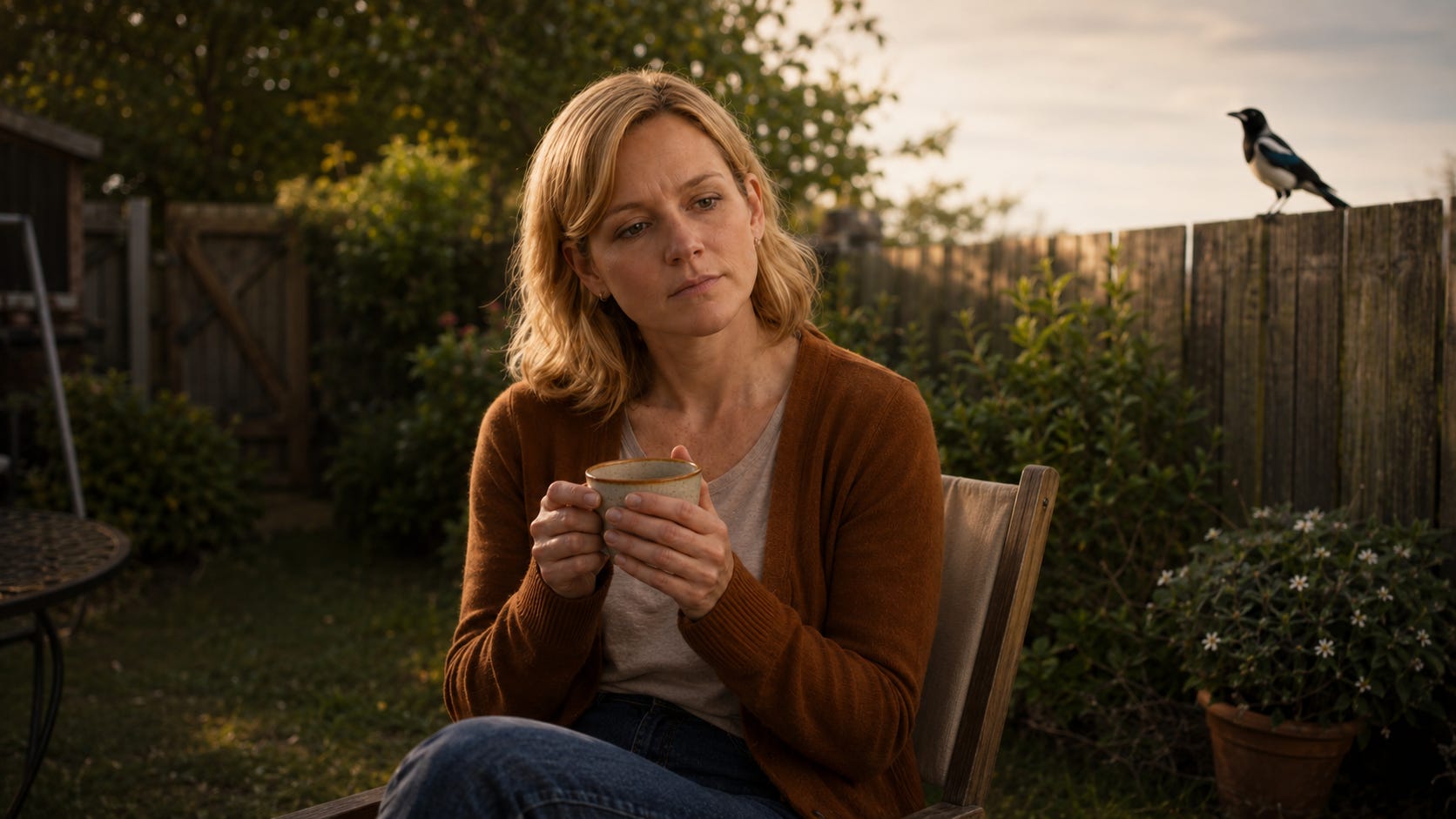
That afternoon she was sitting alone in the back garden with a cup of tea going cool between her hands. The sky had that thin silver wash that sometimes comes before evening, when everything seems briefly undecided about whether to brighten or dim. A magpie landed on the fence, glanced at her sidelong, and moved on.
Clara felt the familiar tightening begin.
Nothing dramatic.
Nothing new.
Just one of those internal contractions she had spent so many years calling by different names:
worry,
failure,
restlessness,
missing out,
not quite there yet.
The mind stepped forward immediately with its old paperwork.
You are still identifying.
You still get caught.
You still don’t know what to do with life when it triggers you.
You should be further along by now.
She almost smiled.
There it was again — the same old habit of turning a weather pattern into a verdict.
And because she had been listening more carefully these last months, another question came not long after:
Further along toward what?
The cup was warm at the rim and already cooling at the base. A breeze moved across the lawn in one visible sweep, laying down the grass and letting it rise again. From a neighbouring yard came the metallic click of someone hanging washing, the quiet domestic percussion of an ordinary life not trying to transcend itself.
Clara sat very still.
The tightening remained.
The self-commentary remained.
The wish to be different remained.
But suddenly none of that felt like evidence of failure.
Only evidence of being human.
That was the strange softening that had been happening lately, so slowly she had barely trusted it. The triggers still came. The old patterns still rose. The same ancient flares of identification still lit up the system. But they did not stay as long. They did not build whole cities inside her the way they once had. And more and more often there was a second movement — not control, not mastery, just some widening around the contraction that let it be what it was without turning it into destiny.
Perhaps that was all “awakening” ever really meant in lived form:
not the disappearance of weather,
but the disappearance of the belief that weather was a self.
The thought settled into her with such quiet rightness that she closed her eyes.
Immediately, because the mind was still the mind, another voice arrived:
But shouldn’t there be more than this?
More peace.
More clarity.
More certainty.
More proof that life was going somewhere recognisable.
Clara let that voice come and go like another bird crossing the yard.
Then another feeling appeared — this one softer, almost aching. A sadness, but without the old sharp edge. A sweet sadness. The kind that rises when something in you sees how hard it has been trying for a long time and, for one unguarded moment, stops making demands.
She would once have tried to figure it out.
What is this about?
Where is it from?
What does it mean?
What memory is underneath it?
Instead she sat with it the way one sits with dusk when it begins to pool in the corners of a room — not to solve it, but because it is there and has its own strange beauty.
The sadness moved in the chest like water finding level.
It was not unpleasant.
Not exactly.
It felt more like the body grieving the years spent trying to bottle life into explanations.
The phrase came then, not as philosophy but as simple seeing:
Every time I try to know it, I lose it.
Yes.
That was the old reflex. To name. To pin. To define. To make the living thing into something manageable, something held, something that could be placed on a shelf of understanding and revisited later with appropriate labels.
But the living thing never stayed.
The moment she turned softness into “my sadness,” or silence into “my issue,” or a trigger into “the thing I still need to fix,” the whole field narrowed. Life became again a cardboard tube held to the eye: one problem, one self, one story, one meaning.
And yet when the tube dropped, everything widened.
The garden became astonishingly busy.
The ants at the paving edge.
The small tear in the tea towel on the line.
The different greens in the rosemary bush.
The insect-chewed holes in one camellia leaf.
The hum of some machine two streets away, carrying through the air with no need to be identified.
Nothing grand.
Just the shocking fullness of what had always been dismissed as “boring.”
That word no longer made much sense to her. Boring compared to what? Compared to the fantasy of a more dramatic life? Compared to a future self who would finally know what to do? Compared to the internal noise that had once made every ordinary moment feel too thin to deserve attention?
The truth was, life became dullest when she was most trapped in herself.
When the self-story softened, even grass became intricate.
Even the pause between two birdcalls became strangely alive.
Even sadness, left unnamed, acquired a sweetness.
By the time the light had begun to fade, Clara could feel the trigger of the day no longer running the show. It had come. It had tightened the body. It had called in all the usual beliefs. But now it was thinning, not because she had beaten it, but because she had met it more softly.
Later, lying in bed with the room dark and one hand resting lightly on her chest, she thought of the old way she used to imagine freedom — as the disappearance of all unpleasantness. No more triggers. No more contraction. No more moments of being caught.
Now that whole fantasy felt almost adolescent.
Freedom was something quieter.
More intimate.
Less photogenic.
The trigger still comes.
The mind still speaks.
Identification still flashes alive.
But less often.
Less long.
Less believed.
And sometimes, in the middle of all that, there is room for a sweetness that no longer needs to know what it is about.
Clara turned on her side and watched the shadow of the curtain move faintly in the night air.
No finish line.
No certificate.
No final attainment.
Only this odd, beautiful life becoming more interesting as she stopped insisting on knowing it.
And in that not-knowing, something inside her rested.
Investigation: Softness instead of a finish line
The material you shared points to a subtle but powerful shift: the aim is not to stop being triggered, stop identifying, or achieve some final stable state. The deeper shift is in how experience is related to. The “awake” person still has contractions, triggers, desires, and moments of being caught — but with less frequency, less duration, and much more softness.
A few core threads stand out.
First, there is the mistaken idea that awakening would mean never identifying again. But the conversation makes clear that this is a fantasy. Identification may continue to arise. What changes is that it is seen more quickly, held more lightly, and does not spiral so completely into suffering.
Second, the longing for a dramatic epiphany can actually obscure the quieter changes already happening. Small shifts — less time lost in triggers, a slightly different response, a little more room around pain — can feel disappointing because they are not spectacular, yet they may be the most real signs of deepening.
Third, the conversation draws a beautiful distinction between pain and the added suffering created by self-attack. The example of hitting one’s thumb with a hammer makes the point cleanly: there is direct pain, and then there is the extra layer of calling oneself stupid, tensing the whole body, turning a simple hurt into a moral event. Softness changes the whole field.
Fourth, what makes life feel “boring” or like one is “missing out” is not necessarily solitude or quiet, but the conditioned narrowing of perception — the cardboard tube view. When that narrows less, life becomes interesting in its detail, unpredictability, and simple vividness. Not-knowing does not flatten life; it opens it.
Finally, there is the sweet sadness. That matters. Not every feeling needs to be solved, traced, or assigned a cause. The old reflex is to capture and explain. But often the attempt to understand is exactly what makes the living feeling disappear. Some experiences are not asking to be known. They are asking to be felt.
A clean summary would be:
Awakening is not the elimination of triggers or identification, but a softer, less punitive relationship to them. The old fantasy of a finish line gives way to a quieter freedom: less struggle, less duration of suffering, more interest in life, and a growing capacity to let experience be what it is without turning it immediately into a self-story.