

Song: Ordinary Is Enough
Elias did not want a ceremony.
That was the first thing.
No candles.
No special music.
No circle of serious faces.
No one saying, “Tell us what has changed.”
No one looking at him as if he had crossed into some rare country and now carried a passport the others did not have.
He had seen enough of that kind of thing to be suspicious of it.
The moment awakening became a badge, something in it curdled.
The moment it became an achievement, the old self had simply found a new costume.
So when Clara asked whether they should celebrate, Elias shook his head.
“No.”
Clara smiled. “That means yes, but carefully.”
He looked at her.
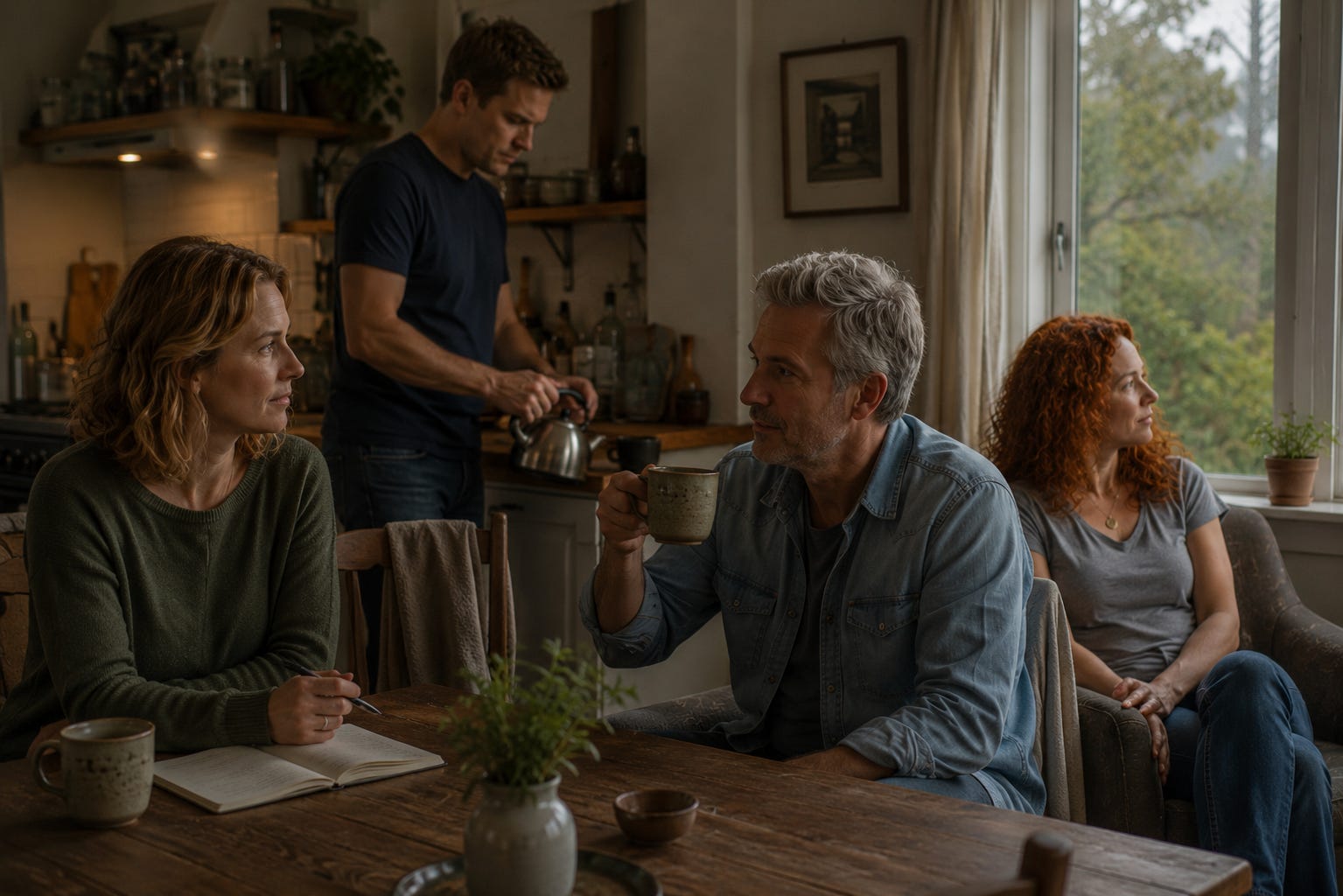
She was sitting at the kitchen table with a notebook open in front of her. Naomi was by the window, half listening, half watching the wind move through the trees outside. Daniel stood at the bench making tea, though he had forgotten to put tea in the teapot and was currently pouring boiling water into nothing.
“What are we celebrating?” Daniel asked.
Naomi pointed at the empty teapot.
“That, apparently.”
Daniel looked down.
“Oh.”
They all laughed.
And that was how the celebration began.
Not with insight.
Not with reverence.
With an empty teapot.
Elias felt the laugh move through the room and through the body called Elias, and there was no need to claim it.
Laughter happened.
That was all.
Beautiful.
Ordinary.
Unowned.
Daniel put tea in the pot this time and said, “So what do we call this? A humble celebration of being awake?”
“Careful,” Elias said. “That sounds like the title of a very boring retreat.”
“Or a very good song,” Naomi said.
Clara wrote it down anyway.
A humble celebration of being awake.
The phrase sat there on the page, slightly awkward and completely right.
Because there was something to celebrate.
Not Elias.
Not a person.
Not a spiritual achievement.
Not a new identity.
But this strange mercy:
life no longer had to be organized around a central wound called me.
Not all the time.
Not perfectly.
Not as a permanent performance.
But enough.
Enough that the old stories had lost their monarchy.
Enough that thoughts could appear without automatically becoming truth.
Enough that feelings could move without needing to become identity.
Enough that the body could be tired, sad, irritated, hungry, foolish, delighted, lonely, warm, and still not be converted into a spiritual report card.
That was worth celebrating.
Quietly.
Daniel brought the tea to the table. This time, actual tea.
There were no matching cups. Clara had a chipped blue mug. Naomi had a white cup with a hairline crack near the handle. Daniel had one that said World’s Okayest Uncle, though he was not an uncle. Elias had the smallest cup because he had chosen last.
“This is perfect,” Clara said. “No one gets to look enlightened drinking from these.”
Elias lifted his cup. “To that.”
They drank.
The tea was too hot.
Everyone made the small face people make when tea is too hot but they try to be dignified about it.
The celebration continued.
Nothing dramatic happened.
Rain began, then stopped.
A dog barked down the street.
Daniel remembered an email he had forgotten to answer.
Naomi’s stomach growled loudly enough to interrupt a sentence.
Clara dropped her pen and said something unprintable.
And through all of it, Elias felt a kind of gratitude that did not need to become emotional in any particular way.
Gratitude not as a feeling that filled the chest.
Gratitude as the absence of argument.
This.
This ordinary mess.
This teapot.
This laughter.
This aching knee.
This unfinished email.
This chipped mug.
This room.
This rain.
This no-one-at-the-centre.
For years, Elias had imagined awakening as an arrival.
A clean arrival.
There would be before and after.
There would be confusion, then clarity.
Seeking, then finding.
Bondage, then freedom.
The mess, then the shining simplicity.
But life had not arranged itself so neatly.
There had been recognitions.
Then forgetting.
Then laughter.
Then contraction.
Then tenderness.
Then old fear.
Then a very ordinary craving for toast.
Then a memory that still hurt.
Then a day of spaciousness.
Then an argument with a parking meter.
The astonishing thing was not that human life had ended.
The astonishing thing was that human life could continue without being taken so personally.
That was the celebration.
Not that nothing hurt.
But that hurt did not always have to say, “I am this.”
Not that fear never came.
But fear did not always have to become a prophecy.
Not that anger disappeared.
But anger did not always need a throne.
Not that thoughts stopped.
But thoughts were no longer automatically crowned king before breakfast.
Naomi looked at Elias for a while.
“What does it feel like today?” she asked.
He knew what she meant.
He closed his eyes for a moment.
There was the chair under the body.
The warmth of the cup.
A faint tightness in the throat.
The sound of rain starting again.
A memory of childhood, there and gone.
A thought saying, Don’t make this sound important.
Another thought saying, Don’t make this sound too ordinary either.
A smile.
He opened his eyes.
“Like nothing much,” he said.
Naomi nodded.
Then he added, “But nothing much is full.”
That was closer.
Nothing much was not empty.
Nothing much was the room before story made it into a project.
Nothing much was the cup before it became my experience of drinking tea.
Nothing much was sadness before it became my sad life.
Nothing much was laughter before it became my joy.
Nothing much was the hand reaching for a biscuit before the mind wrote a commentary about preference, choice, and diet.
Nothing much was incredibly intimate.
Daniel said, “I still keep wanting to understand it.”
“Of course,” Elias said.
“Does that stop?”
“No idea.”
“That’s not helpful.”
“It is if you let it be.”
Daniel sighed. “I hate that.”
“I know.”
They laughed again.
Clara had been quiet. Then she said, “There’s something I like about celebrating this without pretending it makes anyone special.”
“Yes,” Elias said. “That matters.”
Because this was another tenderness of being awake.
It did not put him above anyone.
If anything, it made superiority harder to maintain.
When there was less belief in a separate owner here, it became harder to believe in separate owners over there.
People were doing what they were doing.
Defending what they defended.
Loving how they could love.
Fearing what they feared.
Hurting where they hurt.
Speaking from conditioning.
Reacting from old wounds.
Trying to be safe.
Trying to be seen.
Trying not to disappear.
Trying to matter.
Trying to get through the day.
Just like this organism had done.
Just like it still did, in its ways.
Awake did not make Elias less human.
It made humanity harder to reject.
Including his own.
That was humbling.
The body still forgot things.
The mouth still said awkward sentences.
The nervous system still had preferences.
The belly still tightened around certain people.
The mind still rehearsed future conversations.
The heart still wanted to be met.
The organism still liked praise more than criticism.
Nothing to boast about there.
And yet, something had changed so deeply that he could not deny it.
The old centre had been seen through enough that life felt less like a private burden and more like a vast shared happening.
Not always.
Not as a doctrine.
But often enough.
Clara raised her chipped mug.
“To being awake and still needing snacks.”
Naomi raised hers.
“To not knowing what anything is.”
Daniel raised his.
“To thoughts losing management privileges.”
Elias lifted the tiny cup.
He considered saying something wise.
Nothing came.
Good.
He looked at the three faces around the table.
Then at the rain.
Then at the empty teapot waiting to be refilled.
“To this,” he said.
That was enough.
They drank.
And the small celebration went on as all true celebrations do:
without needing to announce itself.
A biscuit broke.
Someone sneezed.
The rain softened.
Daniel finally answered his email.
Naomi stretched and yawned.
Clara wrote three words in her notebook:
Ordinary is holy.
Then crossed out holy.
She looked at it again and wrote:
Ordinary is enough.
That stayed.
Investigation: A humble celebration of being awake
A humble celebration of being awake is not a celebration of personal achievement.
It is not:
“I made it.”
“I am special.”
“I understand what others do not.”
“I have arrived.”
“I am now spiritual.”
“I am beyond ordinary human life.”
That would only be the self-story wearing ceremonial clothing.
A humble celebration is different.
It celebrates the strange, simple relief of life no longer being organised so completely around the imagined centre.
1. What is being celebrated?
Not the person.
Not the identity.
Not the guide, teacher, seeker, ex-seeker, awakened one, or knower.
What is celebrated is the loosening of misidentification.
Thoughts still arise, but they are less automatically believed.
Feelings still move, but they are less automatically owned.
Stories still form, but they are less automatically mistaken for reality.
Life still happens, but the personal burden has softened.
That is worth celebrating.
2. Humility is built into the seeing
Awake seeing is humbling because it reveals that no one authored it.
No one manufactured awakening.
No one personally achieved the collapse of the personal achiever.
Conditions gathered.
Recognition happened.
Stories weakened.
The organism changed.
Life moved.
So celebration is natural.
Boasting is absurd.
It would be like a wave bragging that it finally understood the ocean.
3. Ordinary life continues
A humble celebration includes the fact that ordinary life goes on.
Tea gets made.
Bills arrive.
Bodies age.
Sleep matters.
Food matters.
Conversations still get clumsy.
Old patterns may still echo.
Grief still visits.
Preferences remain.
Practical problems need attending.
Awake does not mean floating above life.
It means ordinary life is no longer constantly filtered through the same tight ownership.
4. Not taking credit
This is important.
There may be gratitude, wonder, laughter, relief, tenderness, awe.
But there is no need to take personal credit.
The mind may say:
“I did it.”
“I got here.”
“I understand.”
“I am awake.”
Those thoughts may arise.
But they are just more visitors.
The celebration becomes humble when even the thought “I am awake” is seen as a thought.
5. No superiority
Awake does not make anyone better than anyone else.
It may actually reduce superiority.
If the separate self cannot be found here, then the separate self cannot be blamed over there in the same old way.
People are conditioning, biology, memory, fear, longing, habit, tenderness, confusion, and intelligence moving as life.
That does not mean harmful behaviour is excused practically.
But the deep moral harshness softens.
There is less “I am awake and they are not.”
There is more:
“Life is moving in all these forms.”
6. The celebration is quiet
A humble celebration does not need spectacle.
It may look like:
laughing at an empty teapot
feeling gratitude while washing a cup
noticing a thought without obeying it
letting sadness be sad
seeing anger without becoming righteous
making dinner
sitting in the rain
not needing to fix the present moment
feeling the simplicity of being alive
This celebration is not always emotional.
Sometimes it is just the absence of argument.
7. Awake is not a finished personality
The organism does not become perfect.
There may still be impatience, awkwardness, tiredness, preferences, habits, bluntness, mistakes, forgetfulness, and emotional weather.
The difference is that these no longer have to prove or disprove awakening.
They are just part of life.
8. The humour of it
Humour belongs here.
The whole thing is funny.
The seeker tries desperately to get rid of the one who is trying.
The mind wants to understand what cannot be possessed by understanding.
The person wants credit for seeing there is no separate person.
The ordinary cup of tea turns out to be enough.
Humour keeps the celebration clean.
Without humour, awakening easily becomes solemn and self-important.
9. Gratitude without ownership
There may be deep gratitude.
But not necessarily gratitude to someone or from someone.
More like:
This is here.
This life is happening.
The burden is lighter.
The ordinary is enough.
Nothing extra is needed.
That gratitude does not need to become a philosophy.
It can simply be lived.
10. Clean formulation
A humble celebration of being awake is the quiet gratitude that life is no longer so completely organised around the imagined centre of “me.” It is not personal achievement, superiority, or arrival. It is the ordinary continuing — tea, rain, mistakes, sadness, laughter, bills, relationships — with less ownership and less argument. The celebration is humble because no one can truly claim it, and it is joyful because the burden of claiming everything has softened.
'It is the ordinary continuing — tea, rain, mistakes, sadness, laughter, bills, relationships — with less ownership and less argument. '