

The centre of this one is important: intellectual experience is not outside experiencing. Thinking, analysing, remembering, imagining, understanding, and conceptualising are all happenings too. The distinction is not between “real experiencing” and “mere thought”; it is between the thought actually happening now and the world its content claims to describe.
Song: Thought Belongs Here Too
Daniel had begun distrusting his mind.
This worried Clara because Daniel had once trusted his mind far too much.
Now he had gone in the other direction.
Whenever a thought appeared, he dismissed it.
“Story.”
Whenever he remembered something:
“Concept.”
Whenever he tried to understand what Elias was saying:
“Intellectual.”
The word had acquired the tone normally reserved for mouldy bread.
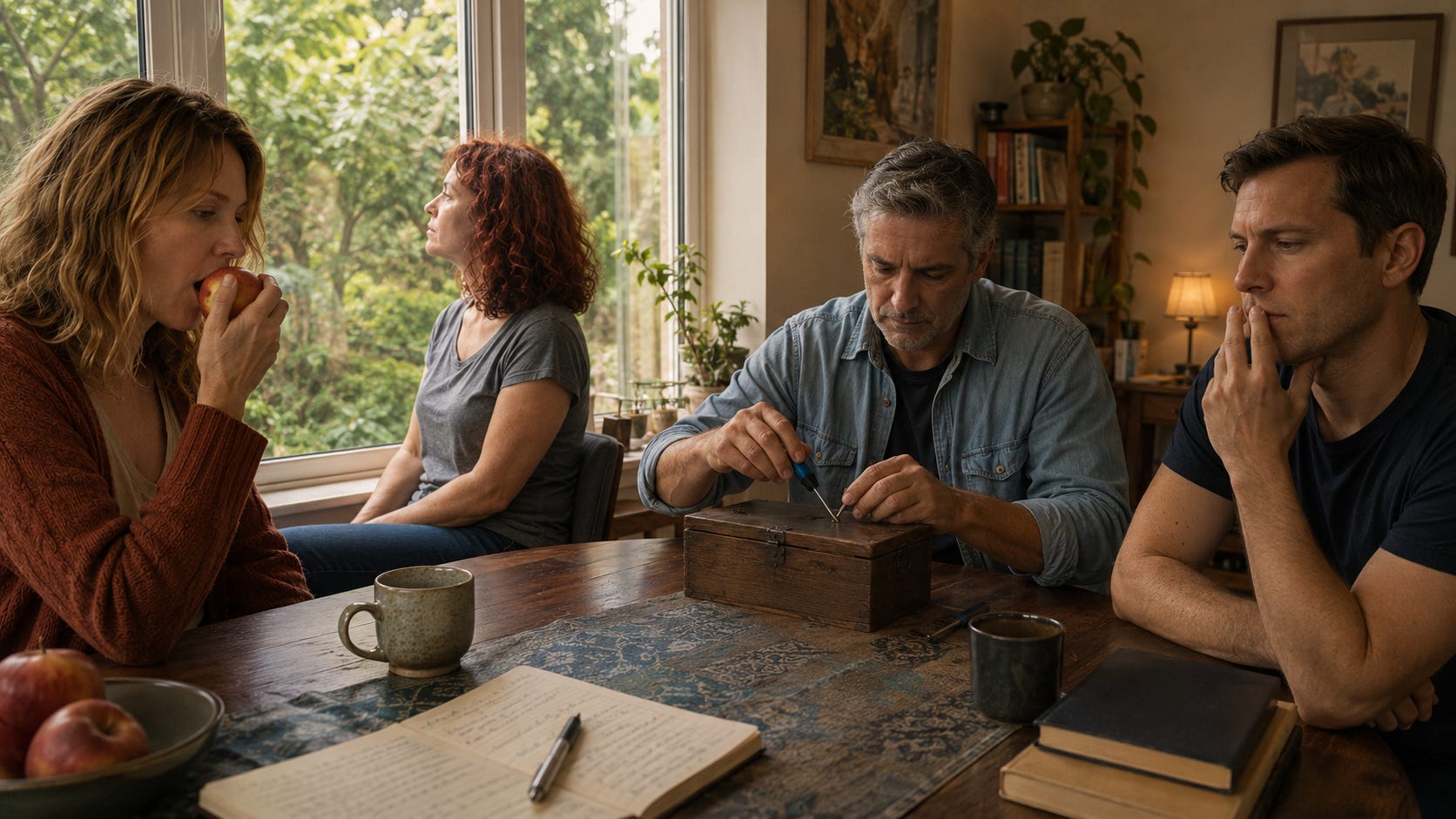
One Saturday afternoon, the four of them were sitting at Naomi’s dining table.
Clara was eating an apple.
Naomi was looking through the window.
Elias was trying to repair the hinge on an old wooden box.
Daniel was watching himself think.
“I’m doing it again,” he said.
Nobody looked up.
“Doing what?” Clara asked.
“Being in my head.”
Naomi turned from the window.
“Where else would your head be?”
“You know what I mean.”
“I probably do.”
“I’m thinking instead of experiencing.”
Elias stopped working on the hinge.
“That sounds interesting.”
Daniel sighed.
“There you go.”
“What?”
“You’re going to tell me that thinking is happening by itself.”
“Probably.”
“And that nobody is doing it.”
“Possibly.”
“And then I’ll understand that intellectually, which will be the problem all over again.”
Elias smiled.
“Excellent. You’ve saved us twenty minutes.”
Daniel did not smile.
“I’m serious. I keep understanding this stuff, but that’s all it is. Understanding. Conceptual. I’m not actually experiencing it.”
Clara bit into the apple.
The sound was surprisingly loud.
Elias said, “What just happened?”
“Clara ate an apple.”
“Already a description.”
Daniel rolled his eyes.
“All right. Crunching sound.”
“Good.”
“And seeing her move.”
“Good.”
“Apple smell.”
“Anything else?”
Daniel waited.
A thought appeared.
This is another one of Elias’s exercises.
He almost ignored it.
Then Elias said, “What happened?”
“Nothing.”
“Really?”
Daniel hesitated.
“There was a thought.”
“What thought?”
“That this is another one of your exercises.”
“And was that thought actually here?”
Daniel frowned.
“Well, yes.”
“Then why did you leave it off the list?”
“Because we’re talking about direct experience.”
Elias nodded.
“And the thought wasn’t directly experienced?”
Daniel opened his mouth.
Closed it.
Naomi smiled.
Clara took another bite of apple.
Crunch.
Daniel said, “The thought was experienced.”
“Yes.”
“But its content was conceptual.”
“Exactly.”
That distinction hung there.
Not:
sensation real, thought unreal.
But:
thought itself occurring—
actual.
What thought says—
possibly about something absent.
Daniel looked at the table.
Wood grain.
Light.
His hands.
A thought:
I understand what he means.
He said it aloud.
Elias asked, “Is that thought excluded from experiencing?”
“No.”
“Does understanding happen somewhere outside life?”
“No.”
“Then perhaps intellectual experience is not the problem.”
Daniel leaned back.
“That’s annoyingly obvious.”
“Many useful things are.”
Later they went for a walk.
Daniel kept investigating.
The footpath felt firm.
Birds called from somewhere ahead.
Warmth gathered beneath his shirt.
A car passed.
Thought:
Probably a hybrid.
Another thought:
I wonder how the battery works.
Another:
Stop thinking.
He laughed.
Clara looked at him.
“What?”
“I just had a thought telling thought not to be thought.”
“Did it work?”
“Spectacularly badly.”
They walked another hundred metres.
Daniel said, “I think I’ve been dividing experience into acceptable and unacceptable parts.”
“How?”
“Body good. Thinking bad.”
Clara nodded.
“Very spiritual.”
“Exactly.”
He pointed towards a jacaranda.
“Seeing purple flowers: direct experience.”
“Yes.”
“Thinking ‘jacaranda’: conceptual contamination.”
Clara laughed.
“And thinking that conceptual contamination is bad?”
“Advanced conceptual contamination.”
They found Elias sitting on a bench ahead of them.
Daniel said, “I think I’ve found the problem.”
Elias looked disappointed.
“Oh dear.”
“Thinking isn’t separate from experiencing.”
“No.”
“But the content of thought can point to things that aren’t here.”
“Yes.”
“So if I think, ‘My brother is angry with me,’ the thought is actually happening.”
“Yes.”
“But the angry brother is not necessarily actually here.”
“Exactly.”
Daniel sat beside him.
“And if I think, ‘I finally understand this,’ that understanding is also an experience.”
“Yes.”
“So intellectual understanding isn’t somehow fake.”
“No.”
“It just isn’t the same thing as what it describes.”
Elias nodded.
Daniel stared ahead.
“That seems incredibly important.”
“It is.”
They stopped beside the river.
Naomi joined them a few minutes later.
She had brought coffee.
Daniel continued.
“Suppose I think about yesterday.”
“Go on,” Elias said.
“The memory is happening now.”
“Yes.”
“The picture of yesterday, the words about yesterday, whatever sensations come with it—all happening now.”
“Yes.”
“But yesterday isn’t happening.”
“Good.”
“Suppose I imagine tomorrow.”
“Yes.”
“The imagining is actual.”
“Yes.”
“Tomorrow isn’t.”
“Yes.”
Daniel looked pleased.
Then suspicious.
“So thought belongs completely to experiencing.”
“Yes.”
“But its content may refer to something outside what’s currently happening.”
“Yes.”
“And that’s where confusion comes in.”
“Often.”
Naomi handed him a coffee.
Daniel took it.
Warm cup.
Coffee smell.
Thought:
Too hot.
He laughed.
“What now?” Naomi asked.
“The thought ‘too hot’ is part of the experience.”
“Yes.”
“And it’s also useful.”
“Yes.”
“And probably accurate.”
“Probably.”
“So we don’t have to treat all concepts as lies.”
Elias shook his head.
“That would itself be a concept.”
Daniel groaned.
“There’s no escape.”
“Correct.”
They walked farther along the river.
Daniel was quiet for a while.
Then he said, “There’s another thing.”
“What?”
“When people say, ‘Get out of your head and into direct experience,’ that can be misleading.”
Elias nodded.
“How?”
“It suggests thought is somewhere else.”
“Yes.”
“As if experiencing is body sensations, sounds, sights, smells—and then thought is this foreign invader.”
“Yes.”
“But thought is another event.”
“Exactly.”
Clara said, “The sixth sense.”
Daniel looked at her.
“What?”
“Not literally. But something like that. Seeing, hearing, smelling, tasting, touching—and thinking.”
Naomi said, “All appearing.”
“Yes,” Clara said. “Different textures of the same happening.”
Daniel liked that.
Thought had texture.
Sometimes verbal.
Sometimes image.
Sometimes memory.
Sometimes calculation.
Sometimes a fragment.
Sometimes a whole imaginary conversation.
Sometimes understanding appeared almost without words.
He had been treating all of this as an obstruction to experiencing.
But it was experiencing.
The obstruction was not thought.
The difficulty came when the content of thought was mistaken for the event it represented.
The sentence:
Something is wrong.
was happening.
That did not mean something was wrong.
The thought:
I am failing.
was happening.
That did not establish a failure.
The memory:
She humiliated me.
was happening now as memory.
That did not mean the past event was happening again.
Daniel stopped walking.
“That’s the doorway, isn’t it?”
Elias turned.
“What?”
“You don’t have to get rid of stories.”
“No.”
“You just see them as what they actually are when they occur.”
“What are they?”
“Present experiences whose content may be about elsewhere.”
Elias smiled.
“Yes.”
That evening, Daniel was alone at home.
He sat at the kitchen table.
The refrigerator hummed.
A clock clicked.
The mind was busy.
A conversation from earlier replayed.
He imagined what he should have said.
Then imagined what Clara might think of him.
Then wondered whether he was making progress.
Then noticed himself wondering whether he was making progress.
Usually he would have tried to move attention away from all of that.
Feet.
Breathing.
Sounds.
Back to the present.
But suddenly he saw the absurdity.
The thoughts were not taking him out of the present.
They were present events.
The imagined conversation was here as imagination.
The memory was here as memory.
The question was here as a question.
The judging thought was here as judging thought.
Even the thought:
I need to return to the present
was already happening in the only place anything ever happened.
He laughed.
The clock clicked.
Thought continued.
Nothing had been purified.
Nothing needed to be.
A few minutes later, an old memory appeared.
Something his father had said when Daniel was eleven.
The familiar tightening came.
Then the sentence:
He always thought I was weak.
For years Daniel would have either believed the sentence or tried to dismiss it as story.
This time neither happened.
There was:
memory-image,
tightness,
the sentence,
sadness,
another thought questioning the accuracy of the memory.
All of it belonged.
The intellectual questioning belonged too.
There was no need to choose between:
feeling the sadness
and
understanding what was happening.
Both were happening.
Different movements.
One life.
Daniel realised that he had created another hierarchy:
body beneath mind,
experience beneath interpretation,
truth beneath concept.
But perhaps experiencing did not recognise his hierarchy.
It simply included everything.
A sensation was happening.
A thought about the sensation was happening.
An interpretation of the thought was happening.
A recognition that interpretation was happening.
Even the intellectual recognition:
All of this is experiencing
was itself another event in experiencing.
There was no place outside it from which to understand it.
Daniel sat there for a long time.
Not thoughtless.
Not wordless.
Not especially peaceful.
Just fascinated.
The intellect had not been expelled from the garden.
It had never left.
Investigation: Thought Is Also Experiencing
There is a useful distinction between actual and conceptual.
But it can easily become distorted.
We may start believing:
Body = actual.
Thought = conceptual.
Therefore:
Body = real.
Thought = unreal.
That is too crude.
Thought is actually happening.
Its content may be conceptual.
This distinction changes the investigation considerably.
1. A thought is an event
Suppose the thought appears:
Something is missing.
What is actually here?
Not only bodily sensations.
There may be:
tightness in the throat,
pressure in the chest,
breathing changes,
and also the sentence:
Something is missing.
The sentence is genuinely occurring.
It belongs on the list.
The mistake would be saying:
Because the thought is actually occurring, something must actually be missing.
Those are different claims.
The thought is actual.
Its content is an interpretation.
2. Intellectual understanding is an experience
Suppose there is a sudden recognition:
Ah. Thought is not being chosen.
That may be called intellectual.
Fine.
But what is “intellectual understanding” except another form of experiencing?
A pattern connects.
A meaning becomes clear.
Perhaps words arise.
Perhaps there is a bodily shift.
Perhaps no bodily shift occurs.
Understanding happened.
It does not need to be denigrated because it involved thought.
The intellect is part of the organism.
It too is life happening.
3. The problem is not thought
Thought can:
calculate the rent,
remember an appointment,
recognise a friend,
write a song,
solve an engineering problem,
notice conditioning,
formulate an Inquiry.
Thought is enormously useful.
Suffering does not require thought to disappear.
The difficulty is often misidentification with thought-content.
A sentence appears:
I am unsafe.
The sentence itself is an event.
Then it may be treated as a direct report of reality.
That second movement matters.
4. Event and content
This may be one of the cleanest distinctions.
Event
A thought is occurring.
Content
What the thought says.
For example:
Event:
A mental sentence appears.
Content:
Nobody cares about me.
The event is undeniable.
The content may be true, false, partly true, impossible to know, or irrelevant.
Seeing this does not require arguing with the thought.
It simply places it correctly.
5. Memory is happening now
A memory refers to the past.
But the memory itself is present.
Picture.
Words.
Bodily response.
Emotion.
All appearing now.
This does not mean the remembered event never happened.
It means the past is not being directly experienced now.
A memory of the past is.
That distinction prevents an enormous amount of confusion.
6. Imagination is also actual as imagination
Likewise:
Tomorrow is not here.
But imagining tomorrow is.
An argument with your sister tomorrow may never occur.
But the imagined argument is occurring now as:
images,
words,
sensations,
predictions.
The body may respond to that imagined scene as if it were imminent.
So conceptual content can have very real biological consequences.
It does not have to be literally happening for the organism to react.
7. “Come back to the present” can become misleading
Where did thought go?
Nowhere.
A thought about next Thursday occurs now.
A memory of 1975 occurs now.
An imagined conversation occurs now.
There is no need to drag experiencing back from somewhere else.
What can change is recognising:
this is thought-about-next-Thursday happening now.
The content travels through time.
The event does not.
8. Feeling and understanding are not enemies
Sometimes awakening language creates an unnecessary conflict:
Stop analysing.
Just feel.
Stop thinking.
Be present.
Get out of the head.
But analysis itself may be what is happening.
Why should it be excluded?
If tightness is present, tightness belongs.
If thought about tightness is present, that belongs.
If intellectual understanding of the thought appears, that belongs too.
Nothing needs to be thrown out in order to produce a pure experience.
9. Layers are still experiencing
There may be:
pain.
Then:
I hate this pain.
Then:
I shouldn’t hate it.
Then:
I understand that resistance is causing suffering.
Then:
I’m only understanding intellectually.
Then:
I need to stop intellectualising.
Look at that extraordinary stack.
Every layer is happening.
None stands outside experiencing.
Even the commentary criticising commentary is commentary.
Seeing this can become rather funny.
10. Inquiry
Take a thought appearing now.
Perhaps:
I need to understand this.
Notice its form.
Is it heard as words?
Seen as text?
Known without audible words?
Does the body respond?
Now separate two things:
The thought is happening.
and:
What the thought says is true.
Are those identical?
Try another thought.
A memory.
A prediction.
A judgment.
Let the whole intellectual event be included.
No need to return to the body as though the mind has committed an offence.
Instead ask:
What kind of experiencing is this?
Thinking.
Remembering.
Imagining.
Analysing.
Understanding.
All belong.
11. The deeper implication
If thought belongs to experiencing, then there is no need to construct a privileged state called “pure experience” in which intellect disappears.
Words can appear.
Concepts can appear.
Reflection can appear.
Understanding can appear.
They simply no longer need to be mistaken for a separate thinker standing outside life and describing it.
Thinking is not something someone does to experiencing.
Thinking is one of the ways experiencing happens.
12. Clean formulation
Intellectual experience is not outside direct experiencing. A thought, memory, concept, analysis, or moment of understanding is itself an actual present event. What is conceptual is its content—the people, pasts, futures, meanings, and conclusions it represents. The useful distinction is therefore not experience versus thought, but the thought actually occurring versus the reality its content claims to describe. Nothing needs to be excluded. Even intellectual understanding is life happening in intellectual form.