

Song: No Better Than Here
I’ll keep the spirit of those “rules,” but bring them into the awakening frame we’ve been using — less moral instruction, more lived seeing.
Story: The School With No Graduation
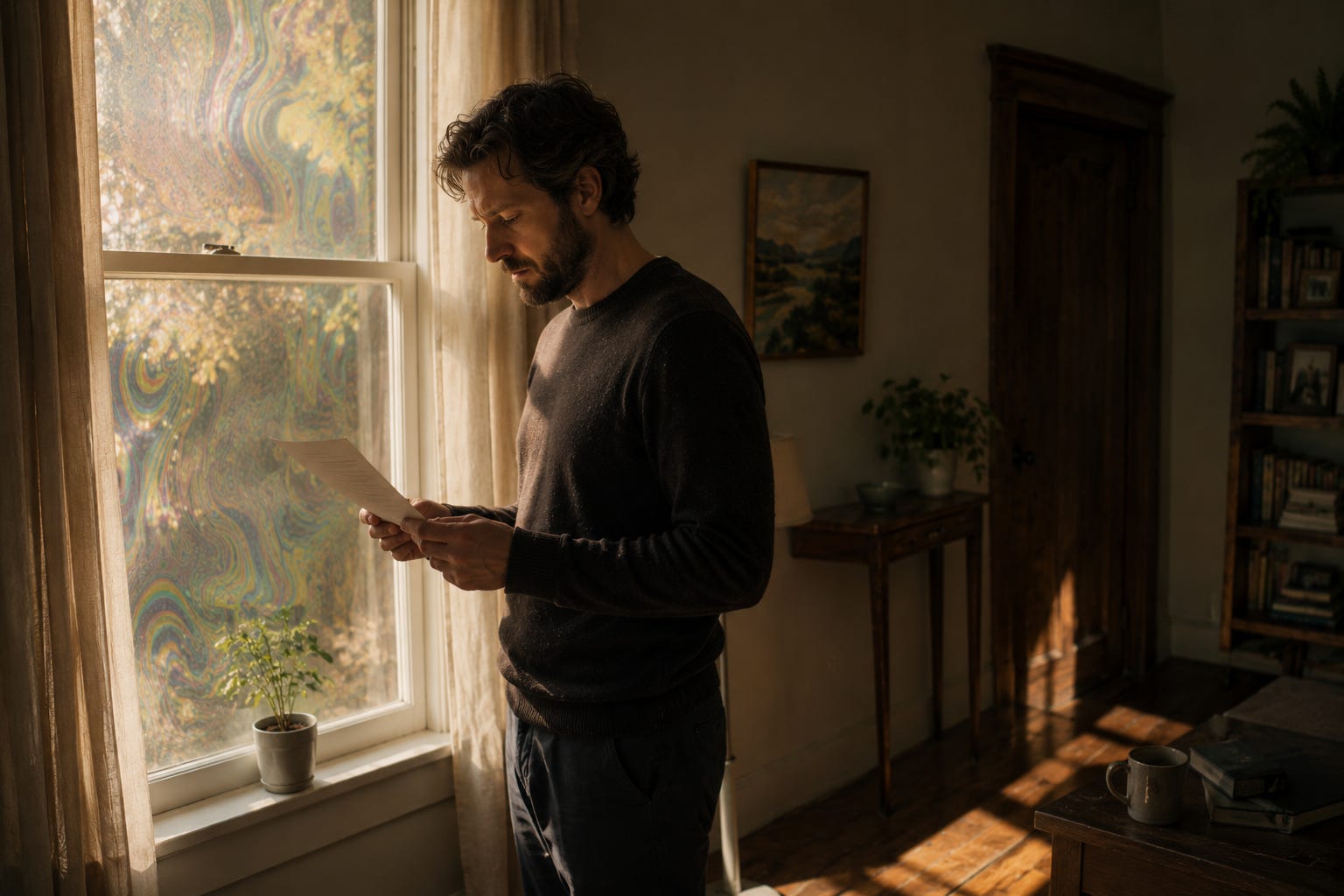
Daniel found the old list folded inside a secondhand book he’d bought years earlier and forgotten on a shelf.
The paper was yellowed at the creases, soft with handling. Across the top, in faded capitals, someone had written:
THE RULES FOR BEING HUMAN
He stood by the window reading it while late afternoon light moved slowly across the floorboards.
You will receive a body.
You will learn lessons.
There are no mistakes, only lessons.
There is no better than here.
The answers lie inside you.
It was the kind of thing he might once have rolled his eyes at — too neat, too polished, too eager to make a system out of suffering. And yet this time, reading it after all these years of seeking, failing, arguing, relaxing, tightening, seeing, forgetting, and seeing again, something in it opened differently.
Not as truth handed down.
More like an old song someone had oversimplified, but not entirely ruined.
He took the paper to the kitchen and set it beside the fruit bowl.
Outside, wind moved through the bottlebrush by the fence. Inside, the kettle began its small pre-boil murmur. Daniel rested both hands on the bench and looked at the first line again.
You will receive a body.
That one landed hardest.
A body.
Not an identity, not a spiritual path, not a destiny.
Just this strange given thing — knees that clicked on the stairs now, old grief stored like weather in the chest, hunger appearing without consultation, pleasure arriving in the tongue before thought, fatigue flattening all philosophy by three in the afternoon, a heart that could still break over things it claimed to understand.
He laughed softly.
So much of his life had been spent trying to be the sort of person who transcended the body’s terms. The sort who didn’t get snagged by desire, mood, pain, attraction, aversion, soreness, shame, restlessness, sleepiness, tears. And yet the body had gone on being the body the whole time — not as obstacle, but as fact.
Not spiritual.
Not unspiritual.
Just the local weather of being here.
He made tea and read the next line.
You will learn lessons.
That one irritated him immediately.
The mind rushed in:
What lessons?
From whom?
To what end?
What kind of cosmic school gives no syllabus and grades everything in grief?
But as he stood there with the mug warming his hands, he could feel the deeper point underneath the sentimental packaging. Life kept presenting the same places of contraction, the same hidden loyalties, the same bright little hooks where identification grabbed and built another self.
Not because the universe was a teacher with a clipboard.
Just because patterns repeated until seen through.
His impatience.
His wish to get somewhere final.
The old tendency to make every trigger into evidence of deficiency.
The hunger to solve life by standing just outside it and naming it correctly.
These did not disappear because he had read enough books.
They returned in slightly altered costumes until the seeing deepened.
Perhaps that was all “lesson” meant.
Not moral improvement.
Not becoming worthy.
Just the repeated invitation to notice where life was still being turned into prison by thought.
He sat at the table and read on.
There are no mistakes, only lessons.
This one would once have felt insulting. Tell that to a child hurt by a parent. Tell that to a wasted decade. Tell that to betrayal, illness, grief, and all the irreversible things the spiritual world liked to repaint in benevolent colours.
And yet, again, there was something in it worth rescuing.
Not that pain is unreal.
Not that harm is secretly good.
But that the story of mistake often adds a second suffering.
If life could only have happened the way it happened, then how much of his agony had come not from pain itself, but from the endless fantasy of alternate timelines? The mind’s devotion to the sentence: It should have been otherwise.
What if much of freedom began exactly where that sentence lost its authority?
Not because one becomes passive.
Because one stops arguing with what is already done.
The tea had gone cool before he reached:
There is no better than here.
He smiled at that one despite himself.
That was the whole engine of seeking, wasn’t it? The myth of “there.” Somewhere else, later, once this is solved, once I am clearer, once I am healed enough, loved enough, detached enough, disciplined enough — then life will start properly.
But every “there” had always turned into another “here” wearing new demands. The horizon was made of thought. The dissatisfaction travelled well.
He thought of Naomi then, of the way she had once said that longing had organized her life like a secret religion. Not longing for any one thing, but longing as such — the conviction that reality was always slightly elsewhere.
Now, years on, he could feel more and more how the violence was not in wanting change, but in using “there” to refuse “here.”
The next line made him pause longest.
Others are merely mirrors of you.
No, he thought.
Not merely.
Life is more mysterious than that.
And yet others do reveal things. Not because they are cardboard reflections, but because encounter exposes hidden structure. The arrogant man brings out one contraction, the needy friend another, the dismissive woman another, the beloved another still. In relationship, unseen places become visible.
Not everything he hated in another was his own trait.
But everything he reacted to told him something about the architecture inside.
Enough to keep the line alive, if stripped of its smugness.
By dusk the room had gone blue at the edges.
The paper lay open beneath the lamp now, its last lines glowing softly:
What you make of your life is up to you.
The answers lie inside you.
Daniel read them and felt the old split immediately.
On one side: yes, responsibility matters, choices appear, consequences unfold, life asks for participation.
On the other: what exactly is “up to you” if thoughts arise by themselves, impulses come unbidden, conditions shape action, and the chooser itself is never found cleanly?
He sat with that a while.
At last he could feel how both lines needed softening.
What you make of your life is not exactly up to “you” in the old sense. But life does keep moving through this organism, through these hands, this nervous system, these apparent choices. There is responsiveness, even if there is no separate controller behind it.
And the answers do not lie “inside you” as hidden treasures in a private vault. More often they appear when the noise quiets enough for what is already obvious to be noticed. The answer is not stored in a secret chamber. It arrives in contact, in stillness, in ordinary nextness.
Not deep inside the self.
Closer than that.
By the time night fully settled, Daniel had stopped reading the list as instructions and started reading it as a set of cracked old pointers toward something simpler:
You get a body.
You get this life.
You get repeated opportunities to see where you still tighten.
You don’t get to escape here by fantasizing there.
Pain happens.
The extra suffering comes from what thought builds around it.
Others reveal where you cling.
Life keeps asking for response.
And what you need most is often not hidden at all — only obscured by noise.
He folded the paper carefully and placed it back inside the book.
Then he turned off the lamp and stood for a moment in the dark kitchen listening to the faint ticking of cooling metal, the far-off sound of a car passing, the soft pressure of feet on floorboards.
No graduation.
No certificate.
No final lesson passed.
Only this ongoing school of being here,
where the same simple material keeps appearing in new forms,
until one day it no longer feels like punishment.
Until one day it feels almost like love.
Investigation: The rules soften when read without metaphysics
The list works best, in my view, when it is read poetically rather than literally.
If taken literally, some lines become clumsy or misleading:
“there are no mistakes” can minimize real harm
“others are merely mirrors” can flatten relationship into narcissism
“what you make of your life is up to you” can overstate control
“the answers lie inside you” can sound mystical or self-enclosed
But if softened, the whole thing becomes usable.
1. You get a body
This is the first humility.
You do not get pure awareness floating above conditions.
You get this body:
conditioning
fatigue
desire
pain
nervous system patterning
sensation
aging
biological weather
Awakening is not escape from embodiment. It is a different relationship to embodiment.
2. Life repeats what is unseen
“Lessons” may simply mean repeated patterns.
The same kind of trigger appears again and again:
rejection
urgency
control
guilt
shame
future-seeking
disappointment
self-criticism
Not because the universe is moralizing, but because unseen patterns recur until they are clearly felt and seen.
3. “Mistake” adds suffering
Pain is real.
Harm is real.
Consequence is real.
But “mistake” as an identity can become a trap:
I ruined it
I should have done otherwise
this proves something about me
At the level of actuality, what happened happened.
At the level of story, countless alternate lives are imagined.
Much suffering lives there.
4. There is no better than here
This is one of the strongest lines if understood properly.
It does not mean nothing should change.
It means “there” is always imagined from “here.”
The mind creates a future state and then uses it to reject present life.
That mechanism is endless.
Change may happen.
But if it is always used to avoid “here,” suffering continues.
5. Others reveal the structure
Others are not “merely mirrors,” but they do expose:
preferences
wounds
expectations
attachments
hidden self-images
What lights up in relationship reveals the nervous system’s architecture.
6. Life is not fully “up to you,” but response matters
This line needs the most correction.
There may be no independent controller in the usual sense.
And yet life unfolds through this organism:
speech happens,
action happens,
responses happen.
So the useful question is not:
“What is under my control?”
But:
“How is life moving here now?”
“What response is appearing?”
That is more honest.
7. The answers are not elsewhere
“The answers lie inside you” can be heard less as self-help and more as:
stop looking only to abstract future solutions, authorities, and ideals.
Often what matters is already closer:
direct experience
honest seeing
the next simple action
the body’s actuality
the obviousness hidden by conceptual noise
8. Clean summary
A cleaner, awakening-based version of the “rules” might be:
You get this body and this conditioning.
Patterns repeat until they are seen more clearly.
The extra suffering comes from the story built around what happens.
“There” is usually imagined from dissatisfaction with “here.”
Others reveal where you still cling.
Life keeps moving; response appears from conditions.
What matters most is usually closer and simpler than thought admits.