

Song: The Room Without Clocks
Elias began noticing it on a Thursday.
Nothing dramatic at first. No visions. No collapse of the ordinary world. Just small failures in the usual feeling of time.
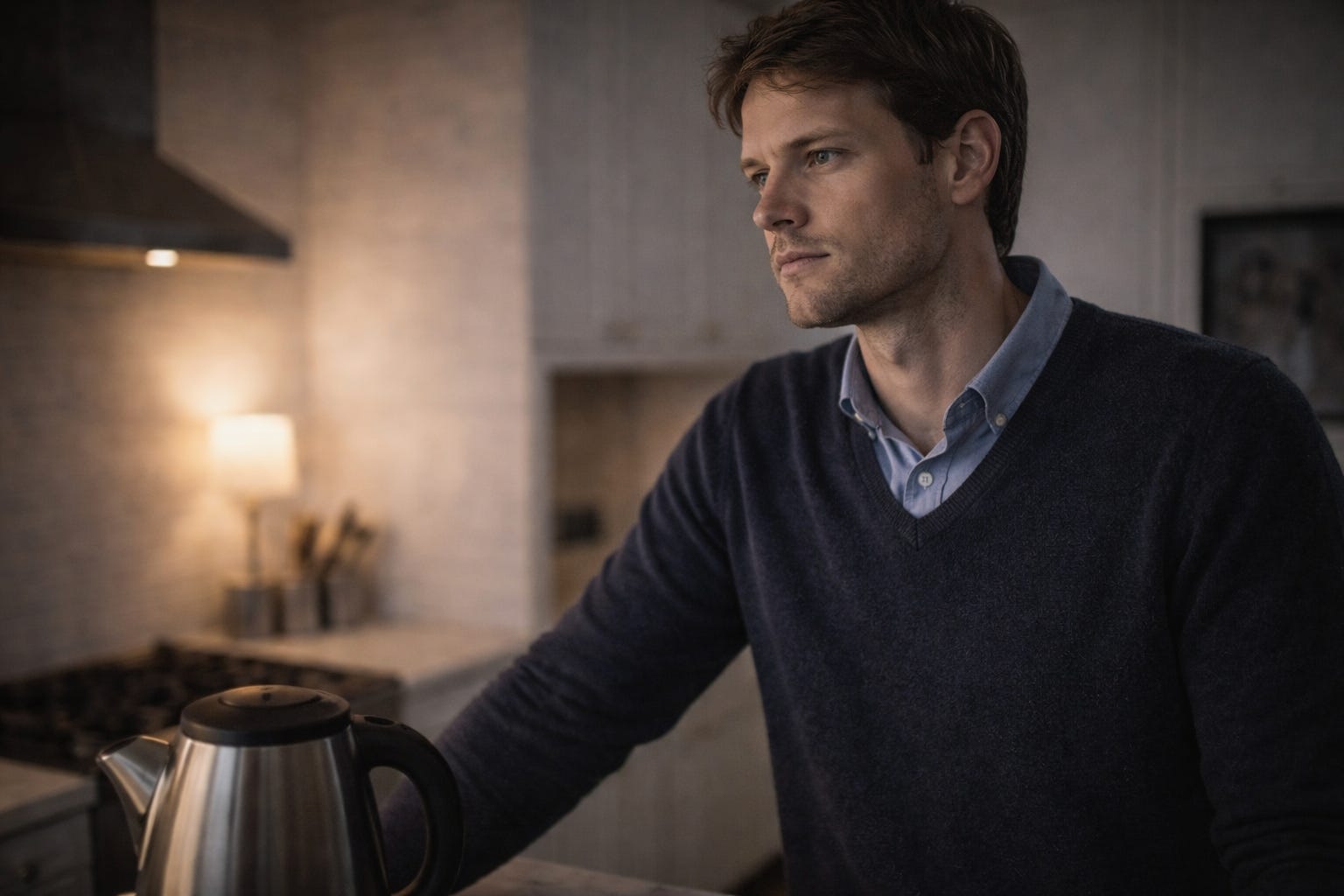
He was standing in the kitchen waiting for the kettle to boil when a memory of being eight years old arrived with unusual force. Not the idea of being eight. Not a thought about childhood. The whole scene came alive at once: the smell of wet concrete after rain, the scrape of his school shoes on the back step, his mother calling from inside the house, a yellow plastic truck lying on its side in the garden bed.
For a second it was not past.
It was simply here.
Not replacing the kitchen, but somehow appearing with it. The chrome kettle. The hum of the fridge. The wet concrete. The small blue jumper on a child’s shoulders. All of it suspended together in a way his mind could not sort into before and after.
Then the kettle clicked off, and the usual order reassembled itself.
He made tea. Sat by the window. Told himself he was tired.
But over the next few days it kept happening.
Walking through the supermarket, he would reach for a carton of milk and suddenly feel the texture of hospital sheets from twenty years earlier, when his father had been ill. Not remembering them — feeling them. Then, while stopped at a red light, he had a flash of some moment that hadn’t happened yet: himself much older, standing in a garden at dusk, one hand on a timber fence, watching birds cross a bruised pink sky. It came and went in an instant, leaving behind not certainty but intimacy, as if the moment already belonged to him.
It unsettled him.
Not because it felt mystical, but because it felt familiar. Too familiar. Like walking into a room you had forgotten you knew.
By Sunday he was actively testing it.
He sat on the porch with a notebook and wrote:
What is time, in actual experience?
He waited.
A magpie called from the powerline.
A truck changed gears down the street.
A pressure moved lightly in the chest.
Thought said, Morning. Sunday. March. Fifty-eight years old. After breakfast. Before lunch.
But none of those were present as direct experience. They were labels. Coordinates. Useful, maybe necessary. But not found in the raw material itself.
What was actually here?
Bird sound. Cool air. Light on the railing. Tingling in the hands. Thought appearing. Breath moving.
He wrote again:
Where is “past” right now?
A memory image arose: his old bedroom, moonlight on the carpet, the ache of being thirteen and not knowing why he felt so alone. The body responded immediately — tightening in the throat, a heaviness behind the sternum.
Yet the past itself was nowhere to be found. There was only this present image, this present sensation, this present thought labelled “past.”
He wrote:
Where is “future” right now?
A picture appeared of tomorrow’s meeting. Then of his own funeral. Then of some absurd scene involving a train platform and a lost suitcase. The body fluttered with anticipation, then anxiety, then amusement.
Again: no future. Only this present imagining, this present reaction, this present naming.
Elias sat very still.
The porch did not disappear. The world did not dissolve into quantum mist. But something loosened.
What he had always called time seemed to exist mostly as thought stitching appearances together. Memory made one kind of image. anticipation made another. Then the mind drew a line between them and called it a life.
Useful, perhaps. Functional. But was it actually there the way the mind said it was?
That evening he read an article about physicists exploring whether time might be emergent rather than fundamental. Another paper suggested that at the deepest level, the universe might be better described without the flowing time of everyday experience. There were also warnings everywhere: these were models, interpretations, unresolved arguments. No one had proved that time was unreal in the way spiritual people sometimes liked to say.
Still, the question stayed with him.
A week later, he had the dream.
In the dream he was walking through a vast building filled with clocks. Grandfather clocks, kitchen timers, station clocks, digital numbers hanging in midair. All of them ticking at different speeds. Some raced forward. Some moved backward. Some had no hands at all.
At the end of a long corridor he found a room with no clocks in it.
Nothing special in the room. Timber floorboards. A chair. Open window. White curtains lifting in the wind.
He stood there waiting for something to happen.
Nothing did.
And that was the strangeness of it. Nothing moved from one moment to the next, yet nothing was frozen. The room was not static. The curtain lifted. Light shifted across the wall. Dust turned in the air. But none of it felt as if it were travelling from past to future. It was simply appearing, complete and immediate, without needing to pass through “time” to be itself.
When he woke, the feeling stayed.
Over the next month he stopped trying to solve it and started looking more quietly.
Not “What does physics say?”
Not “What do mystics say?”
But:
What is here before the story of time is added?
He found no past outside present memory.
No future outside present imagination.
No moving present except as a thought describing change.
There was change, certainly. Morning becoming afternoon. Tea cooling in a cup. His face older in the mirror. Grief softening, then returning, then softening again. But “time” — as an invisible river carrying everything from what-has-been to what-will-be — could not be found in the same direct way as sound, colour, pressure, warmth.
One evening he visited his sister. They sat in her backyard as the light faded. Her daughter ran circles around a lemon tree, laughing for no reason he could see. Elias watched the child’s bare feet thud the grass, watched the leaves flicker in the wind, watched his sister lift her glass and smile at something half-heard.
And suddenly that old future image returned — the garden, the fence, the dusk birds — except it was not future now. It was simply another version of this same depthless immediacy, the same aliveness the mind kept slicing into then and later.
A strange tenderness came over him.
Maybe the problem had never been clocks or calendars. They were fine as tools. Maybe the problem was the unquestioned belief in a separate “me” moving through a real thing called time, carrying a past behind him and leaning toward a future ahead.
But what if life was more like a vast field of appearance, and the sense of passage came from the way memory, anticipation, and change were braided by thought?
What if the child on the back step, the man on the porch, the old figure by the fence, were not beads on a string called time, but patterns appearing in one indivisible reality the mind could only narrate sequentially?
He did not know.
That was the honest part.
But he noticed this: the less he believed in psychological time, the less trapped he felt by regret and becoming. The old wounds still visited. Plans still had to be made. Tuesday still mattered if you had a dentist appointment. But the deep urgency began to thin. Life no longer felt so much like a race between birth and death.
More like weather.
More like music.
More like this.
A bird landed on the fence and looked at him sideways.
His niece shouted from the grass, “Uncle Elias, watch this!”
He turned.
There was no past in the turning.
No future in the turning.
Only movement, colour, voice, evening air.
Only the miracle of appearance, needing no time to arrive.
Investigation: Does time exist? Or is “time” a story about change?
Here’s a careful way to investigate this without pretending to know more than we do.
1. Start with the claim
The statement says:
“Time does not exist—it’s a mirage conjured by quantum entanglement from a fundamentally timeless reality, where past, present, and future coexist eternally.”
That contains several layers:
phenomenological claim: time as ordinarily felt may be partly constructed
metaphysical claim: reality is fundamentally timeless
physics claim: quantum entanglement somehow generates the appearance of time
existential claim: past, present, and future coexist
These should not be blurred together.
2. What is directly observable?
Look in immediate experience.
Right now, what is actually present?
visual appearance
sound
bodily sensation
thought
memory appearing now
anticipation appearing now
Can you find:
the past, apart from present memory?
the future, apart from present imagination?
time itself, apart from thoughts about duration, sequence, and change?
What you may find is:
change is observable
sequence is inferred
time as an independent thing is not directly encountered in the same way sound or colour is
That does not prove time is unreal. It only shows that in lived experience, “time” may be largely a conceptual overlay on changing appearances.
3. Distinguish change from time
This matters.
A cloud moves.
Tea cools.
A body ages.
Music unfolds.
These are changes.
But is time something over and above change?
Or is “time” the conceptual framework the mind uses to organize change?
That question is worth testing.
4. How the mind builds time
In ordinary experience, the sense of time seems to be constructed from:
memory: “that happened”
anticipation: “this may happen”
comparison: “this is different from before”
narration: “my life is moving from one stage to the next”
Without these operations, there is still appearance and change, but the strong feeling of being a self travelling through time may weaken.
5. Where quantum entanglement comes in
This is where caution is needed.
Some speculative and theoretical work in physics explores whether time may be emergent rather than fundamental, and whether correlations or entanglement might play a role in how temporal order appears at certain levels of description.
But from an inquiry point of view, that remains:
a scientific model or hypothesis
not a direct experiential discovery
not settled fact
and not the same thing as spiritual timelessness
So the clean language is:
Prototype / speculation: reality may be fundamentally timeless, with time emerging from deeper relations or structures.
What can be tested directly: past and future appear now as memory and imagination; the sense of being a self moving through time may be partly constructed.
6. Useful questions
Try these slowly:
What is here before the mind says “this has lasted a while”?
Can duration be found outside thought and comparison?
Is the “past” present as anything other than memory now?
Is the “future” present as anything other than imagination now?
Is there an experiencer moving through time, or only changing experience plus a story of movement?
Does psychological suffering depend heavily on time-thought?
For example:
regret = present thought about “what was”
anxiety = present thought about “what might be”
becoming = present thought about “what I must become later”
7. A grounded conclusion
A careful conclusion would be:
In direct experience, what is found is present appearance, change, memory, anticipation, and thought. The past and future are not found as independent domains apart from present mental activity. This suggests that lived time, especially psychological time, is at least partly constructed. Whether physical reality is fundamentally timeless, and whether quantum entanglement explains the appearance of time, remains a deeper scientific and metaphysical question rather than something directly established in experience.
8. The practical edge
The point is not to adopt “time is an illusion” as a belief.
The point is to look and see:
how much suffering depends on psychological time
how much identity depends on narrative continuity
how much immediacy is obscured by living in memory and anticipation
A blunt version:
Clock time is useful. Psychological time is often oppressive. Fundamental timelessness is an open question.
This is a little beyond my understanding but the exercises are helpful!