

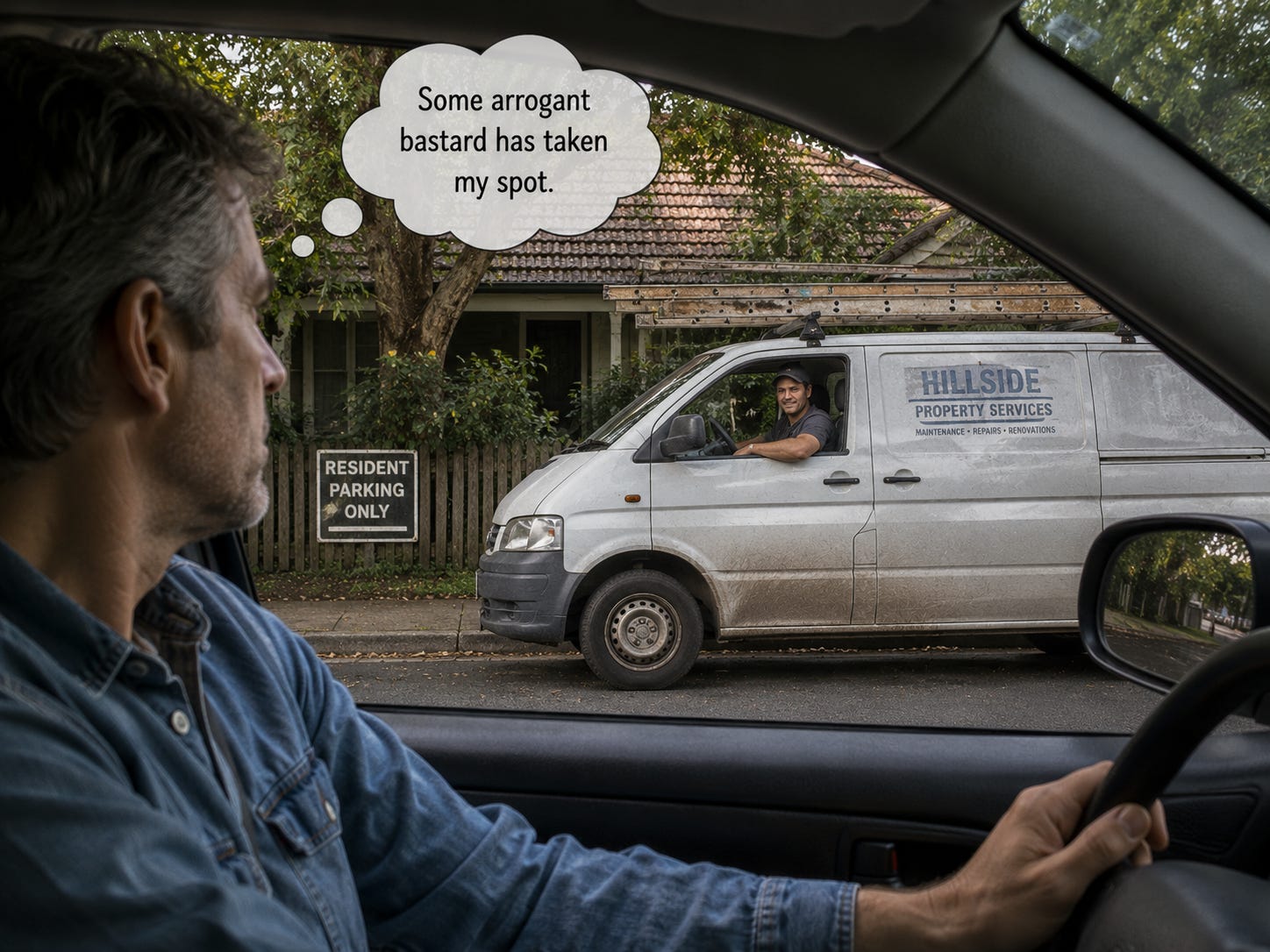
Anger often arrives as strength, but underneath it may be the body’s old expectation of helplessness, humiliation, or defeat. When the underlying strain is spoken honestly, the enemy can suddenly become another frightened human being.
Song: Underneath the Anger
Elias’s parking space had been taken.
It was not legally his parking space.
There was no sign with his name on it, no painted number, no agreement with the council. It was simply the space beneath the jacaranda tree opposite his house where he had parked for nearly twelve years.
Everyone in the street knew this.
At least Elias believed everyone knew it.
When he returned from the shops and saw a white utility vehicle sitting there, his body reacted before the car had fully stopped.
Heat moved into his face.
His hands tightened on the steering wheel.
The chest pushed forward.
The mind supplied the charge:
Some arrogant bastard has taken my spot.
Elias drove slowly past the vehicle.
A ladder was strapped to its roof. A faded company logo was painted on the door. There was plenty of room for Elias to park ten metres farther along.
He knew this.
It made no difference.
The anger was already complete.
He parked beneath another tree, slammed the door harder than necessary, and carried the groceries inside.
A jar of olives rolled out of one bag and struck the floor.
“Of course,” he said.
The olives had apparently joined the conspiracy.
Naomi was in the kitchen making tea. Clara sat at the table with Carol, looking through photographs for the next collection of stories.
They all looked up.
“What happened?” Naomi asked.
“Someone’s taken my parking spot.”
Daniel, who was leaning against the counter eating cheese directly from its packet, looked towards the window.
“You mean the piece of public road?”
Elias glared at him.
“Yes, Daniel. That piece of public road.”
Daniel slowly folded the cheese packet.
“I can sense this is not the moment for legal clarification.”
“No.”
Elias began putting away the groceries.
Each cupboard door closed with unnecessary conviction.
Naomi watched him.
“Where did you park?”
“Down the street.”
“How far?”
“That is not the point.”
“No,” she said. “I didn’t suppose it was.”
Elias placed the milk in the refrigerator and stood staring into it.
The white utility had not harmed him.
It had not trapped his car.
It had not prevented him entering the house.
The extra walk had taken perhaps twelve seconds.
And yet his body felt as if someone had pushed him aside.
He closed the refrigerator.
Carol said, “What is the point?”
Elias turned.
“That people do whatever they want. They don’t care about anyone else.”
Daniel looked out of the window again.
“Is the driver still there?”
“I don’t know.”
“Do we know whether they realise it’s your usual place?”
“That’s irrelevant.”
Daniel glanced at Clara.
Clara gave him a warning look.
Elias heard himself.
That’s irrelevant.
Facts were irrelevant because the body had already reached its conclusion.
Someone had taken something from him.
And he had been unable to prevent it.
Clara said gently, “What actually happened?”
“A vehicle is parked where I usually park.”
“And what happened in the body?”
Elias almost told her not to turn his own language against him.
Then he saw the humour.
He sat at the table.
“Heat,” he said. “Chest tight. Arms tense. Jaw. A feeling of pushing forward.”
“Anything underneath that?” Naomi asked.
“Anger.”
“Yes. Underneath the anger.”
Elias looked towards the window.
The white utility was visible through the jacaranda branches.
He imagined confronting the driver.
The imagined scene arrived instantly.
Elias would say, “I park there.”
The driver would laugh.
He would say it was a public street.
Elias would become more forceful.
The driver would become aggressive.
Neighbours would watch.
Elias would be made to look foolish.
The driver would leave the vehicle there anyway.
Elias would lose.
There it was.
Not merely inconvenience.
Anticipated defeat.
The body was fighting a confrontation that had not happened.
Elias said quietly, “Helplessness.”
Daniel sat down.
The room changed.
Elias continued.
“If I ask him to move, he might refuse. And there’s nothing I can do.”
Clara nodded.
“So the anger appears before the helplessness has to be felt.”
“Yes.”
Carol said, “It makes you feel powerful.”
“For a moment.”
“What happens if you don’t become angry?”
Elias looked.
A different feeling appeared.
Smallness.
Embarrassment.
The sense of being dismissed.
A memory, not quite an image, of his father speaking over him at the dinner table.
There was no need for the memory to be exact. The body knew the shape.
Someone stronger decides.
Your preference does not matter.
Do not show that you are hurt.
Push back or disappear.
The parking space was a piece of road.
But the body had recognised an old stage.
Naomi said, “So he didn’t only take the parking spot.”
“No,” Elias replied. “He became every person who might ignore me.”
The anger softened slightly.
Not because it was irrational and therefore unworthy.
Because it had become understandable.
Conditioning was doing what conditioning did.
A current event touched an old expectation.
The body prepared for a familiar defeat.
Daniel said, “Are you going to speak to him?”
“I don’t know.”
“Good answer.”
Elias looked at him.
Daniel smiled. “I’m learning.”
A knock came at the front door.
Everyone turned.
Elias felt the anger return immediately.
He walked to the hallway.
A man in work clothes stood outside. He looked about forty, tired, with plaster dust along one sleeve.
“Sorry, mate,” the man said. “Is that your car down there?”
“Yes.”
“I’m doing a repair two doors up. I’ve got a delivery coming, and I parked under the tree because there was room for the van. I’ll move in about twenty minutes. Hope that’s all right.”
Elias felt briefly disoriented.
The confrontation had not followed the script.
He could still say something sharp.
He could inform the man that people in the street respected each other’s usual spaces.
He could preserve the anger.
Instead, he said, “Yes. That’s fine.”
The man smiled.
“Thanks. It’s been one of those mornings.”
Elias almost closed the door.
Then something in the phrase caught him.
“One of those mornings?”
The man rubbed his face.
“Baby was up all night. I think I’ve had about two hours’ sleep. Then the apprentice called in sick.”
Elias felt the last of the imagined enemy dissolve.
Not completely.
But enough.
“I know what lack of sleep does,” he said. “It turns every small thing into a personal attack.”
The man laughed.
“Exactly.”
They stood there for a moment, two tired nervous systems at a doorway.
No winner.
No loser.
No territory.
Just conditions meeting conditions.
After the man left, Elias returned to the kitchen.
Daniel raised an eyebrow.
“Did you defend the kingdom?”
“Brutally.”
“What happened?”
“He was tired.”
Naomi smiled. “That treacherous bastard.”
“He has a new baby.”
Clara said, “So the villain has a baby now.”
“Yes. Very inconvenient.”
They laughed.
The parking anger passed, but it left Elias thinking about another incident.
Years earlier, before he had known any of them, he had been driving home after several nights of poor sleep.
A man in a blue sedan had cut across him at a roundabout.
Elias braked hard and sounded the horn.
The other driver stopped in the middle of the road.
He opened his door.
Elias opened his.
Both men stepped out, already shouting.
“What the hell are you doing?”
“You nearly hit me!”
“You came flying through!”
“You don’t know how to drive!”
The details did not matter.
Within seconds, two adults had become animals defending territory.
Elias remembered the heat in his face.
The strange narrowing of vision.
The desire not merely to be safe, but to win.
Then he saw the man’s hands shaking.
Not with rage alone.
Something else.
Elias did not know why, but instead of moving closer he said, “Look, I haven’t slept properly for three days. I’m probably reacting like a lunatic.”
The man stopped.
It was as if Elias had spoken in an unexpected language.
Then the man’s shoulders dropped.
“My wife left last night,” he said.
The road went quiet.
Cars waited behind them.
A woman sounded her horn.
Neither man reacted.
Elias said, “I’m sorry.”
The man looked down.
“I’m trying to get to my brother’s place. I don’t even know where I’m going.”
The conflict had vanished.
Not because they resolved who was at fault.
Not because either man won.
The anger had lost its disguise.
Under Elias’s anger was exhaustion and fear.
Under the other man’s anger was grief and disorientation.
Once those were spoken, there was nothing left for the anger to protect.
They moved their cars to the side of the road.
They spoke for five minutes.
The man cried once, quickly, wiping his face as if ashamed.
Elias gave him directions to his brother’s suburb.
Then they drove away.
He never saw the man again.
But the incident stayed.
Back in Naomi’s kitchen, Elias told the story.
When he finished, Carol said, “So vulnerability interrupted the script.”
“Yes.”
“What was the script?”
Elias thought.
“One man challenges another. Neither can back down. Backing down means weakness. Weakness means defeat. So anger has to keep escalating.”
“And what did saying you were exhausted do?”
“It removed the warrior.”
Daniel said, “It put a human being in his place.”
“Yes.”
Naomi looked thoughtful.
“Anger says, ‘You are the problem.’ Vulnerability says, ‘Something is happening here.’”
Elias nodded.
That was it.
Anger simplified.
It created an enemy and a defender.
You did this.
I must stop you.
You are wrong.
I must win.
But underneath the simplicity was often a more complicated field:
fear,
helplessness,
grief,
shame,
exhaustion,
anticipated humiliation,
the memory of being powerless,
the need to matter.
Anger was not false.
It was the body’s fast solution.
It arrived before the deeper truth could be spoken.
Clara said, “Does this mean we should always look underneath anger?”
“No,” Elias replied. “Sometimes a boundary needs to be immediate. Sometimes anger moves the body away from danger.”
“But afterward?”
“Afterward, perhaps. Especially if the reaction is much larger than the event.”
Daniel pointed through the window.
“One vehicle in the usual parking spot: moderate annoyance.”
“Reasonable.”
“Full-body preparation for social annihilation: possibly something underneath.”
Elias smiled.
“Possibly.”
The utility moved twenty minutes later.
Elias watched from the window as the tired tradesman reversed out of the space.
There was no triumph.
The road had not been restored to its rightful owner.
A vehicle moved.
An empty space appeared.
That was all.
But the next morning another car was parked there.
This time it was a small red hatchback.
The old reaction began.
Heat.
Chest.
Jaw.
The first sentence:
For God’s sake.
Then Elias noticed the rest.
The imagined refusal.
The anticipated humiliation.
The old helplessness preparing its armour.
He stood at the window and let the body speak without obeying the story.
Tightness.
Pushing.
Fear of being dismissed.
Wanting control.
No need to call it irrational.
No need to make it spiritual.
It was conditioning.
A protective response rehearsing an old defeat.
Elias breathed out.
The anger remained for another minute.
Then it changed shape.
Not into peace.
Into tenderness.
Not for the unknown driver.
For the old, frightened movement that believed it had to become large whenever it expected to be powerless.
He picked up his keys.
Daniel was waiting near the door.
“Where are we going?”
“To the shops.”
“Where will you park?”
Elias looked at him.
“Somewhere on planet Earth.”
Daniel nodded.
“Very awakened.”
“No. Just less interested in fighting the road.”
They walked to the car.
The red hatchback sat beneath the jacaranda.
Through its rear window Elias could see a child’s drawing taped to the back seat.
A yellow sun.
A blue house.
Three stick figures holding hands.
The enemy had acquired a family.
Again.
Elias shook his head.
“They make it very difficult to stay furious,” he said.
Daniel opened the passenger door.
“People?”
“Yes.”
“They’re inconsiderately human.”
And with that, they drove away.
Investigation: What Anger Is Protecting
Anger often appears to be about the immediate event:
Someone took the parking space.
Someone cut across the car.
Someone interrupted.
Someone dismissed a request.
Someone failed to show respect.
But the size of the reaction may reveal that the body is responding to more than the current event.
The event is the trigger.
The deeper reaction may involve helplessness, anticipated defeat, shame, exhaustion, fear, or an old expectation of being disregarded.
1. Events first, stories second
The event:
A vehicle is parked where Elias usually parks.
The story:
They have taken my space.
People do whatever they want.
Nobody respects anyone.
If I confront them, they will refuse.
I will be powerless.
I will be humiliated.
The body does not wait for the story to be carefully examined.
Conditioning recognises a familiar shape and activates protection.
Heat.
Muscular tension.
Forward movement.
Narrowed attention.
Readiness to fight.
The response may be disproportionate to the present event, but it is not random.
It has a history.
2. Anger provides temporary power
Helplessness is difficult to feel.
Anger changes the body rapidly.
The chest expands.
Energy rises.
Uncertainty becomes certainty.
Fear becomes accusation.
Smallness becomes force.
Instead of:
I may not be able to change this.
the body experiences:
I will make this change.
Anger can therefore protect against the raw feeling of powerlessness.
It is often easier to feel furious than helpless.
3. The anticipated event may matter more than the actual event
Elias was not only responding to the parked vehicle.
He was responding to an imagined confrontation:
The driver will refuse.
The driver will mock me.
Others will watch.
I will lose.
None of that had happened.
But the body was already living it.
This is common.
The nervous system reacts not only to what happened, but to the future predicted from past experience.
4. Conditioned does not mean irrational nonsense
Calling a reaction “irrational” can become another form of dismissal.
The reaction usually has its own internal logic.
If being dismissed once led to shame or danger, the body may learn:
Act first.
Become forceful.
Do not show vulnerability.
Never let the other person gain the upper hand.
That response may no longer suit the current situation.
But it once served a protective function.
Understanding this creates space without excusing harmful behaviour.
5. Anger narrows the human field
Anger turns a person into a role:
the selfish driver,
the arrogant neighbour,
the difficult partner,
the disrespectful stranger,
the enemy.
Once the role is established, the rest of the person disappears.
The tradesman is no longer a tired new father.
The other driver is no longer a man whose marriage has collapsed.
They become the obstacle.
This narrowing allows conflict to escalate.
6. Vulnerability changes the script
Road rage follows a familiar script:
Challenge.
Defence.
Counterattack.
Escalation.
Neither person can soften because softening appears to mean losing.
When Elias said:
“I haven’t slept properly for three days. I’m probably reacting like a lunatic,”
he stepped outside the role of warrior.
He did not surrender his dignity.
He revealed the actual condition underneath the performance.
The other man could then do the same:
“My wife left last night.”
The conflict dissolved because neither man needed to defend against an enemy.
Two strained human beings became visible.
7. Vulnerability is not submission
Vulnerability does not mean tolerating danger or abandoning boundaries.
It does not mean telling personal truths to someone who is threatening or unsafe.
Sometimes the intelligent response is to leave, seek help, or speak firmly.
Vulnerability is useful when there is enough safety to reveal what anger is hiding.
It might sound like:
“I’m exhausted and I reacted too quickly.”
“I felt dismissed.”
“I’m frightened this will happen again.”
“I don’t know what to do.”
“I’m more hurt than angry.”
“I’m already under a lot of strain.”
This does not guarantee the other person will soften.
But it stops feeding the false certainty that anger creates.
8. The body can be met before the story is acted out
When anger rises, first notice its physical form:
Heat.
Pressure.
Clenched jaw.
Tight fists.
Forward leaning.
Shallow breath.
The urge to speak immediately.
Then ask:
What defeat is being anticipated?
What feels powerless here?
What am I afraid this event says about me?
What would be felt if anger did not arrive?
Is the body fighting the current person, or someone from the past wearing their face?
No immediate answer is required.
The question itself may widen the field.
9. Anger may conceal tenderness
Behind anger may be a frightened movement saying:
Please do not dismiss me.
Please do not make me powerless.
Please do not shame me.
Please recognise that I matter.
Please do not leave.
When that movement is seen, the anger may not disappear.
But it becomes less impersonal and less righteous.
Compassion becomes possible.
Not only for the other person.
For the conditioned organism trying to protect itself.
10. Clean formulation
Anger often appears to be caused by the immediate event, but its intensity may come from an older story of helplessness, humiliation, or anticipated defeat. The body responds conditionally before rational thought examines the situation. Anger creates temporary strength and turns the other person into an enemy. When the underlying strain is spoken honestly, the conflict can lose its structure. Vulnerability does not weaken us; it reveals the human conditions anger was trying to conceal.