

Personal love often depends on the story we hold about another person, while deeper love is what remains when the demand that life match our story begins to settle.
Song: The Bottom of the Lake
Clara loved Daniel.
At least, that was the sentence she had used for years.
She loved the way he made coffee too strong and then complained that it was too strong. She loved the small crease beside his mouth when he was trying not to laugh. She loved that he remembered the names of dogs but forgot the names of their owners. She loved the way he reached across the bed in the night, not always waking, simply checking that she was there.
She loved his opinions when they agreed with hers.
She loved his independence when it did not take him too far away.
She loved his strength when it made her feel safe.
She loved his vulnerability when it allowed her to feel needed.
She loved the Daniel who existed inside the story she carried.
Then Daniel had the stroke.
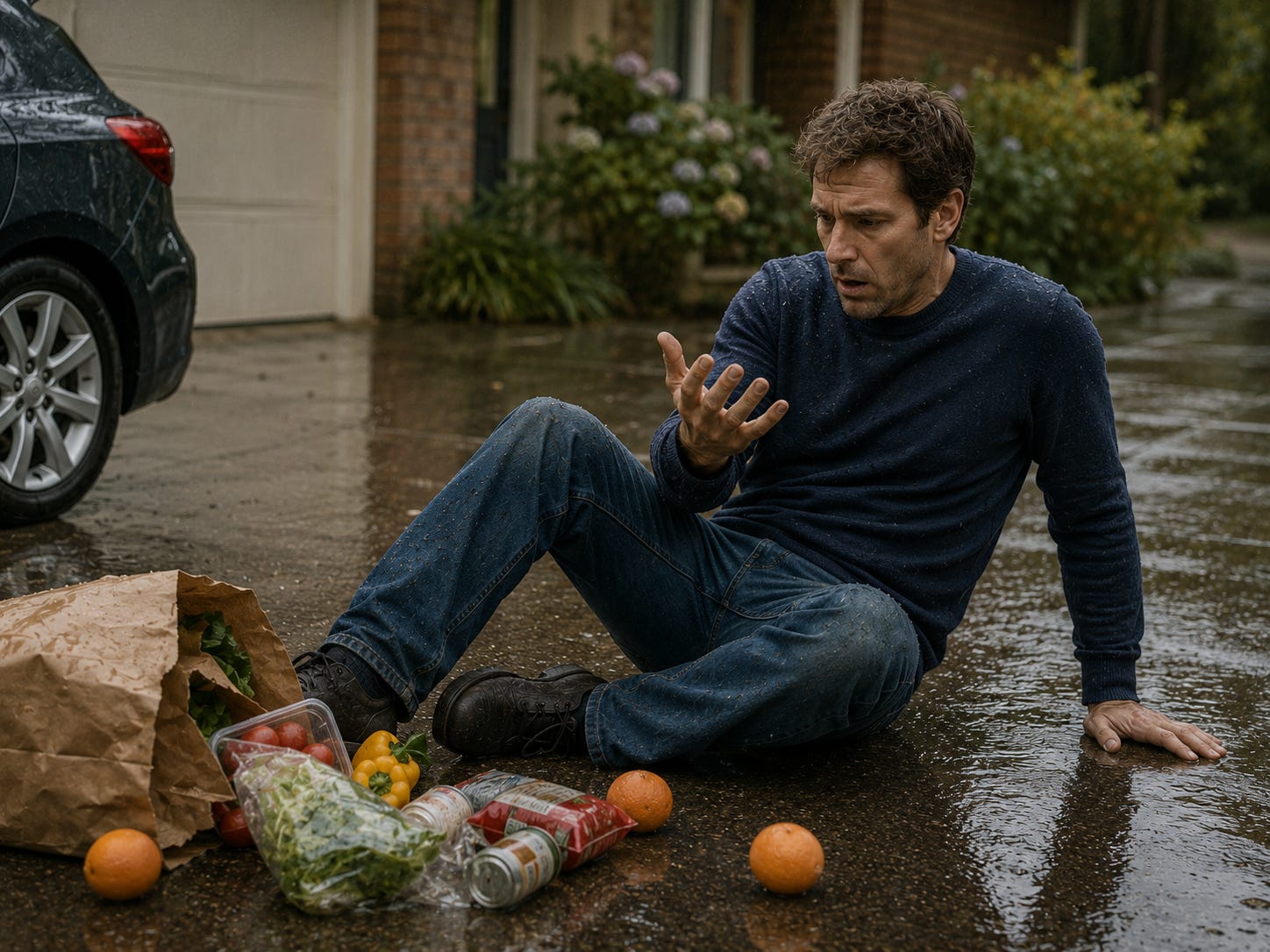
It happened on a wet Tuesday afternoon while he was carrying groceries from the car. One moment he was swearing because the bottom of a paper bag had torn; the next, the oranges were rolling down the driveway and Daniel was sitting on the ground, staring at his left hand as though it belonged to someone else.
After the hospital, after the frightened phone calls, after the scans and the words Clara barely absorbed, Daniel returned home.
But not entirely as the Daniel who had left.
His speech was slower.
Sometimes the right word disappeared halfway through a sentence. He would point at the kettle and say, “The… the hot… the water thing.”
He tired quickly.
He became impatient with buttons.
Music he had loved irritated him.
Food he had hated suddenly pleased him.
He no longer reached across the bed in the night.
Sometimes he looked at Clara with warmth.
Sometimes with confusion.
Once, when she kissed his forehead, he pulled away and asked, “Why are you doing that?”
Clara went into the bathroom and cried into a towel so he would not hear.
She told herself:
This is still Daniel.
Then:
This is not Daniel.
Then:
Of course it is Daniel.
Then:
I have lost him.
Then:
How can I say that when he is sitting in the next room?
Her love became a courtroom.
Every day, evidence was presented.
He smiled at an old joke: Daniel was still there.
He forgot their anniversary: Daniel was gone.
He touched her hand: love survived.
He stared through her: love had been destroyed.
Clara became exhausted from measuring.
One evening she attended the meeting alone.
Naomi sat beside her. Elias was by the fire. Carol had brought cake, though nobody seemed ready to eat it.
Clara told them what had been happening.
“I still love him,” she said.
Then she stopped.
The sentence sounded desperate.
Elias waited.
Clara continued.
“I need to love him. I mean, I do love him. But sometimes I look at him and I can’t find the person I loved.”
Naomi reached for her hand.
Clara let her hold it for a moment, then pulled away.
“I feel terrible saying that.”
Elias said, “What are you calling love?”
Clara stared at him.
“That’s a cruel question.”
“It may be. But I don’t mean it cruelly.”
She looked towards the fire.
“What do you think I mean?”
“I don’t know.”
“You always say that.”
“Because it is usually true.”
Clara felt anger.
Daniel had changed.
Her life had changed.
The future had been torn open.
And Elias wanted to play with definitions.
“I loved who he was,” she said sharply.
Elias nodded.
“Yes.”
“And now I don’t know who he is.”
“Yes.”
“So?”
“So perhaps much of what we call personal love is love for the person as known.”
Clara’s face tightened.
“That makes it sound false.”
“Not false. Conditional upon a story.”
She looked away.
Elias continued carefully.
“You knew Daniel through memory, expectation, familiarity, role, preference. Husband. Companion. Strong one. Funny one. The one who reached across the bed. The one who knew your history. The one who behaved in recognisable ways.”
“That was him.”
“That was how he appeared in relationship with you.”
Clara’s anger sharpened.
“You’re splitting hairs.”
“Perhaps. But the stroke has already split them.”
The room became still.
That sentence hurt because it was true.
The stroke had not only damaged Daniel’s brain.
It had exposed the invisible architecture of Clara’s love.
She had loved Daniel, yes.
But she had also loved continuity.
Recognition.
Shared history.
Reciprocity.
The feeling of being known by him.
The image of them ageing together.
The role she occupied in his eyes.
The stroke had broken parts of the mirror.
And without the familiar reflection, she did not know whether love remained.
Carol spoke softly.
“My husband changed after his illness. Not as dramatically, but enough. I remember thinking, ‘I love you, but I don’t know how to love this version of you.’”
Clara looked at her.
“What happened?”
“I kept trying to find the old version. That made both of us miserable.”
“What did you do?”
“Eventually, I noticed I was not meeting him. I was comparing him.”
That landed.
Clara saw how often she watched Daniel against memory.
Daniel before.
Daniel now.
What he used to say.
What he would have understood.
How quickly he once moved.
How he had touched her.
How he had looked at her.
Every present moment was placed beside an earlier image and found lacking.
She said, “So I’m loving the memory.”
“Sometimes,” Carol said. “And grieving it. That is not wrong.”
Elias added, “But grief becomes confused when it demands that the present restore the past.”
Clara felt tears rising.
“I don’t want to stop loving the old Daniel.”
“You don’t have to.”
“I don’t want to pretend he never existed.”
“You don’t have to.”
“I don’t want this to mean our love was only ego.”
“It doesn’t.”
Clara looked at him.
“Then what does it mean?”
Elias leaned forward.
“It means personal love contains story.”
“Contains?”
“Yes. It may contain affection, attraction, care, loyalty, desire, memory, need, habit, projection, fear, tenderness, and story. The mistake is not that story is present. The mistake is believing the story is the whole of love.”
Naomi said, “A mirror reflects something real. But the reflection is not the person.”
Clara looked at her.
Naomi continued.
“We often love what another person allows us to feel about ourselves. Safe. Chosen. Needed. Beautiful. Understood. When they change, the reflection changes. Then we think love has vanished.”
Clara felt the old resistance rise.
It sounded selfish.
Ugly.
But it was also recognisable.
Daniel’s attention had once reflected Clara back to herself as loved.
His memory of their life had confirmed the continuity of Clara.
His reaching for her in bed had said:
You matter.
You are mine.
I know you.
The stroke had not merely taken away parts of Daniel.
It had taken away a mirror in which Clara had known herself.
She whispered, “Who am I to him now?”
No one answered.
That was the real wound.
Not only:
Who is Daniel now?
But:
Who is Clara if Daniel no longer reflects her in the same way?
The tears came fully.
Naomi moved closer but did not touch her this time.
Clara let the crying happen.
No one reassured her that everything would be fine.
It was not fine.
It was happening.
After a while, Elias said, “There may be another kind of love.”
Clara wiped her face.
“A better kind?”
“Not better. Deeper, perhaps. Less dependent on the mirror.”
She waited.
Elias looked towards the rain streaking the window.
“Andrey once described it as a muddy lake.”
Carol smiled. “I remember that.”
Clara did not.
Elias continued.
“The bottom of a clear lake is always there. But if the water is stirred, sediment rises. The water becomes cloudy. You cannot see through it. The instinct is to reach in and clear it.”
“Which makes it muddier,” Naomi said.
“Yes. The more you stir, the less you see.”
Clara looked at the fire.
“What is the mud?”
“Resistance. Demand. Fear. Image. The insistence that Daniel should be the Daniel you remember. The insistence that you should feel a certain kind of love. The belief that grief means love has failed. The need to know who you are to him.”
“And the clear bottom is love?”
“Careful,” Elias said. “The analogy can become another belief. But perhaps love is not something you must produce. Perhaps it is what becomes evident when the stirring settles.”
Clara shook her head.
“How do I make it settle?”
Elias smiled gently.
“You don’t.”
“That’s convenient.”
“It is also the point.”
“So I just wait?”
“Waiting can be another form of stirring if it means waiting for a result.”
“Then what?”
“Notice the hand in the water.”
Clara was quiet.
The hand in the water.
Trying to recover Daniel.
Trying to recover Clara.
Trying to feel loving.
Trying not to feel resentment.
Trying to be a good partner.
Trying not to grieve too much.
Trying to accept.
Trying to become the person who could handle this beautifully.
Every effort stirred the lake.
The following morning, Daniel stood in the kitchen struggling with a jar.
Clara watched from the doorway.
Before the stroke, he would have opened it without thought.
Now his left hand would not grip properly. He tried to hold the jar against his chest while twisting with his right hand.
He swore.
Clara stepped forward.
“I’ll do it.”
“No.”
“You’re going to drop it.”
“No.”
“Daniel, let me help.”
His face hardened.
“I said no.”
Clara felt anger flare.
She wanted to say:
I do everything for you now.
She wanted to remind him who had spent nights in the hospital.
Who arranged medication.
Who washed him.
Who repeated words patiently.
Who absorbed his frustration.
The whole account rose like sediment.
Then she saw the hand in the water.
Not as a spiritual victory.
As a moment of recognition.
The mind was stirring.
She stopped.
Daniel continued wrestling with the jar.
Clara watched.
Not the old Daniel.
Not the damaged Daniel.
Not her husband as he had been.
A man in the kitchen.
Breathing hard.
Jaw tight.
One hand weak.
One hand working.
Furious at a jar.
For a moment, the story loosened.
There was no comparison.
No before.
No future.
No question about love.
Just Daniel.
Or even less than Daniel.
Effort.
Breath.
Frustration.
Glass.
Hand.
Morning light.
The jar slipped.
Clara caught it before it struck the floor.
Daniel looked at her.
They both began to laugh.
His laugh was different now.
Higher, slightly broken.
But it was laughter.
Clara opened the jar and placed it on the counter.
Daniel said, “Thank you.”
The words came slowly.
Clara felt something move.
Not the old warmth.
Not the feeling she had been trying to restore.
Something quieter.
It did not say:
This is the man I married.
It did not say:
Everything will be all right.
It did not say:
Our love survived.
It did not need to say anything.
There was just a softness toward him.
No reason.
No story.
No demand that he return her love correctly.
She recognised it only after it had already happened.
That evening, she told Elias.
“So that was love?”
“Do you need to name it?”
“I suppose not.”
“What was absent?”
Clara thought.
“Comparison.”
“What else?”
“The demand that he be different.”
“What else?”
“The need for him to recognise me.”
Elias nodded.
“The lake settled for a moment.”
“But it became muddy again later.”
“Of course.”
“He became angry at dinner. I became angry back.”
“Yes.”
“So I lost it.”
Elias shook his head.
“The bottom of the lake does not disappear when the water clouds.”
Clara sat very still.
That was the revelation.
She had been judging love by visibility.
When tenderness was felt, love was present.
When resentment, fear, or grief arose, love was absent.
But perhaps love did not come and go in that way.
Perhaps resistance obscured it.
Perhaps story clouded it.
Perhaps the demand for evidence made it difficult to see.
The lake did not need to manufacture a bottom each time the sediment settled.
The bottom remained.
Weeks passed.
Daniel improved in some ways.
In others, he did not.
Clara continued to grieve.
Sometimes she longed for the man who reached across the bed.
Sometimes she hated the life that had replaced the one she expected.
Sometimes Daniel looked at her with such unfamiliarity that she had to leave the room.
None of this proved love had failed.
It showed the water was stirred.
One night, Clara woke and felt movement beside her.
Daniel’s hand was searching across the sheet.
Her heart leapt.
The old Daniel.
He remembers.
He reached her shoulder and rested his hand there.
Clara held her breath.
Then Daniel murmured the name of his sister.
Not Clara.
His sister, dead for fifteen years.
Pain moved through her.
The beautiful story shattered before it had fully formed.
She almost pulled away.
Then she felt the warmth of his hand.
No correct name.
No proper memory.
No reassuring meaning.
Just a hand.
Warm.
Searching.
Resting.
Clara placed her hand over his.
In the darkness, the lake settled.
Not forever.
Long enough.
Investigation: Love as Reflection and Revelation
Love is one of the most heavily storied human experiences.
We say:
I love you.
But what is included in that sentence?
Affection.
Attachment.
Desire.
Memory.
Preference.
Need.
Recognition.
Shared history.
Security.
Projection.
Role.
Expectation.
Fear of loss.
The way the other person reflects us back to ourselves.
Personal love is not false because it contains these things.
But its fragility becomes visible when the story changes.
1. Personal love often depends on continuity
We love a person partly through a stable pattern:
how they speak,
how they touch us,
what they remember,
the role they play,
the future we imagine,
the version of ourselves that appears in their company.
A stroke, dementia, illness, injury, betrayal, or profound psychological change may disrupt that continuity.
Then the frightening question appears:
Do I still love this person?
Perhaps another question sits underneath:
Who am I if they no longer relate to me as they did?
2. The beloved can become a mirror
Another person may reflect:
I am desirable.
I am safe.
I am understood.
I am needed.
I am chosen.
I am good.
I belong.
This reflection may be tender and completely human.
But when the other person changes or withdraws, the reflected self becomes unstable.
We may believe we have lost love.
Sometimes what has been lost is the mirror.
3. Story is not the enemy
It would be too harsh to say that personal love is “only ego.”
Shared stories matter.
Memory matters.
Promises matter.
Names, anniversaries, jokes, and familiar gestures enrich relationship.
The point is not to destroy the story.
The point is to see that the story is not the whole of love.
Love may remain when recognition fails.
Care may move when reciprocity is absent.
Tenderness may appear without a reason.
4. Love may be revealed rather than created
We usually speak of love as something produced:
I need to feel more loving.
I must open my heart.
I should forgive.
I need to become compassionate.
But effort can become another disturbance.
The attempt to manufacture love may stir up more judgment:
Why can’t I love properly?
Why am I resentful?
Why is grief stronger than tenderness?
Perhaps love is not achieved.
Perhaps it becomes visible when resistance is no longer being continually stirred.
5. The muddy lake
Imagine a clear lake.
The bottom is visible.
Then sediment is stirred.
The water becomes cloudy.
Nothing has happened to the bottom.
It has not disappeared.
It is obscured.
Resistance can work this way.
The sediment may include:
This should not have happened.
You should be who you were.
I should feel differently.
You must understand me.
I need you to confirm who I am.
Our future must match the one I imagined.
I am bad for feeling resentment.
I must recover the old love.
The more the mind reaches in to clear the water, the muddier it becomes.
6. Leaving it alone is not neglect
Letting the sediment settle does not mean neglecting practical needs.
Medical care may be required.
Boundaries may be required.
Grief needs expression.
Help may need to be requested.
Difficult choices may need to happen.
“Leaving it alone” means not using inner force to manufacture a preferred emotional state.
Care can act without demanding that the heart feel a particular way.
7. Love and resistance may coexist
The muddy lake analogy can become misleading if it suggests that a loving person never feels anger, grief, exhaustion, resentment, or fear.
These may all appear.
Love is not proven by their absence.
The water may be muddy while care continues.
A meal is prepared.
A hand is held.
A boundary is spoken.
A tired body rests.
An apology happens.
Love may be moving even when it cannot be felt as warmth.
8. Inquiry
Bring to mind someone you love.
Notice the story of them.
Who are they to you?
What role do they play?
What do they reflect back about you?
What must they continue doing for the relationship to feel like love?
What happens if they no longer remember, agree, respond, admire, need, or understand you?
Notice any contraction.
Do not judge it.
Then ask:
Before the story, is there any simple movement of care?
Not a feeling you must create.
Perhaps warmth.
Tenderness.
Concern.
A wish that suffering ease.
A willingness to remain present.
Or perhaps nothing identifiable.
Let that be enough.
Do not stir the lake to find its bottom.
9. Clean formulation
Much personal love is shaped by story: who the other person has been, what they mean to us, and how they reflect us back to ourselves. When illness or change breaks that story, love can seem to disappear. But deeper love may not be an emotion that must be produced. It may be the foundational openness revealed when resistance, comparison, and demand settle. Like the clear bottom of a muddy lake, love may remain present even when grief, fear, anger, and story temporarily obscure it.