

Song: I Went Looking for the Line
Naomi had spent most of her life feeling like a person set slightly apart from everything.
Not dramatically apart. Not in some tragic or cinematic way. Just enough to make life feel like a constant negotiation between what was “her” and what was “not her.” Her body was hers. Her thoughts were hers. Her opinions, her history, her hurt, her hopes — all hers. And outside that small defended territory was the rest of the world: other people, other moods, other demands, other weather.
It felt obvious.
If someone ignored her message, she felt the contraction immediately, as if the world had moved against her. If someone praised her, there was a brief lift, like sunlight falling on a closed room. If a noise startled her, if a memory surfaced, if anxiety moved through the stomach in the early hours, the reflex was always the same:
This is happening to me.
She never questioned that sentence. Why would she? It seemed to explain everything.
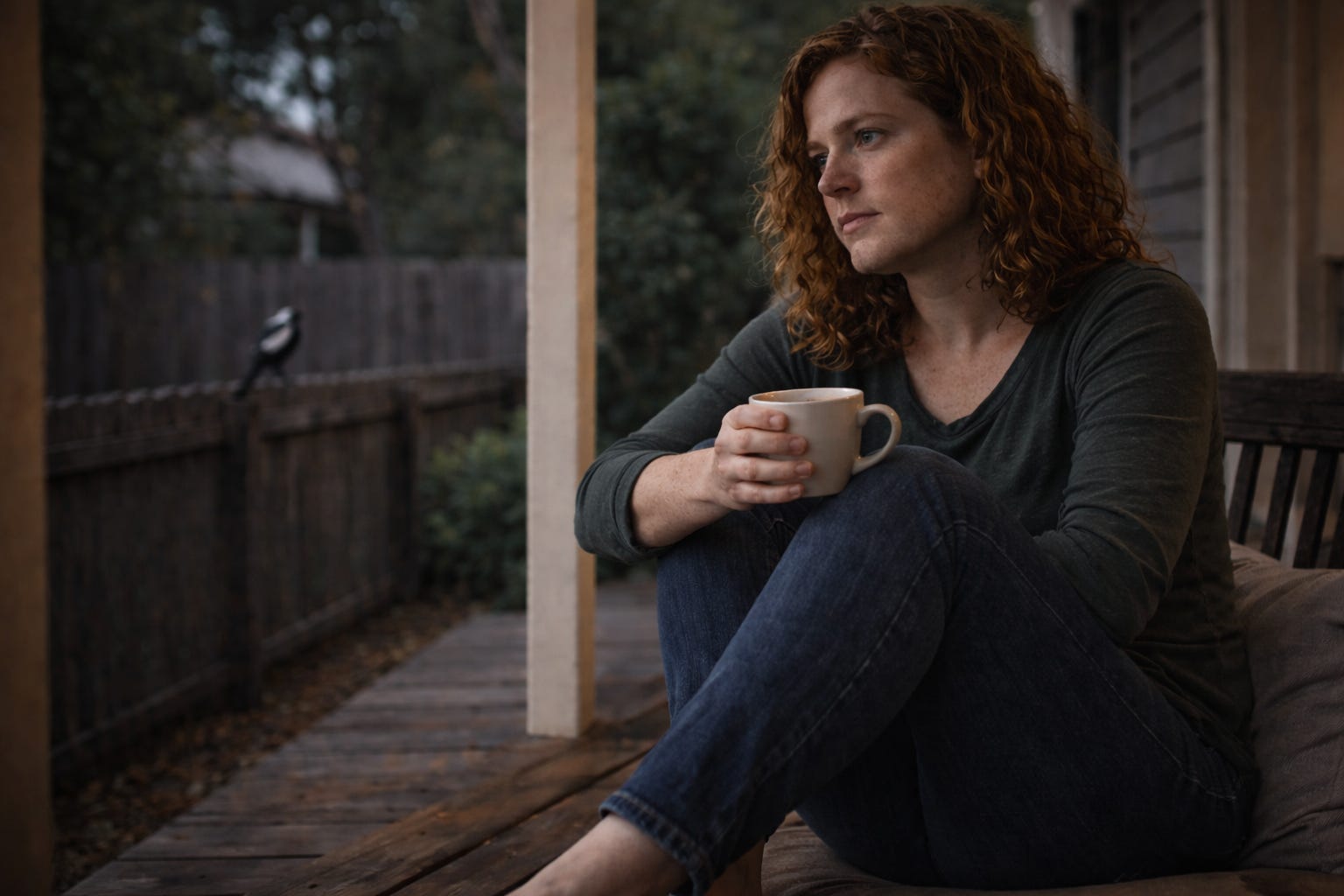
One Saturday morning she took her tea onto the back porch. The street was quiet. A magpie called from somewhere beyond the fence. A neighbour’s dog barked once, then twice. Naomi sat with one leg tucked under her, still half caught in the residue of a dream she could no longer remember.
Her mind was already busy.
I need to reply to that email.
Why did I say that yesterday?
What if she’s pulling away?
I should be calmer than this by now.
Then, because she was tired of the whole machinery, she remembered a question someone had once asked in a group:
There is hearing, but where is the hearer?
At the time she had dismissed it as clever spiritual language. But this morning something in her was too worn out to argue. So she just sat there and listened.
Birdcall.
Traffic in the distance.
The faint rattle of a spoon against the inside of her mug as she set it down.
Hearing was happening, that much was clear. But the hearer? She looked for it the way she might look for her keys or her phone. She expected to find some centre — some internal listener sitting behind the face, receiving the world.
But all she found was more experience.
Tightness in the chest.
Cool air on the forearm.
The pale timber of the porch rail.
A thought saying, I’m doing this wrong.
She frowned. Then laughed softly.
Even that — the thought, the frown, the laugh — was just more happening.
For a moment the usual arrangement loosened. The world was not over there and Naomi over here, receiving it all from behind some private wall. There was just the call of the magpie, the warmth of the mug, the movement of breath, the hum of thought, the flicker of sunlight on the leaves.
Not joined together. Not melted into some mystical soup.
Just not divided in the way she had assumed.
The shift was so ordinary she almost missed it.
Nothing exploded. No choir of angels. No cosmic revelation. The porch did not become holy. Her problems did not evaporate. But the hard line she had always imagined between “me” and “everything else” could not be found in the way she expected.
She tried again.
There is seeing, but where is the seer?
Fence. Tree. Sky. Tea steam. Her own hand resting on her knee.
Seeing was obvious. But the seer? Again, when she looked directly, she found no little owner sitting inside the head, peering out through the eyes. There were thoughts about one, yes. Feelings clustered around one, definitely. Memories referring to one, constantly. But the one itself? It was strangely absent.
Or perhaps not absent. Perhaps only imagined.
A gust of wind moved through the bottlebrush by the fence, and the branches shivered. Naomi felt a ripple of something she almost called joy, but that word came too late. It was simpler than joy. More like relief.
All this time she had been trying to manage life as if she were a separate someone standing against it. Trying to improve the one at the centre. Heal her, defend her, perfect her, explain her, present her properly.
But what if that central someone was mostly a story stitched together from memory and thought?
What if experience did not belong to anyone?
The mind answered quickly, as minds do.
That’s dangerous.
That’s absurd.
You still have responsibilities.
You still have a name.
You still have wounds.
And Naomi nodded, because those things were true in their own way. The relative life remained. Her phone would still buzz. Bills would still need paying. Old sensitivities would still rise in the body. She was not becoming stupid. She was not vanishing into a cloud.
But beneath all that movement, something had become less convincing.
The sentence This is happening to me no longer felt as solid.
There was sadness sometimes. There was irritation, hunger, pleasure, doubt, tenderness. There were stories about Naomi. There were roles she played. But in immediate experience, there was just what was happening — sound, colour, sensation, thought — arriving without asking permission and leaving without consultation.
The “me” who claimed ownership seemed to come afterward, like a commentator rushing onto a stage after the actors had already begun.
She sat there a long time.
A truck passed. A child shouted somewhere down the street. The tea cooled. A fly circled once near her ankle. The world remained utterly itself.
And still she could not find the border she had lived by.
Later that day, she met a friend at a café. They talked about ordinary things — work, family, sleep, the strange speed of the year. At one point her friend asked, “You seem different. Lighter or something. What happened?”
Naomi looked down at the table. At the spoon. At the ring of moisture beneath her glass.
How could she explain something so small and so enormous?
She smiled.
“I’m not sure,” she said. “I think I stopped assuming there was someone in here separate from all this.”
Her friend laughed. “That sounds very mystical.”
“It wasn’t,” Naomi said. “It was more like… I went looking for the line, and I couldn’t find it.”
Her friend raised an eyebrow, but Naomi didn’t try to defend it. She no longer felt the same urgency to make experience fit a concept.
That evening, walking home, she heard her name called from across the road. Her body turned before thought did. Sound. Motion. Recognition. Then the old reflex began to gather — me, over here, being called by someone, over there — but it broke apart halfway through, transparent now.
There was just the calling, the turning, the streetlight coming on, the breeze against the face, the pulse of life moving without supervision.
And in the middle of it — or rather, nowhere outside it — an intimacy so complete it needed no owner.
Not one.
Not two.
Just this.
What is duality? What is non-duality?
Duality begins with the sense of separation:
I am here, and the world is out there.
I am this body, this mind, this life, and everything else is other.
That division feels obvious. But when looked at closely, is it actually found in experience itself? Or is it added by thought?
A sensation appears.
A sound appears.
A thought appears.
Then almost immediately comes the interpretation: this is happening to me.
That “me” can feel central. But is it ever directly encountered in the same way a sound, a colour, or a bodily sensation is encountered? Or is it mostly an idea gathered from thought, memory, and habit?
In that sense, duality is not necessarily a fact of experience. It may be the result of identification: taking what appears—body, thought, emotion, role—to be what you are.
Non-duality is not the adoption of a new belief. It is the seeing that the assumed split between self and world may not be as solid as it seemed.
“Non-dual” simply means “not two.”
Not because everything has been merged into one idea,
but because the boundary first assumed may not actually be found.
There is hearing, but where exactly is the hearer?
There is seeing, but where exactly is the seer?
There is thinking, but can a thinker be located apart from thought?
This is not a matter of philosophy. It is a matter of looking.
Before labels.
Before explanation.
Before the mind says what this is.
There is simply what is happening.
And within that happening, awareness is present. Not as an object. Not as something seen. But as the undeniable fact that experience is known.
What if that awareness has no owner?
What if it is not personal?
What if the one said to be living experience is itself part of the appearance?
These are not conclusions to adopt, but questions to test.
So the invitation is simple:
look now.
Before the next thought names the moment.
Before identity rushes in.
What is here?
And can a separate self actually be found?