

Song: No Meter on the Wall
Naomi had been staring at the same message for twenty-three minutes.
She had changed Hello to Hi, changed it back again, deleted the first paragraph, restored it from the notes app, then added a sentence explaining why the first paragraph was necessary.
The message was intended for a guide she had recently discovered.
It was now 1,146 words long.
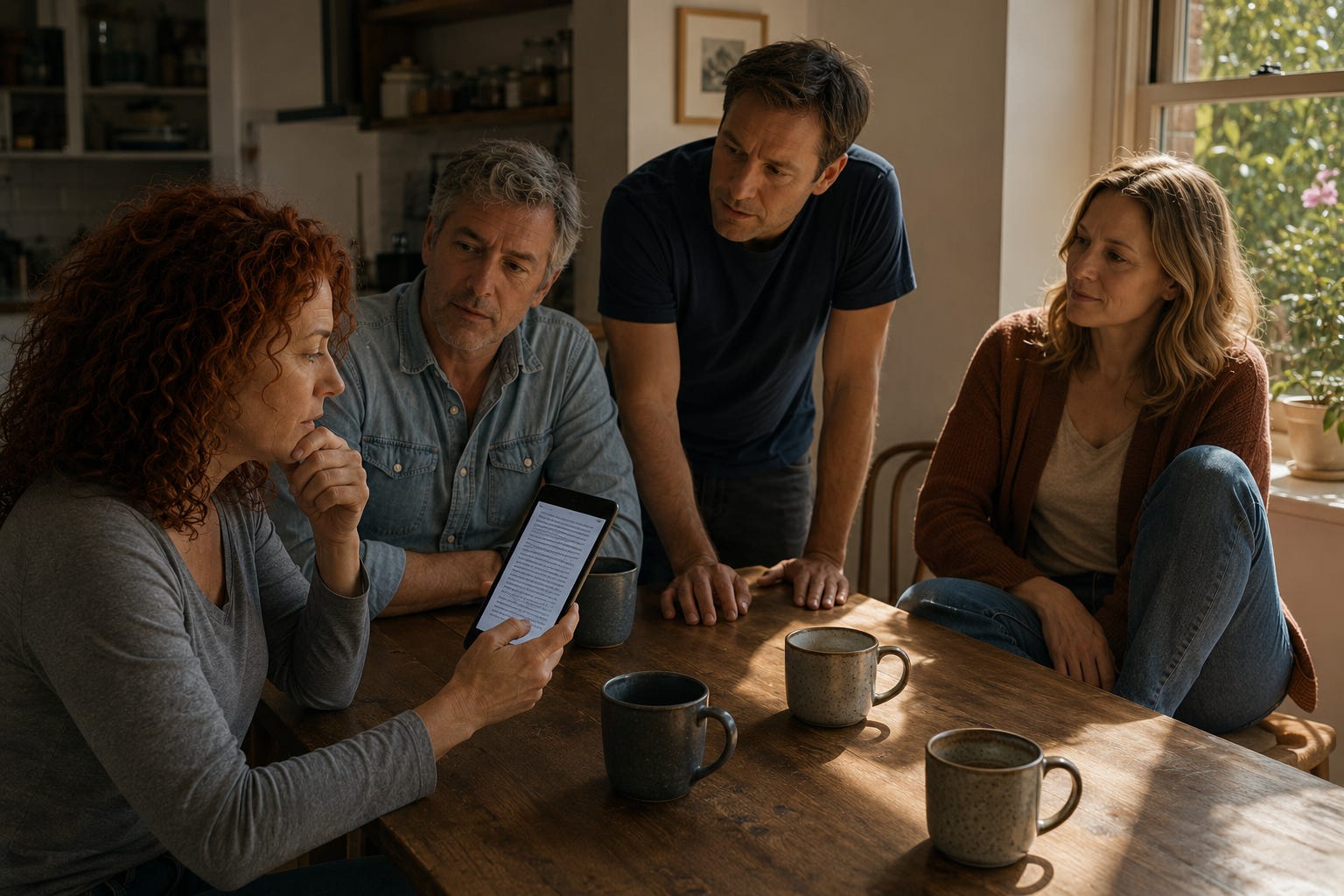
Elias placed four mugs on the kitchen table and glanced at Naomi’s phone.
“Nearly finished?”
“No.”
“Nearly started?”
“No.”
Daniel leaned over just far enough to see the solid wall of text on the screen.
“That message has chapters.”
Naomi looked up sharply.
Daniel retreated. “Not a criticism. An observation.”
Clara was sitting near the window, one leg folded beneath her. Late-afternoon light moved across the floorboards and rested against the toe of her shoe.
“What are you trying to tell him?” she asked.
“Everything he needs to know.”
“To do what?”
“To understand me.”
Naomi looked back at the screen.
“I don’t want another person giving me advice that would have been useful thirty years ago. I don’t want another explanation of the obvious traps. I don’t want to spend six months wandering down some road only to discover that it was never the road.”
“So you’re giving him the complete map,” Daniel said.
“I’m trying to.”
“Of the territory?”
“Of me.”
Nobody spoke for a moment.
The refrigerator hummed. A car passed outside. Somewhere in the back garden, a magpie knocked something metallic from the edge of the birdbath.
Elias sat opposite her.
“How much of you must he understand before he’s allowed to help?”
“That’s exactly the problem. I don’t know.”
Naomi’s shoulders were high and tight. There was a hollow sensation beneath her ribs, familiar enough that she had stopped regarding it as a visitor. It was simply where the body began.
She looked toward the plate of biscuits beside the kettle.
Then back at the phone.
“Suppose he answers warmly,” Elias said. “What happens?”
“I’ll relax.”
“And then?”
“I’ll probably tell him more.”
“And then?”
Naomi’s face changed.
Only slightly.
Clara saw it.
“You’ll wait for the warmth to change,” she said.
Naomi looked at her.
“Yes.”
The answer arrived without thought.
“Yes. That’s exactly what I’ll do.”
She placed the phone facedown.
“At first they say they want to know. They say to send whatever is relevant. They say they love this stuff. Then, eventually, there’s a change. The reply is shorter. The tone is different. Some boundary appears that apparently existed all along, although nobody told me about it.”
“And what does that change mean?” Elias asked.
“That I’ve done it again.”
“Done what?”
“Used too much.”
“Too much what?”
“Them.”
The room became very quiet.
Naomi pressed the heel of her hand into the hollow beneath her ribs.
“It’s as if every relationship has a meter,” she said. “I can’t see it, but it’s running. Every message, every need, every honest thing I say uses some of the allocation. Eventually I look up and discover I’ve spent all of it.”
“And then?” Clara asked.
“They leave.”
The words were almost soundless.
Daniel looked down at his mug.
Elias did not tell Naomi that nobody would leave. He did not promise limitless availability or claim that boundaries were imaginary. People did reach their limits. People sometimes offered more than they could sustain. Some withdrew clumsily. Some disappeared.
False reassurance would merely put a prettier curtain over the same window.
Instead, he asked, “Can you show us the meter now?”
Naomi frowned. “It’s a metaphor.”
“I know. Show it to us.”
“I can’t.”
“What can you show us?”
Naomi closed her eyes briefly.
“The phone against my palm.”
“Yes.”
“My shoulders.”
“Yes.”
“The hollow feeling.”
“Yes.”
“The sentence, ‘I’ve already said too much.’”
“Good. Is the sentence appearing?”
“Yes.”
“Is what it claims appearing?”
Naomi opened her eyes.
“What?”
“The sentence is here. Is an exhausted guide here?”
“No.”
“Is a relationship ending here?”
“No.”
“Is a meter here?”
“No.”
“That doesn’t mean nobody will ever set a boundary,” Elias said. “It means the boundary is not happening now. Right now there is a phone, tightening, a thought and four people sitting around a table.”
Naomi looked irritated.
“That sounds too simple.”
“It is simple.”
“It doesn’t feel simple.”
“No. The experiencing is simple. The history carried by it is enormous.”
Her eyes filled.
She turned her face toward the window as if the garden required sudden inspection.
Clara spoke softly.
“When someone reaches a limit, what does the mind say the limit reveals about you?”
Naomi swallowed.
“That they were happy to know the edited version. Then they encountered the actual me.”
“And the actual you costs too much?”
Naomi nodded.
There it was.
Not I am unworthy.
Not quite.
Something more intimate and more painful:
My existence exhausts people.
Her hand moved toward the plate.
She picked up a biscuit and stared at it.
“Now I want this.”
“Then have it,” Elias said.
Naomi looked suspiciously at him.
“You’re not going to ask me to sit heroically with the emptiness?”
“No.”
“Or tell me the urge isn’t real?”
“No.”
“Or say an awakened person wouldn’t need a biscuit?”
Daniel looked offended. “That would disqualify most of the country.”
A laugh escaped her before she could prevent it.
She took a bite.
For a few seconds there was sweetness, crispness, the movement of the jaw. The hollow place softened around the edges.
Then the thought appeared:
You shouldn’t have done that.
Naomi sighed.
“There. Immediately. Even the biscuit becomes an exam.”
“What actually happened?” Elias asked.
“I ate it.”
“And what was added?”
“That I failed to remain with the feeling.”
“Did you decide to make the hand reach?”
“It seemed to happen.”
“Did you manufacture the sweetness?”
“No.”
“Did you invite the criticism?”
“No.”
“Then where is the failed person?”
Naomi searched.
There was chewing.
There was a half-eaten biscuit in her fingers.
There was a thought describing a failed woman.
But the woman herself could not be separated from the description.
“I can’t find her,” she said.
“Don’t make that into an achievement,” Clara warned.
“I was just about to.”
“I know.”
Naomi laughed again, then wiped beneath one eye.
Elias turned the phone faceup and slid it back toward her.
“What do you actually want to ask this man?”
She looked at the enormous message.
“I want him to help me see where I am.”
“Where are you?”
“If I knew that, I wouldn’t need to ask.”
“Where are you now?”
Naomi waited.
“A kitchen.”
“What else?”
“A hollow feeling. Shoulders beginning to drop. Fear that I’ll waste more time. Anger that I’ve worked so hard and still live as if something is always about to get me.”
“What do you want him to help you see?”
“The moment this turns into me. The moment a boundary becomes proof. The moment a thought becomes a prosecution.”
Elias nodded toward the phone.
“Write that.”
Naomi deleted the message.
All 1,146 words.
Then she typed:
I’ve been exploring this for a long time and have had a clear recognition that I no longer doubt. But ordinary life is still dominated by vigilance, rehearsing and the fear that being fully known will make people withdraw. I would like help seeing the moment this conditioning becomes “me.” Is that something you work with?
She read it twice.
Then four more times.
Her thumb hovered over Send.
“What happens if he doesn’t answer?” she asked.
“Disappointment,” Elias said.
“If he says he doesn’t have time?”
“Perhaps sadness. Perhaps anger.”
“If he thinks I’m too much?”
“That would be a thought occurring in him.”
“And it wouldn’t mean anything about me?”
“It might mean your communication exceeded his capacity. It might mean he was tired. It might mean you weren’t a good fit. It could mean many things.”
“That isn’t very comforting.”
“Freedom isn’t the guarantee of a comforting reply,” Elias said. “It’s the end of turning every reply into a verdict on your existence.”
Naomi looked at him for a long time.
Then she pressed Send.
Nothing dramatic happened.
No old wound healed.
No permanent peace arrived.
The hollow sensation remained, though it no longer seemed to be demanding an immediate explanation. Her shoulders dropped by themselves.
Daniel stood and opened the back door.
Cool air entered the kitchen, carrying the smell of damp soil and rosemary.
“What would life do now,” Clara asked, “if it didn’t have to prepare its next defence?”
Naomi looked through the doorway.
The garden was bright after rain. Water trembled along the tomato leaves. The magpie had returned to the birdbath and was pretending not to be responsible for anything.
“I think it would go outside,” Naomi said.
So they went outside.
The phone remained on the table.
For the moment, no one was measuring anything.
Investigation: The Invisible Allocation
This is not an exercise in learning to communicate perfectly. It is an investigation into the apparent person who believes connection must continually be earned and preserved.
1. Begin with a small living example
Choose something current but not overwhelming:
A message awaiting a reply.
Something said in a group.
A boundary someone recently set.
A moment when you wanted comfort, food or distraction.
A fear that you have explained too much.
Let the situation come to mind without trying to intensify it.
2. What is actually here?
Notice:
Three bodily contacts.
Two sounds.
One patch of light or shadow.
Any bodily sensations that are obvious.
The urge to fix, explain, eat, rehearse or escape.
The exact content of the thoughts appearing.
“Can’t tell” is a valid observation. No poetic description of the body is required.
A thought such as I have been too much is actually appearing as a thought. What it claims about another person, the future or your worth is conceptual.
3. Separate event from story
Ask:
What happened?
Perhaps:
A reply was brief.
Someone stated a limit.
No answer has arrived.
Food was eaten.
A question came out awkwardly.
Then ask:
What was added?
Perhaps:
They are withdrawing.
I’ve exhausted them.
I ruined everything.
I should have known better.
This proves something is wrong with me.
Do not try to remove the story. Simply recognise story as story.
4. Look for the meter
Where is the measurement showing that your allocation has been exhausted?
Can a number, gauge, boundary line or quantity of personal worth actually be found?
Another person may genuinely have limited time, energy or interest. That limit can be real.
But does their capacity contain a measurement of your worth?
Can a boundary be found to say anything by itself?
5. Find the accused
The prosecution says:
You said too much.
You needed too much.
You failed again.
Where is the one being prosecuted?
Is it the contraction in the chest?
Is it the image of the body?
Is it a remembered face?
Is it the word me?
Can an actual defendant be found outside the sensations, thoughts, images and memories presenting the case?
Do not answer from philosophy. Look.
6. Meet the protector
When rehearsing begins, do not immediately redirect it.
Notice:
Rehearsing is happening.
What is it promising?
Perhaps:
I can prevent rejection.
I can avoid being blindsided.
I can find the wording that guarantees safety.
I can ensure that nobody misunderstands me.
Has rehearsing ever produced that guarantee?
Is rehearsing being chosen, or does it begin by itself?
7. When food or another comfort appears
Do not turn the urge into a spiritual examination.
Notice the sequence:
Sadness, hollowness or agitation.
An image or thought of food.
Anticipated taste or relief.
Movement toward or away from it.
Pleasure, disappointment or criticism.
The story I succeeded or I failed.
Whether eating happens or does not happen, can the event be allowed to end without creating a person from it?
Eating happened is an event.
I am hopeless is a story.
8. The question beneath the question
Gently complete:
If I am fully myself, then…
Let the first response come.
Then examine it.
Is it a present fact?
A memory?
A prediction?
A bodily alarm?
A sentence learned from earlier events?
Nothing needs to be forced away. The discovery is not that boundaries never occur or people never leave. The discovery is that no departure, reply, meal, mistake or moment of discomfort contains a verdict about a separate self.
For a few seconds, there may simply be:
Sound.
Pressure.
Breathing.
A thought.
An urge.
This.
No curriculum.
No invisible meter.
No one standing outside the experiencing who must pass.