

Song: Visitors at the Door
Elias was talking about visitors.
Not people exactly.
Experiences.
Pleasure.
Humor.
Pain.
Fear.
Sadness.
Warmth.
Irritation.
Loneliness.
Ease.
Dread.
A sudden laugh.
A tightening in the chest.
A memory with teeth.
A quiet moment of sunlight on the table.
“All of them,” he said, “arrive from the same place.”
Daniel frowned slightly.
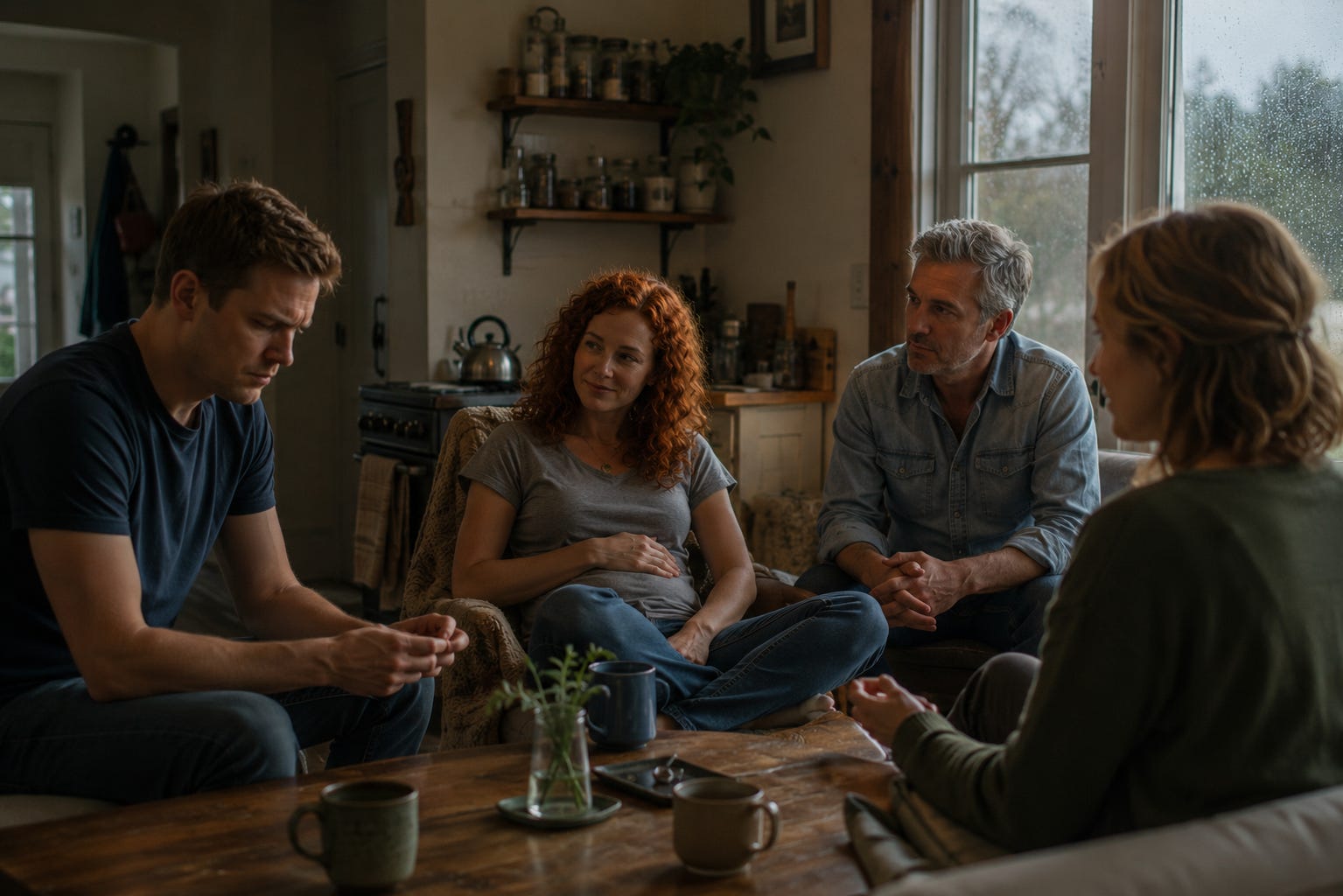
They were sitting in Clara’s kitchen late in the afternoon. Rain had been falling and stopping all day. The windows were grey at the edges, and the kettle had just clicked off for the third time because nobody had actually poured the water.
Naomi was sitting cross-legged in an armchair by the window, one hand resting on her stomach. Clara was at the table, turning a teaspoon between her fingers. Daniel sat nearest the door, as if some part of him still liked an escape route.
Elias looked around at them.
“Every experience is a visitor,” he said. “A mood turns up. A laugh turns up. Fear turns up. Pain turns up. Warmth turns up. A thought turns up. None of them ask permission.”
Daniel looked down at his hands.
“I can see that with thoughts,” he said. “Or sometimes with moods. But pain and fear feel different. They feel like intruders.”
“Of course,” Elias said. “Because the organism prefers some visitors and resists others.”
Clara smiled. “That sounds very polite. My organism does not merely resist fear. It throws furniture at it.”
Naomi laughed, and the laughter changed the room.
It appeared suddenly, bright and effortless.
No one had made it happen.
No one had chosen it.
It had simply arrived.
Elias pointed gently toward Naomi.
“There. That.”
Naomi looked up. “What?”
“The laugh. Where did it come from?”
Naomi paused.
“I don’t know.”
“Exactly.”
He let that settle.
“Now, if fear had arrived instead, we would have treated it differently. We might have asked where it came from, what it meant, how to get rid of it, how long it would stay, whether it proved something about us. But the laugh arrived just as mysteriously as fear does.”
Daniel leaned back.
“That’s annoying.”
“Yes,” Elias said. “Beautifully annoying.”
The kettle clicked again, having cooled and been restarted by Clara without anyone noticing. The kitchen smelled faintly of tea leaves and wet wool.
Daniel said, “Some visitors come more often than others.”
Elias nodded. “Yes.”
“For me,” Daniel said, “anxiety is not exactly a surprise guest. It has its own key.”
Clara laughed softly.
Daniel continued, “And shame. Shame knows where the mugs are.”
“That may be true,” Elias said. “Some visitors are regulars. Some are rare. Some stay for five seconds. Some unpack bags and act as if they own the place.”
“And some,” Naomi added, “drink all the milk.”
“Exactly,” Elias said. “But still, they arrive. That is the point.”
Daniel was quiet.
He could feel something in him wanting to argue.
Surely fear was not the same as pleasure.
Surely pain was not the same as humor.
Surely sadness was not the same as peace.
They felt different.
They behaved differently.
They affected the body differently.
Some were welcome.
Some were not.
Elias seemed to hear the objection before it was spoken.
“I’m not saying they feel the same,” he said. “I’m not saying you respond to all of them the same way in practical terms. If pain says move your hand from the stove, move your hand. If fear says check for danger, check. If grief comes, cry. If laughter comes, laugh.”
He leaned forward.
“What I’m saying is that, at the level of appearing, they are all the same kind of event.”
“A happening,” Clara said.
“Yes. A happening.”
Daniel looked toward the rain-dark window.
He understood it conceptually.
A laugh happens.
A thought happens.
A contraction happens.
A pain happens.
A fear happens.
But in real life, the distinction came fast.
Pleasure arrived and the body said, yes, stay.
Fear arrived and the body said, no, wrong door.
Humor arrived and the mind said, more of this.
Sadness arrived and the mind said, what did I do wrong?
It was not the visitor alone that created the trouble. It was the bouncer at the door.
The bouncer had opinions.
You may enter.
You may not.
You are spiritual.
You are regression.
You are acceptable.
You are proof of failure.
You are welcome.
You are dangerous.
You mean I am doing well.
You mean I am broken.
Daniel felt the truth of that like a small internal shift.
“The suffering comes from the checking,” he said.
Elias smiled.
“Some of it, yes. The visitor may still be painful. But the extra suffering comes from standing guard at the door, trying to admit only the pleasant ones.”
Clara poured the tea at last.
Four cups.
Steam rising.
A small domestic ceremony nobody had planned.
She placed one cup in front of Daniel.
“So what does welcoming mean?” she asked. “Because I can already hear the mind turning it into a new rule. Welcome everything. Be open. Don’t resist. Fail at welcoming. Feel bad about failing at welcoming.”
Naomi nodded. “Yes. Then resistance arrives and gets rejected because it is not welcoming.”
“Good,” Elias said. “That is exactly the trap.”
He picked up his cup but did not drink.
“Welcoming does not mean liking. It does not mean smiling at pain. It does not mean forcing the door open with spiritual politeness.”
“Spiritual politeness,” Clara said. “That’s a dangerous disease.”
“It means,” Elias continued, “not pretending the visitor has not arrived. It means the first response is recognition rather than war.”
Daniel repeated it quietly.
“Recognition rather than war.”
“Yes.”
A gust of rain hit the window, then softened.
Elias said, “Fear arrives. Before the story says it should not be here, can it be known simply as fear arriving? Pain arrives. Before it becomes my terrible problem, can it be known as pain arriving? Humor arrives. Before it becomes my good mood, can it be known as humor arriving?”
Naomi closed her eyes.
“And pleasure?”
“Pleasure too.”
“That one seems easier.”
“Usually,” Elias said. “But even pleasure becomes suffering when the hand closes around it.”
Daniel saw that too.
Pleasure came, and immediately the mind wanted more.
Peace came, and immediately the mind asked how to keep it.
Laughter came, and the mind wanted to become the kind of person who laughed easily.
A soft meditation came, and the mind made a plan.
Even the pleasant visitors were not left alone.
They were grabbed at the door and asked to sign a lease.
Clara said, “So the issue isn’t just rejecting unpleasant experience. It’s ownership.”
Elias nodded. “Ownership and control.”
Daniel looked at his tea.
A familiar tightness was beginning in the stomach. Not intense. Just enough to be noticed.
The mind quickly reached for meaning.
This is anxiety.
This means you don’t really understand.
This means you’ll lose this.
This means you are still afraid.
Then he saw it.
A visitor.
Not a profound visitor.
Not a mystical visitor.
Not even a particularly interesting one.
Just tightness.
The bouncer was already moving toward it with a clipboard.
Daniel almost laughed.
“Something just came,” he said.
“What?” Naomi asked.
“Tightness.”
Clara looked at him. “And?”
“And the usual committee came with it.”
“What does the committee say?” Elias asked.
“That this tightness means something. That I should do something. That it’s not as good as the room was a minute ago.”
Elias waited.
Daniel watched.
The tightness remained.
The committee chattered.
Rain moved down the glass in thin diagonal lines.
The tea was too hot to drink.
Then, without any drama, the tightness was simply there.
Not liked.
Not solved.
Not interpreted.
There.
And because it was only there, it did not fill the whole room.
Daniel looked up.
“That’s different.”
“Yes,” Elias said. “Not special. Different.”
The room grew quiet.
No one tried to improve the silence.
That itself felt like a kind of welcome.
The rain was welcome.
The tea was welcome.
The tightness was welcome.
The uncertainty was welcome.
The wish to understand was welcome.
The faint impatience with not understanding was welcome.
Even the bouncer was welcome, standing by the door, still holding his clipboard, not yet sure he was unemployed.
Naomi opened her eyes.
“So nothing needs to be thrown out.”
“No,” Elias said. “Nothing needs to be thrown out.”
“Even resistance?”
“Especially resistance. If resistance arrives, it is also a visitor.”
Daniel shook his head.
“That ruins everything.”
“It does,” Elias said. “Beautifully.”
Clara smiled into her cup.
For a while they sat without speaking.
The afternoon light thinned. The rain moved away. A car passed outside, hissing along the wet street. Somewhere in the house, a clock ticked with exaggerated seriousness.
Daniel noticed a small pleasure in the quiet.
Then noticed the wish to keep it.
Then noticed the fear that it would go.
Then noticed the absurdity of trying to keep a visitor from leaving.
The whole inner house seemed softer.
Not open in some grand permanent way.
Just not quite so heavily guarded.
Eventually Elias said, “The practice, if we can call it that, is not to become someone who welcomes everything perfectly. That would be another guard at the door. The practice is simply to notice when the door is being guarded.”
“And then?” Daniel asked.
“Then the noticing is already the beginning of welcome.”
Clara looked at him. “That simple?”
“That simple.”
Naomi laughed again.
The same mystery as before.
The same origin as fear.
The same nature as pain.
The same uninvited arrival.
Only this time, nobody tried to keep it.
Investigation: All visitors, one doorway
The central pointer is this:
Every experience arrives.
Pleasure arrives.
Pain arrives.
Humor arrives.
Fear arrives.
Sadness arrives.
Thought arrives.
Resistance arrives.
Peace arrives.
Confusion arrives.
None of them are personally manufactured in the way the mind imagines.
They turn up.
1. Pleasant and unpleasant experiences share the same nature
At the level of felt quality, experiences differ enormously.
Pleasure does not feel like fear.
Humor does not feel like pain.
Sadness does not feel like ease.
But at the level of appearing, they are all the same kind of event.
They arise.
They are known.
They change.
They pass.
The mind usually treats them as different categories:
Pleasant: welcome.
Unpleasant: problem.
But both arrive from the same mystery.
2. We naturally welcome some visitors and reject others
The organism is naturally drawn toward what feels good and away from what hurts.
That is not wrong.
That is biology.
The issue begins when this natural movement becomes psychological war.
Fear appears and thought says:
“This should not be here.”
Pain appears and thought says:
“This means something is wrong with me.”
Sadness appears and thought says:
“How do I get rid of this?”
A contraction appears and thought says:
“I am failing.”
That resistance creates extra suffering.
3. The bouncer at the door
A useful image is the inner bouncer.
The bouncer stands at the door of experience and says:
“You can come in.”
“You cannot.”
“You are spiritual.”
“You are bad.”
“You mean progress.”
“You mean failure.”
“You are acceptable.”
“You are dangerous.”
This bouncer is not evil.
It is protective conditioning.
But it creates exhaustion because experience is already arriving. The door has already opened. The visitor is already in the room.
4. Some visitors are regulars
Daniel’s point matters: some experiences feel like regular guests.
Anxiety may come often.
Shame may come often.
Fear may know its way around the house.
Sadness may have a familiar chair.
Welcoming does not mean pretending all visitors are equally easy.
It means even the familiar difficult visitor is recognized as an experience arriving, rather than as proof of identity.
“Anxiety is here” is lighter than “I am an anxious person.”
“Shame is here” is lighter than “I am broken.”
5. Welcoming does not mean liking
This is crucial.
Welcoming fear does not mean enjoying fear.
Welcoming pain does not mean refusing practical care.
Welcoming sadness does not mean dramatizing sadness.
Welcoming resistance does not mean celebrating contraction.
Welcoming means:
This is here.
It means recognition before war.
6. Resistance is also a visitor
This prevents the practice from becoming another self-improvement project.
If resistance appears, that too is an experience.
So the invitation is not:
“Do not resist.”
The invitation is:
“Notice resistance arriving.”
Then resistance is included instead of being made into a new enemy.
7. Pleasure also gets grabbed
The issue is not only rejection of unpleasant experience.
Pleasant experiences also get turned into suffering when the mind tries to own, repeat, secure, or preserve them.
Peace appears:
“How do I keep this?”
Joy appears:
“How do I become this kind of person?”
Humor appears:
“I want more of that.”
Pleasure becomes suffering when it is no longer allowed to visit and leave.
8. The foundational practice
If there is a foundational practice here, it is very simple:
Let experience arrive.
Not passively in the practical sense.
Not without boundaries.
Not without action when action is needed.
But inwardly, stop pretending that some experiences should not be part of life.
They are already part of life.
They are here.
Clean formulation
All emotional and mental experiences — pleasure, humor, pain, fear, sadness, thought, resistance, peace — arise from the same mysterious source and arrive uninvited. The organism naturally prefers some and resists others, but unnecessary suffering begins when unpleasant experiences are treated as intruders or personal failures. Welcoming does not mean liking everything; it means recognizing what has already arrived. Even resistance is included. The practice is not perfect openness, but noticing when the door of experience is being guarded.
Perhaps peace begins not when the difficult visitors stop arriving, but when we no longer ask their presence to justify itself. I especially loved the thought that even resistance is a visitor. It leaves no part of us standing outside the door. Beautifully expressed, Vince.
‘Let experience arrive.
Not passively in the practical sense. Not without boundaries. Not without action when action is needed.
But inwardly, stop pretending that some experiences should not be part of life.
They are already part of life.
The noticing is already the beginning of welcome.’
👌
Very detailed story with specifics. Clicked into place. ❤️