

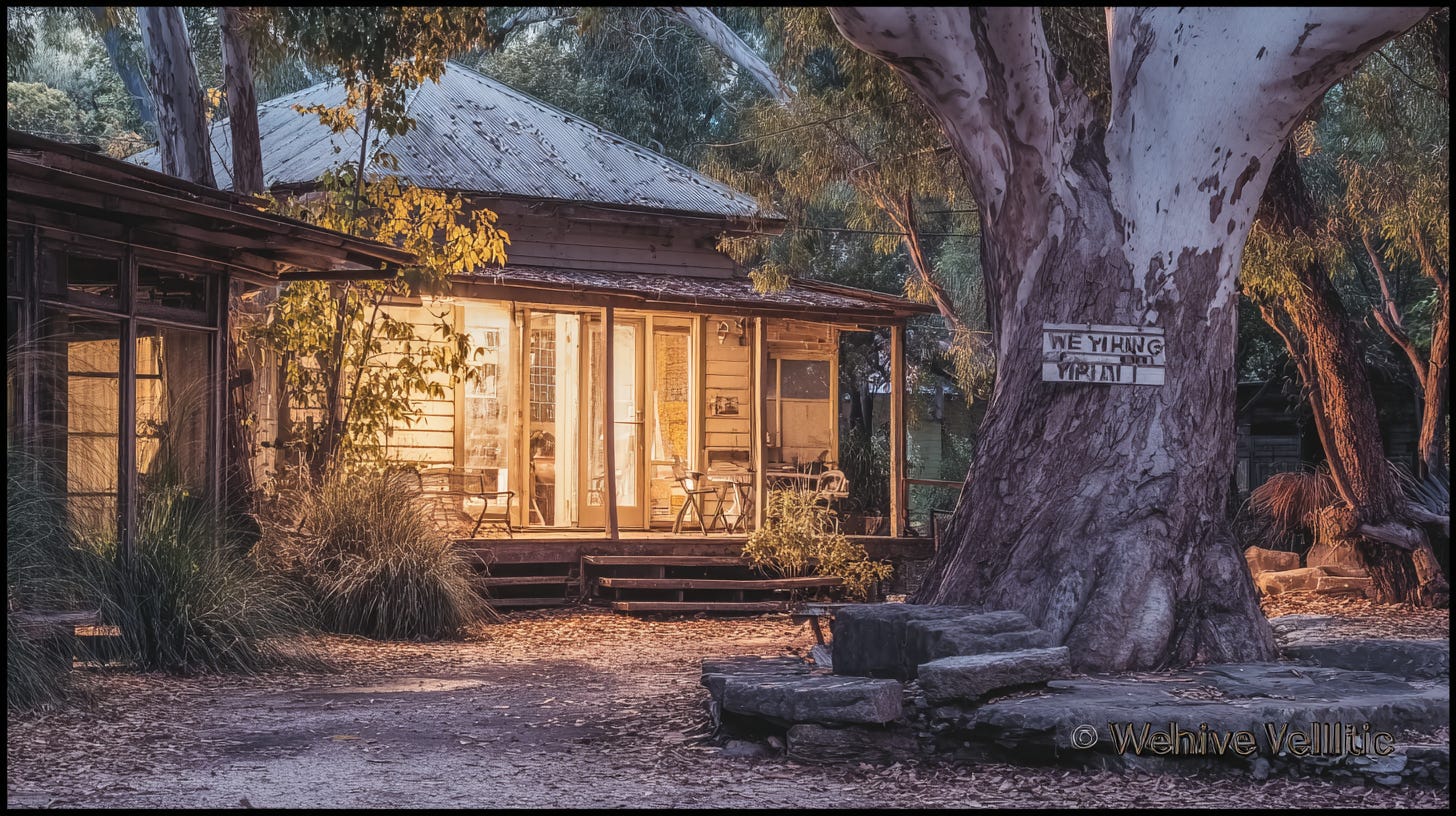
The house stood at the end of a rutted track, a weatherboard body with a verandah like a thoughtful lower lip. Wind worked the gums into their whispering, and magpies stitched sound across the morning. Floorboards inside had the old habit of answering steps; a kettle began its low, patient murmur as though it, too, were listening.
They arrived quietly, each with the particular gravity of why they’d come. Clara took the chair by the window, palms open, eyes soft and unfocused, as if allowing the world to land without interference. Naomi wrapped her fingers around a mug to steady the micro-tremor that came with efforting. Elias hesitated near the door until the room’s calm agreed to make space for him. Daniel carried the air of a seasoned skeptic who had nonetheless shown up. Mira slid into the light as if the light were a friend she trusted more than her thoughts.
A facilitator—neither master nor leader so much as an attentive gardener—set the cup down and spoke almost like an invocation. “Let the day discover itself. No chase. No fixing. Let’s notice what’s here and let it tell us what it is.”
The house, which had long preferred listening to declaration, seemed to approve.
I. Nothingness as everythingness
Silence settled in the way heat settles on timber. Clara’s voice entered it without disturbing it. “It doesn’t feel like a thing,” she said. “More like the absence that includes everything. Nothingness that is… all of this.” She gestured, not outward exactly but through the air, as if tracing a shape that was at once too large and too intimate to point to.
Her shoulders remained wide. The corners of her mouth held a private smile—the kind that arrives when an old argument has ended itself. “And in that—this—there’s an odd fact: the body still behaves as if someone were steering. The sternum inclines, the breath pauses for a permission that never comes. Movements compact themselves around an imagined center.”
The others felt it—how their own torsos had subtly gathered inward the moment an unspoken authority was presumed. Naomi noticed her jaw, the back teeth resting into one another as if bracing. Elias was aware of his gaze tipping down, a small gravitational nod to an idea he couldn’t name. The facilitator simply waited, not to extend the point but to let the recognition lodge in tissue.
“What is it like to not know?” the facilitator asked, not to interrogate but to widen the frame.
Clara’s answer arrived with a quiet exhale. “Natural. Like loosening a belt after a long meal you didn’t realize you’d been holding yourself together for. Not-knowing is rest. Knowing was the attempt to keep the sky from being sky.”
Outside, a breeze changed its mind; inside, the group registered a micro-sag of musculature, the way bodies reorganize when they are not being measured.
The discovery took time to deepen: not-knowing as comfort rather than crisis. It kept deepening as the minutes stretched without a requirement that anyone fix, claim, or certify the experience. Around that recognition, the house felt larger, as if the walls had decided to stop needing to prove they existed.
II. The brain’s theatre
The conversation found its next shape naturally. Daniel, who distrusted big claims but trusted what happened in his own stomach, said, “If I rehearse an argument I might have tomorrow, my body flares like it’s already in trouble.”
Clara didn’t hesitate. “Whatever the brain declares is happening, is happening—for the organism—even if the declaration is inaccurate.”
It was not a metaphysical statement, but a practical one, and the room took it practically. The facilitator proposed an experiment. “Let’s test how the organism answers pictures and facts.”
They sat with eyes open. “Call up an image,” the facilitator said. “A scene that never occurred but could.” Naomi pictured a conversation with her sister in which every word turned to flint. Immediately her breath rose into the upper ribs. Without instruction, her attention narrowed to the theater of the forehead. Hands warmed.
“Now drop the picture,” the facilitator continued. “Name three facts in this room.” Elias said, “Chair under thighs. Sound of kettle. Light on floorboards.” As if on cue, his abdomen loosened a degree; the eyes widened to include the window’s rectangles as part of one undivided field.
Clara told them about a scientist she occasionally worked with—a woman whose affection for the nervous system expressed itself in small drills that taught honesty to perception. “She tapped my patellar tendon while we tracked micro-adjustments in posture. The body recalibrated before any thought arrived to explain. The movement happened; the thought wrote its press release afterward.”
That detail rippled through the group. They each recognized how often internal press releases had claimed authorship of movements already underway. The discovery here was not abstract: it was a felt re-sequencing—event first, story second. The relief was not in discrediting the brain, but in acknowledging its talent for convincing fiction.
“Let’s give the brain some help,” the facilitator said. “When a picture arrives, say ‘image.’ When a sound or contact presents, say ‘event.’ Not to scold, but to catalogue.” They tried it, and found themselves smiling at how quickly their bodies changed temperature, tension, and direction depending on which label was honest.
They lingered there: the room full of adults noting aloud like patient field biologists—image, event, image—and letting their breath tell them which was which.
III. How awakening arrives
Later, on the verandah where heat left the boards with a sigh, someone asked when this had begun for Clara.
“Thirty-odd years ago,” she said. “It arrived like clean weather after a month of smoke. Absolute. Life revealed itself empty and meaningless.” She saw the flinch that particular phrase still produced in people and smiled. “Not bleak empty. Not despair. Empty like a perfect canvas—no narrative to defend. Meaningless like sky—that radical neutrality that allows every cloud.”
She watched a magpie stitch the air with a phrase only it understood. “And then the edge softened. The drama dissolved into a broad warmth. Old patterning continued. The sense of being the one behind it flickered and often didn’t show up at all. If someone asked, ‘Are you awake?’ it was like asking water to confirm it was wet.”
Mira, listening with her hands wrapped in a shawl, felt the tug of an old fantasy. “Part of me still expects a bell to be struck. The bell named me. One definitive strike and I never lose it.”
The group let the expectation be seen without reproach. The discovery here was slow and intimate: the recognition that the expectation itself was a story the organism believed so hard that muscles shaped themselves around it. An idea made posture.
“Notice what is already here,” the facilitator said softly. “Before the bell. Before the need for the bell.” They didn’t speak for a long while, and in that time each of them found the quiet that did not improve with naming.
IV. Flow, or tea without a claimant
Dusk gave the kitchen its gold. The kettle went on as if it were continuing a conversation. Mira made tea. Clara watched, delighted by how movement can be its own teacher. The action had the grace of something that didn’t need a signature—wrist tipping, steam rising, cups arranged with the economy of hands that serve a task rather than a self-image.
“Sometimes it’s like this,” Mira said, and her voice carried equal parts reverence and surprise. “Just the pouring and the heat and the smell. Other times there’s a narrator insisting I’m the one doing it, and everything tightens and I start performing for an audience that isn’t here.”
Clara’s eyes brightened: not at the poetry, but at the simple accuracy of the report. The discovery—often dismissed as “too ordinary to matter”—was given its rightful weight. Tea did not become sacred because of some ritual; the sacred was the absence of division during the act.
“Mark these,” the facilitator said. “Don’t downplay them. The organism tastes non-division a hundred times a day and the mind downgrades each taste as ‘nothing special.’ These are the precise glimpses of life when it’s not trying to be a person.”
They stayed there, letting the pouring be the point, letting the tea affirm a world that didn’t require someone in the middle to authenticate it.
V. Weight, pain, and the extra we add
As evening gathered, thunder rehearsed itself on a distant ridge. The air thickened like a conversation that needs to be had. Naomi’s confession arrived with the weather.
“I’m tired of being at war with everything,” she said. “With my own body. With the people I love. I stamp ‘wrong’ across sensation, across situations, across myself. And then I judge the stamping.” She laughed once—sharp, involuntary—at the redundancy of her suffering. Tears surprised her, like finding a note in her own handwriting she didn’t remember composing.
Clara didn’t offer comfort. She offered sight. “Do you feel the instant the stamp lands?” she asked.
Naomi nodded. “It’s a physical act, almost. A little grip in the throat. A quick pull behind the eyes.”
“Where is the thing itself,” the facilitator asked, “and where is the story about the thing? If the label is withheld for three breaths, what remains?”
Naomi tried it and felt the difference. Pain remained, but without indictment it loosened its demand to be a moral. The discovery lasted long enough to be trusted. She saw that she could meet an eleven-out-of-ten ache and still not need to declare the world broken.
Elias spoke then, and the group adjusted to hold what came. He told them about his son—the addiction, the years of bargaining with God and with history, the repeated discovery that control was the story he knew how to carry even as it hurt him to carry it. “I believed my torment was proof that I loved him,” he said. “Now I can admit it was proof that I didn’t trust life without me at the center.”
He did not need anyone to absolve him. The absolution arrived because the statement was true. Something in his chest unlatched; his eyes didn’t lower, for once. The organism redistributing itself when it no longer had to hold court over reality.
Daniel spoke into the new space with his own plainness. “When rage surfaces, I let the body complete the old charge in a kind way. Sound into a towel. Run until the legs are empty. Cry without subpoenaing a verdict. If I pretend the movement is truth, I get stuck. If I let it be energy, it does what energy does.”
They stayed in that territory longer than conversation usually allows—a group of humans noticing that suffering intensifies where judgment is glued to description, and softens when description is allowed to be honest without the drama of verdicts.
VI. How words make rooms (or let them breathe)
The storm, it turned out, was mostly theater. A few drops polished the verandah; the air cooled and steadied. They turned on the kitchen light and the night responded by sending moths.
They spoke of language because language had been selecting them all day. “Words are thin,” the facilitator said, “but they’re also instruments. A verb lets life move through; an adjective can stick to a surface and call that surface a person.”
Clara offered examples with the calm of someone who had made friends with grammar. “Breath moving. Kettle rising. Voice trembling. These leave the scene unowned. ‘Selfish. Lazy. Ruined.’ These are verdicts, quick cement.”
Naomi, who had always been honest enough to ask the right questions, ventured one that made everyone still. “Is ‘lying’ a description or a weapon?”
The answer unfolded carefully. “If you say, ‘He said words that don’t match the events,’ you have described the scene. If you declare, ‘He is a liar,’ you’ve manufactured an identity out of a moment and welded it to a person.”
Elias listened as if he were hearing remodeling instructions for a house he’d been living in for decades. He tried replacing “He is lost forever” with “He used today” and felt the way his ribcage responded to one sentence and not the other.
The discovery here was not merely ethical. It was somatic. Rooms change with language. Bodies do, too.
VII. The day’s experiment
Without anyone directing it, the day had built its own arc:
In the morning: the nature of identity as an after-the-fact headline attached to movements already underway; the organism inclining toward imagined authority and calling that inclination “me.”
Midday: the brain as playwright; the body as loyal audience; the usefulness of labeling image and event to teach honesty to nerves.
Afternoon: awakening as both lightning and thaw; the silliness of asking dew if it is wet; the tenderness of catching the expectation that a bell would one day name what was already the case.
Late afternoon: flow in the kitchen—simple action without a claimant—given its rightful status as revelation.
Evening: the difference between sensation and sentence; the essential kindness of letting charge complete without elevating it to law.
Night: verbs that allow, adjectives that incarcerate; how a sentence can either invite a room to breathe or close the windows.
At every point of discovery they lingered. They let each insight mature from idea to body fact: not merely understood, but metabolized. They watched how posture followed belief and how belief could be coaxed into telling the truth by a change of sentence.
The house held it all with the intelligence of timber that has survived seasons.
VIII. Reflections before sleep
Near midnight, the verandah steps became pews for a congregation with no sermon. The paddock turned itself into an uncomplicated dark; a night bird said its name the way only night birds can—by uttering sound without commentary.
Mira spoke first, precisely because she usually waited. “The tea was the whole teaching,” she said, embarrassed by the simplicity and relieved by it. “When there was just pouring, there was nothing missing. When the narrator arrived to take credit, the shoulders crept toward the ears.”
Naomi’s discovery had continued to unfold over hours. “I can feel the stamp before it lands,” she said. “The throat readying itself to make the scene mean ‘wrong.’ If I wait twelve seconds and just name what exists—wet on cheek, ache in chest—the world doesn’t require rescue. I don’t either.”
Elias looked into the yard where the edges of things had become agreements with shadow. “Care doesn’t improve when I suffer,” he said, astonished by the sentence, as though someone else had set it on his tongue. “I thought torment was proof of love. It turns out attention is proof. Quiet attention.”
Daniel nodded, a little surprised to find himself approving of anything that sounded like peace. “Today I didn’t believe my own headline,” he said, and the humor in it was clean.
Clara, who had guided without trying, let the darkness say most of what she wanted to say. “Non-division doesn’t get lonely,” she offered at last. “It hosts.”
The facilitator said nothing more useful than, “Rest,” and they did.
IX. What remained in the morning
Dawn arrived like a promise it didn’t need to make. The kettle began again. The house, having eaten the night, exhaled. They moved through the simple choreography of leaving.
Before they stepped off the verandah, the facilitator named what the day had offered, not as doctrine but as field notes one might fold into a pocket:
The sense of “me” is often a caption that lands after the picture. Movements organize themselves; an idea claims them. Seeing this is not a metaphysical trick; it’s a way to tell time honestly.
Not-knowing is not a void to be terrified of; it is the felt absence of strain when the organism stops pretending to secure the sky.
The brain sells imagination and event at the same price; the body pays both as real. Labeling fairly—image, event—returns credit to what exists and saves the body some unnecessary fees.
Awakening can arrive like a voltage or as a thaw. Either way, it dissolves the claimant; it does not inflate a claimant into a saint.
Moments of simple action without a narrator—pouring tea, stepping through a doorway, soap turning to lather—are not small. They are the unguarded view of life functioning without the fiction of a manager.
Suffering multiplies where labels fuse to sensation. Description is kind. Judgment is heavy. Care for others does not require wearing agony as a credential.
Grammar matters: verbs let the world breathe; adjectives turn weather into identity. Sentences alter rooms; choose the sentence that keeps the window open.
They didn’t hug as much as they allowed proximity to affirm the easy fact that each had been part of a room learning to be honest. The gravel took their tires; the track remembered how to be a track.
In the house, the cups still warmed the rack. Light moved from one board to the next with the patience of something that had forgotten the concept of time.
If anyone had stayed to write what the day had been for, they might have left one sentence propped against the kettle for the next visitor:
Look at what is actually here.
Notice how swiftly a story arrives to own it.
Let the story be late.
Feel how the organism changes shape when reality doesn’t have to compete with a headline.
And perhaps, in a margin, a final note about the phrase no one needed any longer: when the old habit of deference arises—sternum easing downward, breath held, gaze tipping, muscles gathering inward as if to make a smaller target—call it what it is: a learned choreography playing itself. It requires no monarch to exist. It resolves more quickly when witnessed than when resisted. It says nothing true about who anyone is.
The house understood. It had been practicing not-knowing since timber was tree.
For more pointers and suggestions, check out this link to vince-bot using the website as its knowledge base.
Vince Schubert YouTube Channel
Free online meetups every Saturday at 9 pm (Sydney Australia time)
and one each Monday 7 am ( Sydney Australia time). This meeting starts at 6am and is only available to paid Substack subscribers.
and each Wednesday at 4 pm (Sydney Australia time)
and every Friday 7 am (Sydney time) - never published. Only available to participants who request it by email.
You can check your local time here:
Or visit the website for countdown timers to each meeting.
Please note that it's always the same time on the same link. Arriving late and leaving early is fine.
Click here to Join Zoom Meeting https://us02web.zoom.us/j/86991485768?pwd=WkIvNk9zS1Q0VlVMR3lENW12Um5DQT09
Here is a link to all of the published recordings.
Audio files can be found here:
& 2024 files here; https://drive.google.com/drive/folders/1_bEDgZlbsVBW4EK9u4hVAFzW9jIVCBwN?usp=share_link
There is also paid 1on1 (& also 2 on 1) guiding here: With vince &/or Marius
Although the website still requires a lot of work, there are resources here; WakingUpWithVince.com
..and more here; WakingUpWithMarius
If any link doesn’t work properly, please let me know. vinceschubert@gmail.com
Given the multitude of small costs (that add up to something significant) required to produce these offerings, please consider donating whatever you can comfortably afford. Moneys over and above running costs are directed to the establishment of Suan Jai Sanctuary.
..and remember - lots of little bits make a big bit. ❤️