

SONG — “Money & me”
Naomi didn’t even remember putting it there.
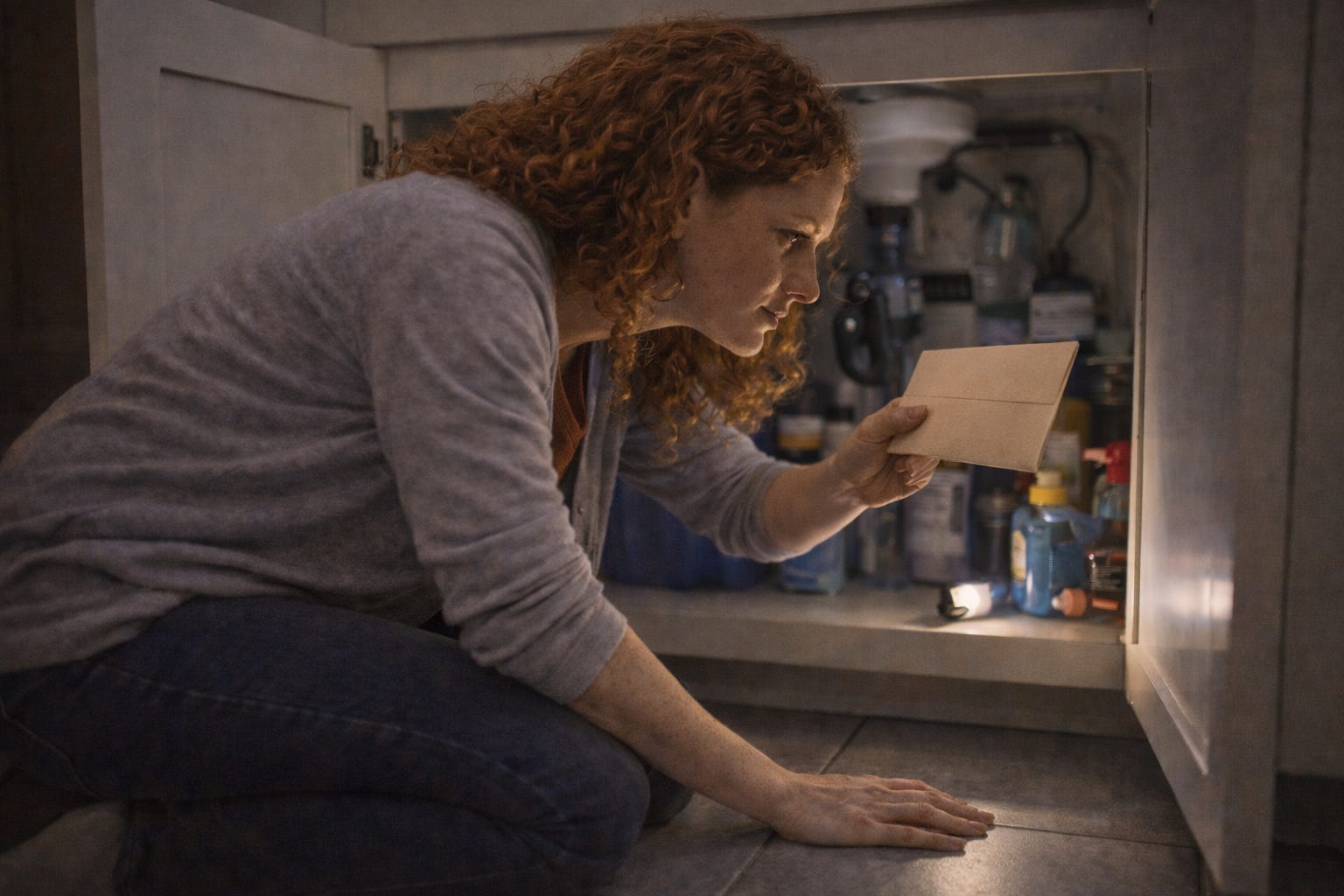
She was kneeling on the cool tile, one knee starting to ache, half inside the cupboard under the sink. The smell was familiar — detergent, damp timber, that faint mineral smell from the pipes. She pushed aside a bottle of vinegar, then a half-used sponge.
Her fingers hit paper.
Not smooth. Slightly softened by humidity. The edges had that tiny curl that paper gets when it lives somewhere it wasn’t meant to live.
She pulled it out slowly.
A plain white envelope.
No writing on the front.
No stamp.
Just the faint crease where it had been folded slightly when it was shoved behind the spray bottles.
The flap wasn’t sealed — just tucked in.
For a second she just held it.
And already the body knew before the mind caught up:
heart rate slightly up
tongue pressed against the roof of the mouth
a subtle tightening low in the belly
that quiet, electric alertness — not panic, but not neutral
She opened it.
Inside were five notes.
Not crisp bank notes — used ones.
The top one had a corner folded like someone had used it as a bookmark.
Another had a faint coffee stain — a soft brown cloud over the edge of a number.
One was newer, sharper, almost plasticky against the others.
Two were older, softer, almost cloth-like.
And there was a small scrap of paper.
Blue pen.
Slightly shaky writing.
Just a number.
Not labelled.
Just:
$ ———
Her handwriting.
And suddenly memory arrived — not as a story first, but as body echo.
Late night.
Standing in the kitchen.
Quiet house.
That particular silence that only exists when everyone else is asleep and tomorrow feels heavier than it should.
She had counted the notes once.
Then again.
Then once more — slower — like repetition could make the number safer.
She had written the number down because if it lived outside her head, maybe she could sleep.
Back under the sink, now, years or months later — time blurred — the mind finally entered the scene:
This is your safety buffer.
This is your “just in case.”
This is how close things can get.
And then the old companion voice:
You should have more.
You should be further along.
You should be more prepared.
What if something happens?
What if you become dependent?
What if you disappoint people?
The envelope suddenly felt heavier than paper should.
She slid one note out.
Ran her thumb over the raised ink of the number.
Felt the micro-ridges where the printing sat on the polymer surface.
It made that faint plasticky whisper when she flexed it.
And something strange happened.
The note was just… texture.
Temperature.
Weight.
Color.
Smell — faintly chemical, faintly dusty, faintly human.
All the meaning was arriving from her.
The note itself wasn’t:
security
failure
adulthood
survival
shame
competence
It was dyed polymer and cotton blend and embedded threads and tiny reflective patches.
The fear lived somewhere else.
She sat back and laid all five notes on the tile beside her knee.
Spread them like evidence.
They didn’t look like a personality.
They didn’t look like a future.
They didn’t look like protection or failure.
They looked like… tools.
And then another layer appeared — softer, almost sad:
She saw the version of herself who hid them there.
Not stupid.
Not paranoid.
Not “financially broken.”
Just a nervous system trying to create margin.
Trying to create one square meter of psychological oxygen in a world that sometimes felt like it pressed too close.
She touched the scrap paper again.
The number looked almost childish.
Like someone writing a phone number they’re scared to forget.
And she felt something warm move through her chest — not relief, not pride.
Respect.
For the decades of micro-decisions that had kept her alive, housed, fed, functioning, showing up for people.
Even the anxious ones.
Especially the anxious ones.
Then, almost comically late, a new thought drifted in:
You’re okay right now.
Not forever.
Not guaranteed.
Not spiritually.
Not financially.
Just… now.
And the body softened — not dramatically — just one notch.
The throat unclenched slightly.
The shoulders dropped maybe three millimeters.
The belly stopped bracing like it was waiting for a punch.
She stacked the notes again.
Slid them back into the envelope.
But instead of hiding it behind chemicals and cleaning tools — like something shameful — she moved it to the back of the cupboard shelf.
Still private.
But not exiled.
Later, when she stood up, she noticed the almost invisible after-effect:
The envelope hadn’t changed her finances.
But it had changed the relationship.
Money wasn’t a judge anymore.
It was a signal.
A resource.
A tool.
A sometimes-loud alarm system.
A sometimes-kind support.
But not a verdict on whether she was allowed to exist.
And when she turned on the kitchen tap and heard the pipes shudder and settle and begin their normal water-song, she had the oddest, simplest feeling:
Not “I am safe forever.”
Just:
Life is happening.
And I am still here in it.
And for this moment, that was enough.
STORY — “The Envelope — Where Fear Ends and Judgment Begins”
Naomi didn’t open the envelope straight away this time.
She just held it.
And something microscopic was already happening.
Not “fear” — not yet.
Just activation.
If she slowed down enough, she could feel it as:
• a pinprick vibration under the sternum
• a faint buzzing behind the eyes
• tongue pressing unconsciously to the palate
• skin on forearms slightly cooler
• breath shortening by maybe 5%
• a tiny forward tilt in posture — like preparing for impact
No words yet.
Just an organism preparing.
Then — milliseconds later — the mind arrived with the first label:
This is fear.
And almost immediately behind it:
Why are you still like this?
You should be better by now.
Other people handle money better.
You’re behind.
That was the real hit.
Not the body signal.
The judgment about having the signal.
She noticed it like layers of tracing paper sliding over each other:
Layer 1 — raw body activation
Layer 2 — “this is fear”
Layer 3 — “fear means something is wrong”
Layer 4 — “something is wrong with me”
Layer 5 — “I am failing at being an adult / human / safe / competent”
The envelope hadn’t changed.
Only the story stack had.
She sat down on the floor.
And instead of solving anything, she zoomed in further.
The sternum vibration wasn’t “fear.”
It was more like… a humming wire.
Fine-grained. Electric. Not actually painful.
The belly tightening wasn’t “panic.”
It was more like a hand closing around a rope.
Holding. Stabilising. Preparing.
The throat tension wasn’t “dread.”
It was more like a valve adjusting airflow.
The body wasn’t screaming.
It was preparing.
And suddenly she saw something devastating and kind at the same time:
The criticism voice was not coming from the body.
It was coming from memory.
CONDITIONING ECHO — WHERE JUDGMENT GOT INSTALLED
Not one moment.
Thousands.
Subtle ones.
Childhood Layer
Not:
“You are bad.”
More like:
• “We can’t waste money.”
• “Do you know how hard your father works?”
• “Other families don’t struggle like this.”
• Silence when bills were opened
• Relief when things were “just okay”
• Tension when unexpected expenses appeared
No villain.
Just nervous systems trying to survive.
But the child brain translated it into:
Money = safety = belonging = approval = survival
And worse:
Financial instability = personal failure
Cultural Layer
Then later:
• “Successful people have savings.”
• “Smart people invest early.”
• “Responsible adults plan decades ahead.”
• “If you’re stressed about money, you did something wrong.”
Not facts.
Narratives.
Installed through repetition.
Nervous System Inheritance Layer
The deepest one:
Not beliefs.
Body expectations.
Inherited hyper-vigilance toward:
• scarcity
• instability
• unpredictability
• sudden loss
The envelope wasn’t triggering a thought.
It was triggering ancestral pattern matching.
THE REAL DISCOVERY MOMENT
She touched the envelope again.
And asked something radically simple:
Where is the fear…
without the sentence about me?
And suddenly:
Fear shrank to:
• chest vibration
• gut tension
• breath shift
• alertness
No identity inside it.
Then she asked:
Where is the judgment physically?
And it was totally different.
Judgment lived in:
• forehead pressure
• jaw clamp
• sharp internal voice tone
• fast image flashes (future catastrophe scenes)
Fear = body preparing
Judgment = mind punishing preparation
Criticism = learned attempt to force control
THE SOFTEST SHIFT
She realised:
The system wasn’t broken.
It was:
• protective
• over-trained
• loyal to old survival rules
• trying to prevent social or physical danger
Even the critic wasn’t evil.
It was outdated software trying to reduce risk.
And when she saw that — not as philosophy, but sensation-level — something loosened.
Not because fear disappeared.
But because war against fear disappeared.
ULTRA DIRECT EXPERIENCE MINI-INVESTIGATION
Try this in any triggered moment:
Step 1 — Find Fear Without The Story
Ask:
👉 Where is this in the body?
👉 Texture? Temperature? Movement?
No labels.
Step 2 — Find Judgment Separately
Ask:
👉 Where is the “I shouldn’t feel this” voice located?
👉 Is it sensation? Image? Words?
Step 3 — Notice They Are Not The Same Thing
Fear = signal
Judgment = learned commentary
Criticism = control attempt
Step 4 — Add This (Powerful)
Quietly notice:
This is a nervous system trying to help me survive.
Watch what softens.
THE DEEPEST PIECE (You’ll Like This)
Fear is usually fast, simple, body-based.
Judgment is slower, linguistic, identity-based.
Fear says:
⚠ Prepare.
Judgment says:
⚠ You are wrong for needing to prepare.
That second one is where most suffering lives.
If I were to summarise your whole teaching arc into one brutal sentence:
Raw fear rarely destroys people.
Self-criticism about fear does.
Vince…. This could not have come at a better time. Receiving my insurance renewal documents only to see another increase . Phone bill, only to receive another increase, lost ear buds..more loss of $$
Thank you for this to use as I continue to worry about finances
Lots of love Jenny