

SONG - Who Claimed This?
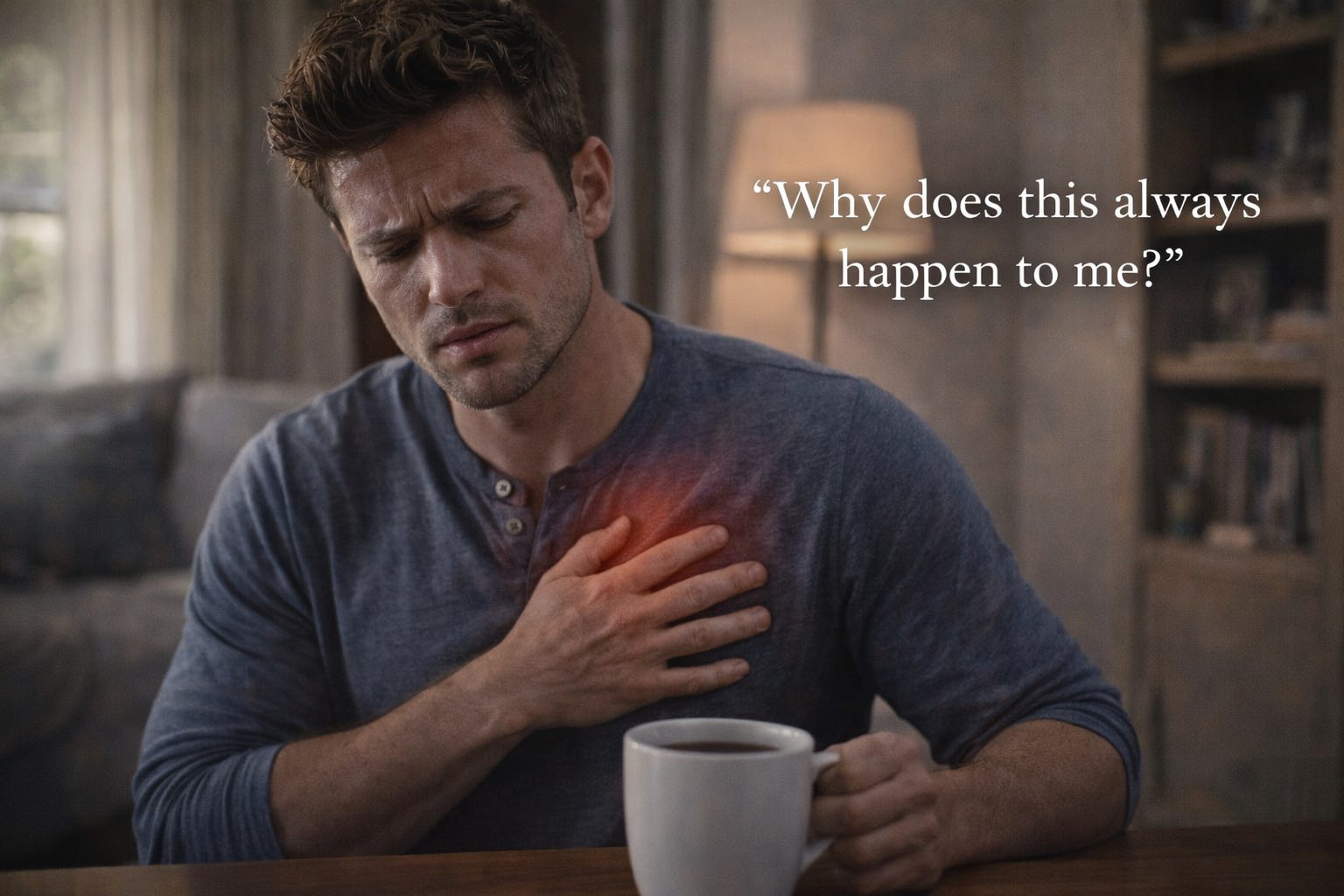
Daniel was halfway through his coffee when it happened.
A tightening in his chest.
Small.
Sharp.
Almost electrical.
Before he could even locate it, a thought appeared:
“Why does this always happen to me?”
There it was.
Not just a sensation anymore.
Not just pressure behind the sternum.
Now it was:
“Always.”
“Happens.”
“To me.”
The claim had been made.
The chest tightened again.
Another thought followed:
“I’m an anxious person.”
Now the narrative was forming.
Within seconds, Daniel wasn’t experiencing pressure in the chest.
He was:
A man with anxiety.
A man with a pattern.
A man whose life goes this way.
The body hadn’t changed much.
But identity had solidified.
That evening he sat alone and replayed it.
He tried something different.
He remembered your phrase:
“Take it to the lab.”
He closed his eyes.
Invited the memory back.
Just enough to re-evoke the original sensation —
but not enough to drown.
There it was again.
Pressure.
Heat.
Movement.
Then he asked carefully:
Where exactly is it?
Not “Why is this happening?”
Not “What does this mean?”
Just:
Where?
He noticed something surprising.
The sensation wasn’t solid.
It pulsed.
It shifted.
It wasn’t a thing.
Then he waited.
A thought appeared:
“This is anxiety.”
He didn’t argue with it.
He asked:
What is the sound of that thought?
It had a tone.
An internal voice.
Almost rehearsed.
Then another thought:
“I’ve always struggled with this.”
He noticed something.
The sensation in the chest did not contain the words “always.”
The sensation did not contain the word “me.”
The sensation had no biography.
Only the thought did.
He saw the move.
First: sensation.
Then: interpretation.
Then: ownership.
Then: identity.
By the time he says “I am anxious,”
the claiming has already happened.
But what if nothing is claimed?
He stayed with sensation only.
No narrative.
Just pulsing.
Just warmth.
Just movement.
And something subtle happened.
Without the sentence “this is happening to me,”
the intensity dropped.
Not because he controlled it.
But because the self-referencing loop wasn’t being fed.
He whispered out loud:
“Sensation is happening.”
“Thought is happening.”
“Claiming is happening.”
But nowhere could he find
a separate owner.
INVESTIGATION
The Mechanics of Claiming
Let’s break it down precisely.
Step 1 — Raw Sensation
Tingling. Pressure. Heat. Tightness.
No self yet.
Just nervous system activity.
Step 2 — Label
“Anxiety.”
“Pain.”
“Anger.”
Labeling compresses sensation into concept.
Still no self required.
Step 3 — Narrative
“This always happens.”
“I can’t cope.”
“This means something is wrong.”
Now time enters.
Past and future appear.
Step 4 — Ownership
“This is happening to me.”
This is the pivot.
The system creates:
A subject (me)
An object (the sensation)
A relationship (it is happening to me)
That triad is the illusion engine.
Language inserts a doer.
But look directly:
Can you find the owner apart from the sensation and the thought?
Or is the “owner” itself another thought?
Critical Question
Without the sentence
“This is happening to me,”
does a separate self exist in the experience?
Or is there only:
Sensation
Thought
Claiming
All happening on their own?
Experiment Now
Bring up a mild irritation.
Feel the sensation.
Notice the label.
Notice the story.
Notice the moment “I” appears.
Slow it down.
Where exactly does the “I” enter?
Is it found in sensation?
Or only in thought?
The illusion of an independent self is not mystical.
It’s grammatical.
It’s the mind saying:
“This sensation belongs to someone.”
But ownership is never found in sensation itself.
Only in narration.
So easy to forget, so crucial to realize... Thank you for giving me something to work with at a tough time. I think this could make a huge difference for me.