

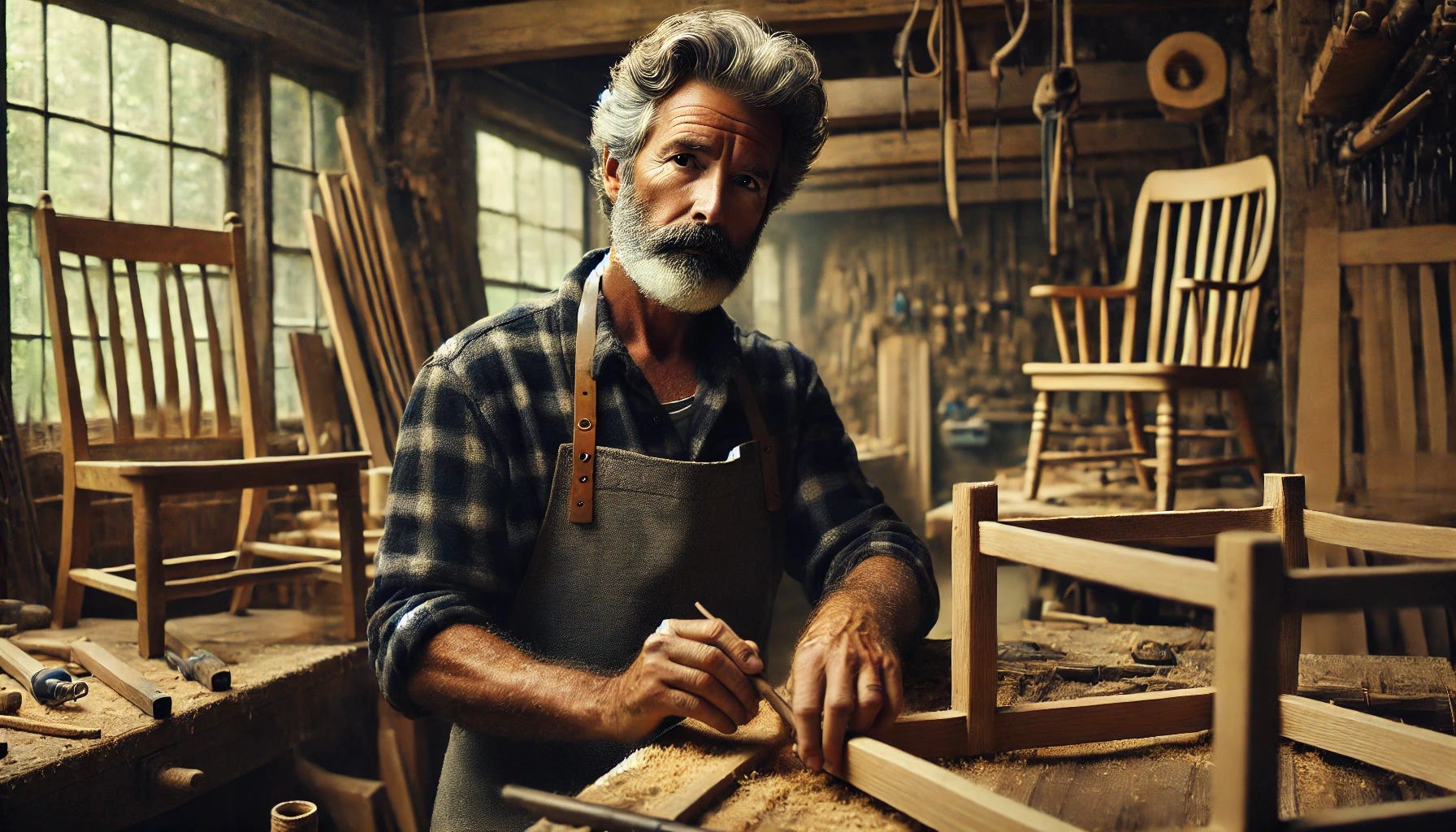
Eli had always hated Mondays. For thirty-two years, he punched in at the factory, stood beneath fluorescent lights, and tightened bolts on machines he didn’t understand. “Good pay,” they said. “Stable work.” And that was true—until the machines didn’t need him anymore.
The day the factory shut down, Eli didn’t speak. He just walked home, sat at his kitchen table, and stared at his hands—rough, tired, empty.
Weeks passed. He slept too much. Drank too much. The town buzzed about “retraining programs” and “AI transitions,” but Eli didn’t care. He wasn’t interested in becoming a software technician at 61.
One morning, something changed. It wasn’t dramatic. He just stood in the shed out back, where his grandfather’s old tools had gathered dust for decades. His hand touched a chisel. Muscle memory stirred.
He didn’t know why, but he dragged a plank of maple to the workbench and began cutting. Just cutting. Not to make anything. Not to start a business. Just to see what would happen.
Days slipped by unnoticed.
He shaped legs. Sanded edges. Tossed out failures. No blueprint. No goal. Only the hum of the blade, the curl of the wood, the smell of sawdust.
One afternoon, a chair sat finished in the light. Not perfect. Not symmetrical. But real. Solid. His.
Eli didn’t feel pride. He didn’t feel anything, really—except quiet. A deep, clean quiet. Like something that had always been holding on had finally let go.
His neighbor stopped by. “You make that?”
“Guess so.”
“You selling them?”
Eli shrugged. “Don’t know.”
Word spread. Orders came. He didn’t advertise. People just showed up. He never rushed. Never planned. Just worked when he worked, rested when he rested.
One customer asked, “What’s your brand about?”
Eli looked confused. “Brand?”
“Your mission. Your story. Your why.”
Eli paused. Then said slowly, “I just make chairs.”
“But why?”
Eli wiped his hands. “Because that’s what happens here.”
He tapped his chest once. Lightly.
Years passed. His chairs found homes all over town. Some said they were the most comfortable chairs they’d ever sat in. Others said there was something peaceful about them—like the wood itself had been listening while it was shaped.
But Eli never talked about that. He didn’t talk much at all.
He wasn’t happy in the way the world sells happiness. He didn’t meditate, didn’t journal, didn’t care about enlightenment. He never said words like “awakening.”
But when he worked, he wasn’t there.
There was just the curve of the grain.
The blade.
The sound.
The stillness.
No story. No identity. No striving.
And when he died, the town held a small gathering in the park.
They didn’t read from books.
They didn’t quote philosophers.
They just sat in his chairs.
In silence.
And one woman whispered,
“I don’t think he ever needed a purpose. I think he just… stopped pretending to need one.”
That’s it.
That’s the story.
No grand insight. No drama.
Just this:
The man lost his role.
Then lost the need for one.
And in the space where “Eli the worker” used to be,
life moved freely,
as craft, as presence, as chairmaking.
Not for meaning. Not for success.
Just because that’s what arose.
This is awakening.
Not a special state.
Not a spiritual badge.
Just the end of struggle.
And the beginning of what happens
when you stop trying to be someone.
And simply… begin.
🙏💖🫠