

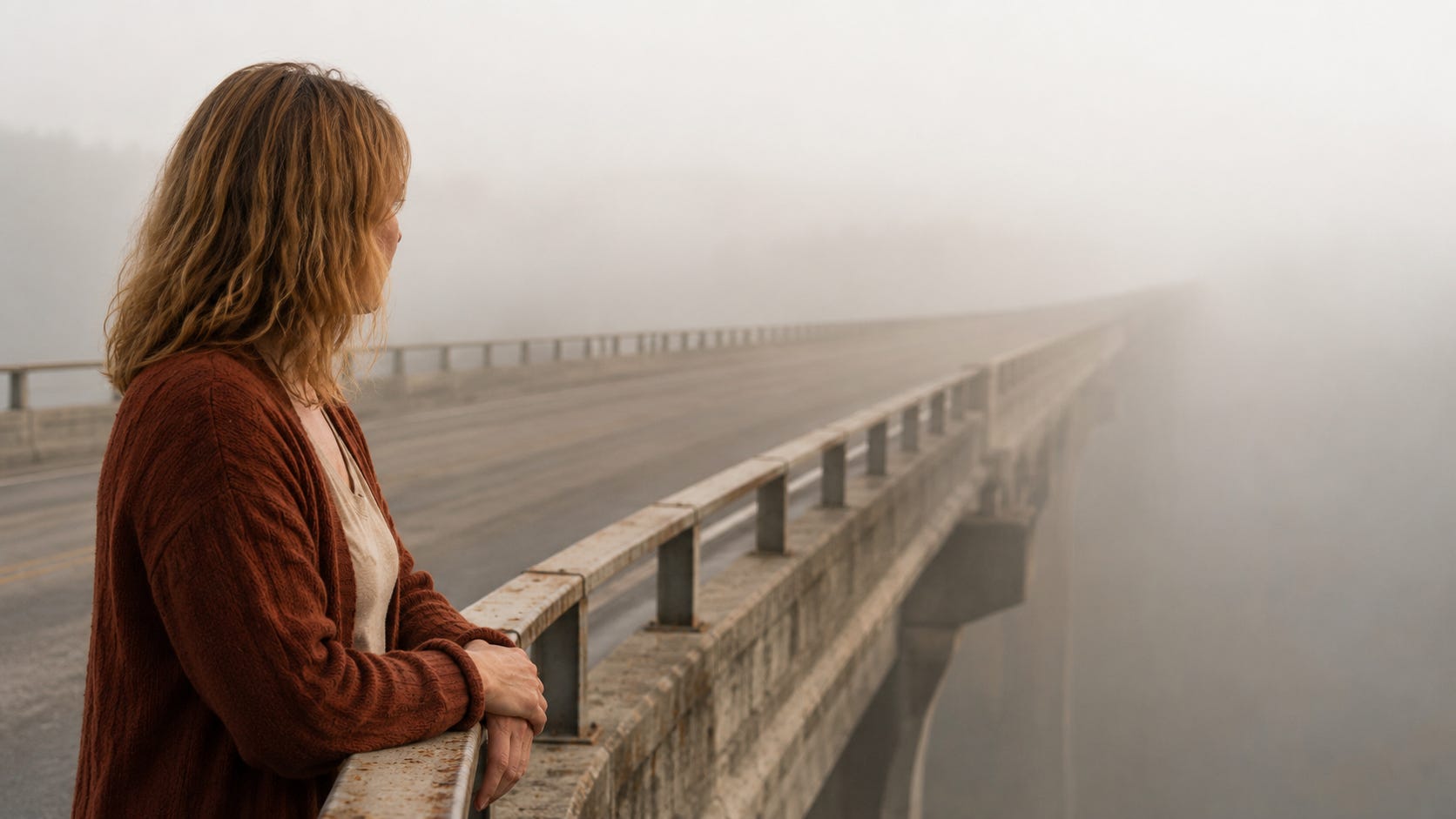
Uncertainty is not a defect to overcome; it is closer to the actual condition of life. Certainty is usually the story we build so the unknown feels manageable. This story catches that shift beautifully: suffering often clings to “knowing,” while not-knowing begins to feel less like danger and more like freedom.
This one feels especially central to the whole project: awakening as becoming comfortable with the fact that reality is vastly larger than anything the mind can know.
Song: The Bridge Without a Map
Clara did not like bridges she could not see the end of.
This had never been a problem with actual bridges.
Actual bridges were generally visible.
They had railings, signs, concrete, painted lines, traffic going in both directions.
You knew what they were for.
The bridge that troubled Clara was the one in her head.
It appeared whenever the future refused to explain itself.
What if the lease changed?
What if her sister stopped speaking to her?
What if she got sick?
What if the money ran short?
What if awakening never stabilised?
What if it did?
What if everything she thought she understood turned out to be wrong?
That last one had become especially persistent.
She was sitting in Elias’s garden one afternoon with Naomi, Daniel, and Carol.
A breeze moved through the bamboo along the fence.
Clara had been quiet for several minutes.
Then she said, “I think I’m getting worse at knowing things.”
Daniel looked up.
“That sounds promising.”
Clara gave him a look.
“I’m serious.”
“So am I.”
“I used to feel as if I knew who I was. I knew what mattered. I knew what I wanted. I knew which people were good for me and which weren’t. I knew what awakening was supposed to look like.”
“And now?” Naomi asked.
Clara shook her head.
“Now everything feels… uncertain.”
Elias smiled.
Clara noticed.
“Why are you smiling?”
“Because you said it as if uncertainty is something that has gone wrong.”
“It feels wrong.”
“That is different.”
Clara leaned back in the chair.
“I don’t know how to live without knowing.”
Elias pointed at the bamboo.
“Do you know what that will do in ten seconds?”
“No.”
“Do you know what thought will appear next?”
“No.”
“Do you know whether Daniel will say something annoying in the next thirty seconds?”
“Yes.”
Daniel laughed.
“Finally, certainty.”
The laughter loosened the moment.
Elias continued.
“Do you know how you will feel tonight?”
“No.”
“Tomorrow?”
“No.”
“Next year?”
“No.”
Clara sighed.
“I understand the point.”
“Do you?”
“Yes. Life is uncertain.”
“That’s a sentence.”
Clara looked at him.
“What do you want?”
“Look.”
She frowned.
“At what?”
“Uncertainty.”
“You can’t look at uncertainty.”
“Exactly.”
Clara went quiet.
Elias said, “What is here instead?”
She looked around.
Leaves moving.
Warmth on her arms.
A bird somewhere beyond the fence.
Daniel scratching his ankle.
Carol holding a mug.
A thought:
I don’t know what he’s getting at.
Then another:
Maybe that is the point.
She smiled slightly.
“There’s just this.”
“Yes.”
“And uncertainty is a story about what I don’t know.”
“Good.”
Clara paused.
“But the future really is uncertain.”
“Of course.”
“So that part is true.”
“Perhaps. But notice something. The future is not here as uncertainty. The future is here as thought.”
That landed.
The future did not arrive as a grey fog.
It arrived as sentences.
What if?
Maybe.
Suppose.
Later.
One day.
I hope.
I fear.
I need to know.
Clara closed her eyes.
The uncertainty she feared was made of images and bodily responses.
A picture of herself alone.
Tightness in the chest.
An image of money disappearing.
Pressure behind the eyes.
A thought:
What if I make the wrong choice?
Another thought:
I need to know before I act.
Elias said, “What does certainty feel like?”
Clara opened her eyes.
“What do you mean?”
“You say uncertainty feels dangerous. What does certainty feel like?”
She thought.
“Solid.”
“Where?”
“In the body?”
“Yes.”
She checked.
“When I think I know something, the body kind of stops questioning.”
“Interesting.”
“It feels firm. Settled.”
“So certainty has a bodily reward.”
Clara nodded slowly.
Daniel said, “Like putting a lid on a box.”
“Yes,” Clara said. “Exactly.”
Elias said, “Even if the box contains nonsense.”
Clara laughed.
“Yes.”
That was uncomfortable.
She remembered all the things she had once been certain of.
This relationship will last forever.
My mother understands me.
I need this career.
I am bad at conflict.
I cannot handle being alone.
Meditation is the answer.
Meditation is not the answer.
I am progressing.
I am failing.
All of those had once felt solid.
Some had dissolved completely.
Others had turned into their opposites.
Yet while they were believed, certainty had felt like truth.
Carol said, “Maybe certainty is not knowing. Maybe it’s the sensation of closing.”
Clara looked at her.
That was good.
Certainty as closing.
A conclusion.
A narrowing.
A door shut against further movement.
Elias nodded.
“And uncertainty?”
Clara thought.
“Open.”
“Does open feel safe?”
“No.”
“Why not?”
“Because anything can happen.”
Elias smiled.
“Anything has always been happening.”
Clara looked at the bamboo again.
The leaves moved differently now.
Not because they had changed.
Because she had stopped asking them to reassure her.
Naomi said, “Maybe uncertainty feels dangerous because we think certainty was protecting us.”
Clara felt something tighten in the belly.
Yes.
Certainty had been armour.
Knowing what kind of person someone was.
Knowing what would happen next.
Knowing what she should do.
Knowing what everything meant.
If she knew, she could prepare.
If she knew, she could defend.
If she knew, she could survive.
Elias said, “Did certainty actually prevent life from surprising you?”
“No.”
“Did knowing protect you from heartbreak?”
“No.”
“Did knowing stop illness?”
“No.”
“Did knowing prevent mistakes?”
“No.”
“Then what did certainty do?”
Clara was quiet for a long time.
“It made me feel as if someone was in charge.”
Elias nodded.
There it was.
The usefulness of certainty.
Not truth.
Control.
An imagined hand on the wheel.
Clara felt grief rise unexpectedly.
Not dramatic.
Just tender.
“I spent so much time trying to know.”
Naomi reached over and touched her arm.
Clara said, “I thought if I understood enough, I could finally relax.”
Elias said, “Perhaps relaxation begins when understanding is no longer required.”
The sentence moved through her slowly.
That felt backwards.
The whole life had been organised around:
Understand, then relax.
Solve, then rest.
Know, then move.
Be certain, then trust.
But perhaps the order was impossible.
There was always more unknown.
Always more outside the frame.
Always another consequence.
Another person.
Another variable.
Another hidden condition.
Life was too large for certainty.
That evening, they walked to a small footbridge near Elias’s house.
It crossed a creek that had swollen slightly from recent rain.
The bridge was narrow and curved through overhanging trees.
From the entrance, the far end could not be seen.
Clara stopped.
Daniel noticed.
“You hate this.”
“I don’t hate actual bridges.”
“You’re standing strangely.”
“I’m thinking.”
“That’s the problem.”
She laughed.
Then walked.
The first few metres were visible.
Then another few.
Water moved below.
The bridge curved.
There was no need to see the whole bridge.
Each step revealed enough.
Clara stopped halfway.
She looked back.
The entrance was partly hidden now.
Ahead, still no end.
She stood in the middle of a path she could not completely see in either direction.
The body tightened.
Then softened.
Not because she suddenly trusted the bridge.
Because she noticed the bridge had been carrying her while she wondered whether it would.
Daniel came beside her.
“What’s happening?”
“I don’t know.”
He smiled.
“Very advanced.”
She nudged him with her shoulder.
They kept walking.
The far end eventually appeared.
Nothing profound happened.
No revelation.
No voice from the sky.
Just the ordinary fact that the next part of the bridge became visible when they reached it.
Later that night, Clara woke at 2:17.
The old mind began.
What about the lease?
What about money?
What about your sister?
What if this uncertainty gets worse?
What if you never feel grounded again?
The body tightened.
Then she remembered the bridge.
Not as a technique.
As an image.
The mind wanted the far bank.
Life was offering one plank.
She lay still.
A car passed outside.
The refrigerator clicked on.
A thought came.
Then another.
She did not know what would happen tomorrow.
She did not know what awakening was becoming.
She did not know what she would feel in an hour.
And for once, she did not convert that into an emergency.
The unknown was not attacking her.
It was simply not known.
That was all.
Clara smiled in the dark.
The certainty had never been solid ground.
It had been a story about the ground.
The actual ground had always been this:
one breath,
one sound,
one thought,
one step,
then another.
And perhaps that was enough.
Investigation: Uncertainty Is What Is
We often treat uncertainty as a temporary problem.
The assumption is:
Once I know enough, I will feel safe.
Once I understand, I can relax.
Once I decide, I can stop worrying.
Once I know where this is going, I can trust it.
But life keeps refusing to provide final certainty.
That may not be a failure.
It may be the actual condition.
1. Certainty feels like knowledge, but often it is closure
Notice what happens when thought says:
“I know.”
The questioning stops.
The body may settle.
A conclusion forms.
The field narrows.
That can feel like truth.
But certainty and truth are not the same.
Many things once known with complete confidence later prove partial, mistaken, or obsolete.
Certainty may simply be the sensation of the mind closing around a conclusion.
2. Uncertainty is not an object
Look for uncertainty directly.
Can you find it?
What appears instead?
Thoughts about the future.
Images.
Tightness.
Prediction.
Not-knowing.
The future does not arrive as “uncertainty.”
It arrives now as thought-content.
This matters.
Because what feels like a vast threatening unknown is often a present thought saying:
“I don’t know what will happen.”
3. The mind wants certainty because certainty feels like control
If I know what happens next, I can prepare.
If I know who someone is, I can protect myself.
If I know who I am, I can behave correctly.
If I know what awakening is, I can reach it.
Certainty creates the image of a manager who understands the map.
But did certainty ever really control what happened?
Illness still came.
People changed.
Relationships ended.
Opportunities appeared unexpectedly.
Mistakes happened.
Life surprised.
The map did not control the territory.
4. The suffering person often thinks they know
There is a strange harshness in certainty:
This is terrible.
I cannot handle this.
I will always be like this.
They do not care.
I have failed.
This should not be happening.
Notice how suffering often comes with conclusions.
Not questions.
Conclusions.
The painful story says:
“I know what this means.”
Uncertainty loosens that.
Maybe I do not know what this means.
That small opening can change everything.
5. Not-knowing is not confusion
Not-knowing does not mean being incapable of practical thought.
You can know:
the appointment is at three,
the rent is due Friday,
this food is hot,
this person said these words.
Useful knowledge remains.
The deeper not-knowing concerns the story built around facts:
What does this mean for my whole life?
What will happen?
Who am I becoming?
Was this good or bad?
Where is all of this going?
There may be no final answer.
6. Uncertainty is openness
Certainty says:
This is what it is.
Uncertainty says:
I do not fully know.
That leaves room.
Room for more information.
Room for surprise.
Room for change.
Room for the other person not to match our image.
Room for the body to respond differently.
Room for life to be larger than the story.
This openness may initially feel frightening because it lacks walls.
But walls also limit.
7. The bridge reveals the structure
Imagine crossing a bridge whose far end is hidden.
Do you need to see the entire bridge before taking the first step?
Usually no.
The next plank is enough.
Then the next.
Life works like this far more often than the mind likes to admit.
We rarely receive the whole future.
We receive:
this conversation,
this sensation,
this option,
this response,
this day.
The mind asks for the far bank.
Life gives the next step.
8. Certainty creates identity
Identity requires knowing:
I am this kind of person.
I like these things.
I do not do that.
This is what happened to me.
This is what my life means.
These stories create continuity.
They are useful socially.
But when held tightly, they become confinement.
Not-knowing loosens identity:
Perhaps I do not need to know who I am.
Perhaps the current response does not define me.
Perhaps the next moment may surprise me.
9. Inquiry
When uncertainty feels uncomfortable, ask:
What exactly is uncertain right now?
Can uncertainty itself be found?
Or is there a thought about something not known?
What does the body do when it wants certainty?
Where does it tighten?
What conclusion would make the body feel safer?
Then ask:
Do I actually know that conclusion is true?
And finally:
What is available without knowing?
A sound?
A breath?
A practical next step?
A conversation?
Nothing at all?
Let that be enough.
10. Clean formulation
Uncertainty is not a flaw in life that certainty eventually repairs. Uncertainty is closer to the natural condition: most of what happens next is unknown. Certainty is often a story that gives the nervous system a temporary feeling of control. Awakening does not necessarily provide better answers; it weakens the demand for answers. The unknown stops being a threat and becomes the openness in which life continues to unfold.