

Song: Only Experiencing
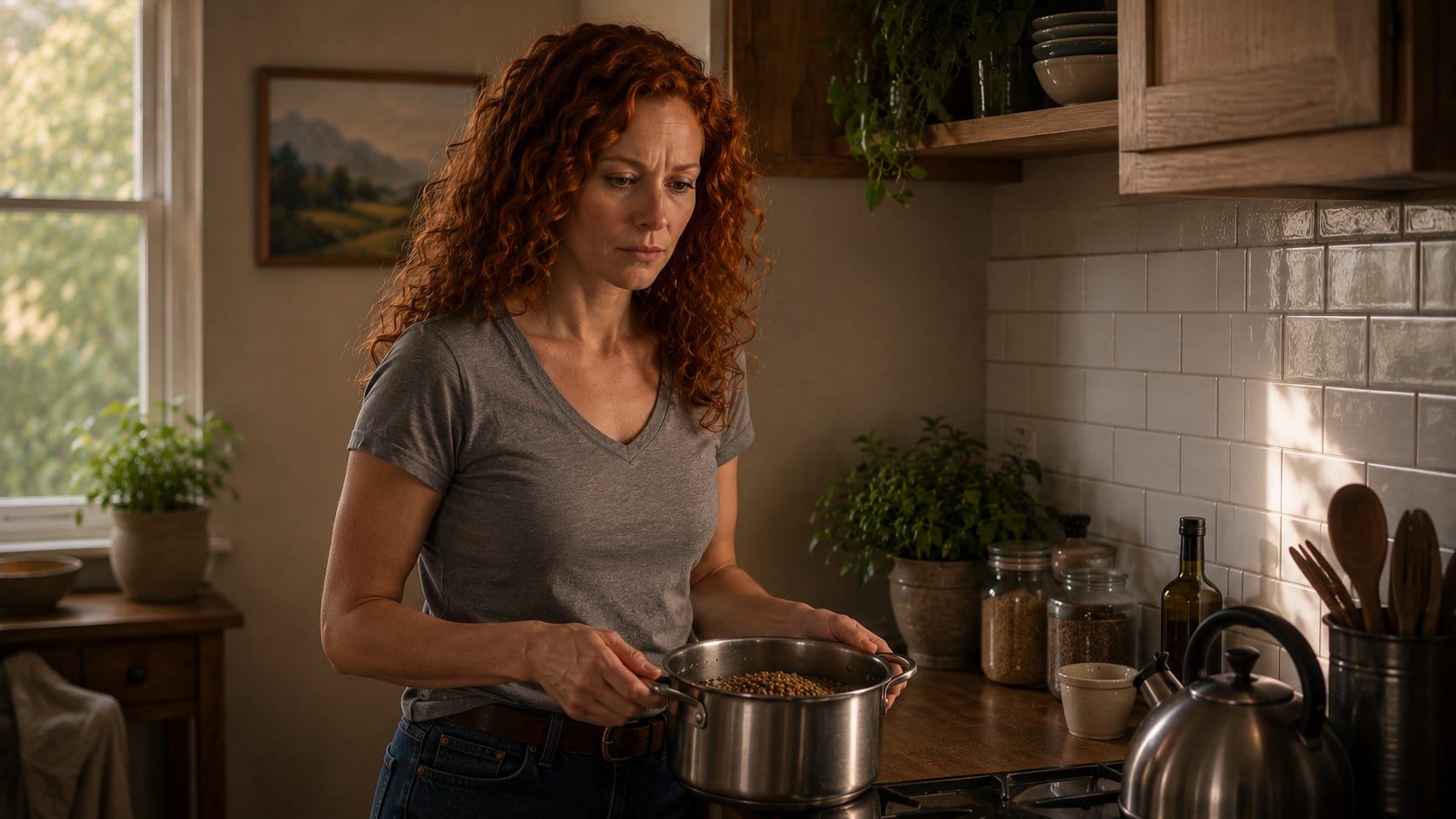
Naomi was halfway through an argument with someone who wasn’t there.
She was in the kitchen rinsing lentils under the tap, but inwardly she was in a very different room — a remembered room, or perhaps an imagined one. Someone had said something two days earlier, a comment small enough to seem harmless on the surface, but sharp enough to keep catching in her mind. She had replayed it all morning. Rewritten her response. Improved her tone. Then sharpened it again. By late afternoon the whole thing had grown dense and convincing.
The body had followed.
Jaw tight.
A pulling in the solar plexus.
Heat behind the face.
The familiar pressure of having been misunderstood.
She tipped the lentils into the pot and stood very still.
Something in her was tired of the whole performance.
Not the content — though that too. More the way it all kept becoming a world. A sentence remembered, then interpreted, then defended against, then woven into identity, until there she was again: the one who had been hurt, the one who needed to answer, the one standing in a reality shaped by thought.
She put both hands on the bench and looked.
Not at the story. At what was actually here.
Coolness in the fingers from the rinsed lentils.
Water sound fading in the sink.
Tightness in the throat.
Pressure in the chest.
The hum of the fridge.
A thought forming.
An image of the person’s face.
Another thought.
Heat in the belly.
Then suddenly, for no grand reason, the whole structure turned slightly inside out.
It was not: I am having this experience.
It was more like: there is only experiencing.
Not Naomi, standing apart from life, having sensations and thoughts and memories.
Just sensing.
Just hearing.
Just tightening.
Just image-ing.
Just thoughting.
Just this whole intimate verbing of life.
For a moment the shift was so simple she nearly missed it.
The argument lost its centre.
The story did not disappear. The remembered conversation still came. The imagined reply still flickered through. But now it was obvious that all of that was also just more experiencing. Not reality in itself. Not proof. Not a world to enter. Just story appearing now.
And because it was appearing now, its content dropped in importance.
Not permanently. Not absolutely. If she later chose to call the person or set a boundary or clarify something, then the content might matter. But in that moment, standing at the kitchen bench with the lentils waiting and the pot unheated, what mattered was much simpler:
Story was happening.
Which meant experiencing was happening.
And that was all that was actually given.
She felt a strange, quiet relief.
The mind had always been trying to get her to focus on what everything was about.
What this feeling means.
What that memory reveals.
What this reaction says about me.
What the other person intended.
What I should do.
But now the whole machinery looked secondary.
Aboutness was always one step after the fact.
Actuality was not in the explanation.
It was in the experiencing.
She stayed there a while, letting the insight move through without trying to pin it down. The body was still activated. The throat still held its tension. The thought-stream still tried to gather force. But none of it required a Naomi in the middle to own it.
It was all just happening.
And the “me” who seemed to live at the centre of it all was revealed, for a breath or two, to be part of the same display — another appearance, another thought-made reference point, another about.
The kettle clicked on by mistake where she must have brushed it earlier.
The sudden sound startled her, then made her laugh.
There it was again: sound, startle, laughter.
No owner required.
Later that evening she walked to the park.
The sky had that washed-out silver-blue look it sometimes gets before dusk. Children were shouting near the swings. A teenager on a bike was riding in slow loops with no hands. Naomi walked without trying to turn the walk into a practice. She was not watching herself. Not improving herself. Just noticing that experience kept arriving without needing to be framed.
Seeing.
Hearing.
Footstep.
Wind on cheek.
Memory.
Birdcall.
Thought.
Sadness.
Light on water.
More thought.
Each time the mind moved to say what it was about, she could feel the old contraction begin — the narrowing into significance, identity, continuity. And each time, not by force but by recognition, it softened again.
Aboutness was optional.
Experiencing was not.
At one point she sat on a bench and a grief image surfaced — her father’s hands in the hospital, pale and still under fluorescent light. The chest tightened immediately. Tears came with no warning.
For a second the old habit moved in:
This means I haven’t processed it.
This is about loss.
This is about how alone I felt.
This is about what should have happened.
All true perhaps, in their own register.
But before any of that, there was simply this:
image-now,
ache-now,
tears-now,
breathing-now.
The rest was commentary.
Potentially useful later.
But commentary.
She did not push the story away. She did not despise it. She simply saw it take shape and did not confuse it with the living fact from which it rose.
That changed everything.
Not by removing pain.
By removing the extra burden of mistaking narrative for reality.
The grief could move then.
Not as a chapter in Naomi’s life.
Not as an identity statement.
Not as evidence for anything.
Just griefing.
Just one more movement in the endless weather of experiencing.
She sat there until the tears passed.
Then there was cool air drying the face.
Distant traffic.
A dog pulling its owner across the grass.
The taste of salt at the corner of the mouth.
The first evening chill settling into the sleeves.
And in the middle of all that — or rather nowhere outside it — the plain, extraordinary fact that life did not need a narrator to be fully itself.
There was only experiencing.
Not “I am that.”
Not “this means I am consciousness.”
Not another polished conclusion.
Just this whole living happening before language fractures it into subject and object, before thought turns it into “me” and “my world,” before aboutness begins its soft takeover.
By the time Naomi stood to go home, the park had darkened. Lamps were coming on one by one along the path. Her phone buzzed in her coat pocket.
She glanced at the message, smiled, and slipped the phone back without answering yet.
A reply might come later.
The content might matter later.
Action might matter later.
But right now, what was true was only this:
buzzing,
walking,
coolness,
night-coming,
thinking,
aliveness.
Nothing needed to become a person’s problem quite so quickly.
Nothing needed to become a story before it was allowed to be felt.
She walked on under the lamps, one pool of light after another, while the mind kept offering meanings like little wrapped gifts she no longer felt obliged to open.
Investigation: There is only experiencing
This can be approached very directly.
The usual structure is:
I am here
experience is happening to me
thoughts are about things
feelings are about situations
memories are about the past
plans are about the future
This feels obvious because language and thought are built that way.
But if we look more closely, something simpler may be found.
1. What is actually given?
Right now, what is directly present?
sound
colour
bodily sensation
thought
image
emotion
memory appearing
anticipation appearing
These are all forms of experiencing.
But where is the separate “I” who is having them?
Usually what appears is another thought:
“I am hearing”
“I am anxious”
“I remember”
“I need to respond”
That thought then becomes part of experience too.
So the first shift is from:
I am experiencing
to:
there is experiencing
And then perhaps even more simply:
experiencing
2. The problem of “about”
Thought turns almost everything into aboutness.
this feeling is about what she said
this sadness is about childhood
this fear is about the future
this anger is about injustice
this desire is about what I need
Sometimes that content matters practically. Sometimes action is needed. But before action, and before interpretation, what is here is not “aboutness.” It is experiencing.
The story may arise.
If so, that too is being experienced.
The content may become relevant later.
But its relevance is secondary to the fact that it is currently appearing.
3. Why this matters
Aboutness quickly recruits identity.
The moment something is “about” something, the mind builds:
a knower
a sufferer
a judge
a responder
a self in relation to content
This is the subject-object structure coming online.
But if what is actually here is just:
tightness
image
thought
heat
memory
sadness
then much of the extra structure is added after the fact.
4. “What it is about” may be irrelevant — for now
This is important.
Not forever.
Not absolutely.
Not as a denial of practical life.
But in the immediate moment, before response is required, the content is often irrelevant.
For example:
a thought about failure appears
a memory image appears
shame arises in the body
Before deciding what it means, before unpacking biography, what is actual is:
thought appearing
image appearing
shame-sensation appearing
The rest is commentary.
That commentary may help later if a conversation, boundary, or decision is needed. But if it arrives too early, it often replaces direct contact with concept.
5. The self as another “about”
Even “I” may be a form of aboutness.
The thought “this is happening to me” is already interpretation.
It is a story about experiencing.
And if that story is present, then what is actual is still just:
thought
sensation
ownership-feeling
identity-feeling
All of which are more experiencing.
6. Questions to test
Right now, what is actual before naming?
Is there anything here other than experiencing?
If a story is present, is the story itself not just another experience?
What changes when content becomes secondary and experiencing primary?
Does suffering intensify when the mind moves quickly into “what this is about”?
Can there be a pause in which thought is allowed, but not believed as the core reality?
7. Clean formulation
What is directly actual is experiencing. Thoughts, memories, emotions, and stories may all arise, but they are themselves forms of experiencing rather than access to an independent reality outside it. The moment thought turns what is happening into “about” something, interpretation has begun. That content may later matter for practical response, but in the immediate moment it is secondary. What is primary is simply that experiencing is happening.
8. Blunt version
There is only experiencing.
Everything else is about it.
9. Practical edge
This is not meant to make life abstract or detached.
It is meant to simplify.
When caught in suffering, instead of asking:
What does this mean?
Why is this happening?
What is this about?
What does this say about me?
there may be relief in seeing:
experiencing is happening
story is happening
reaction is happening
Then, later, if a response is needed, respond.
But first:
actuality.
Then story.