

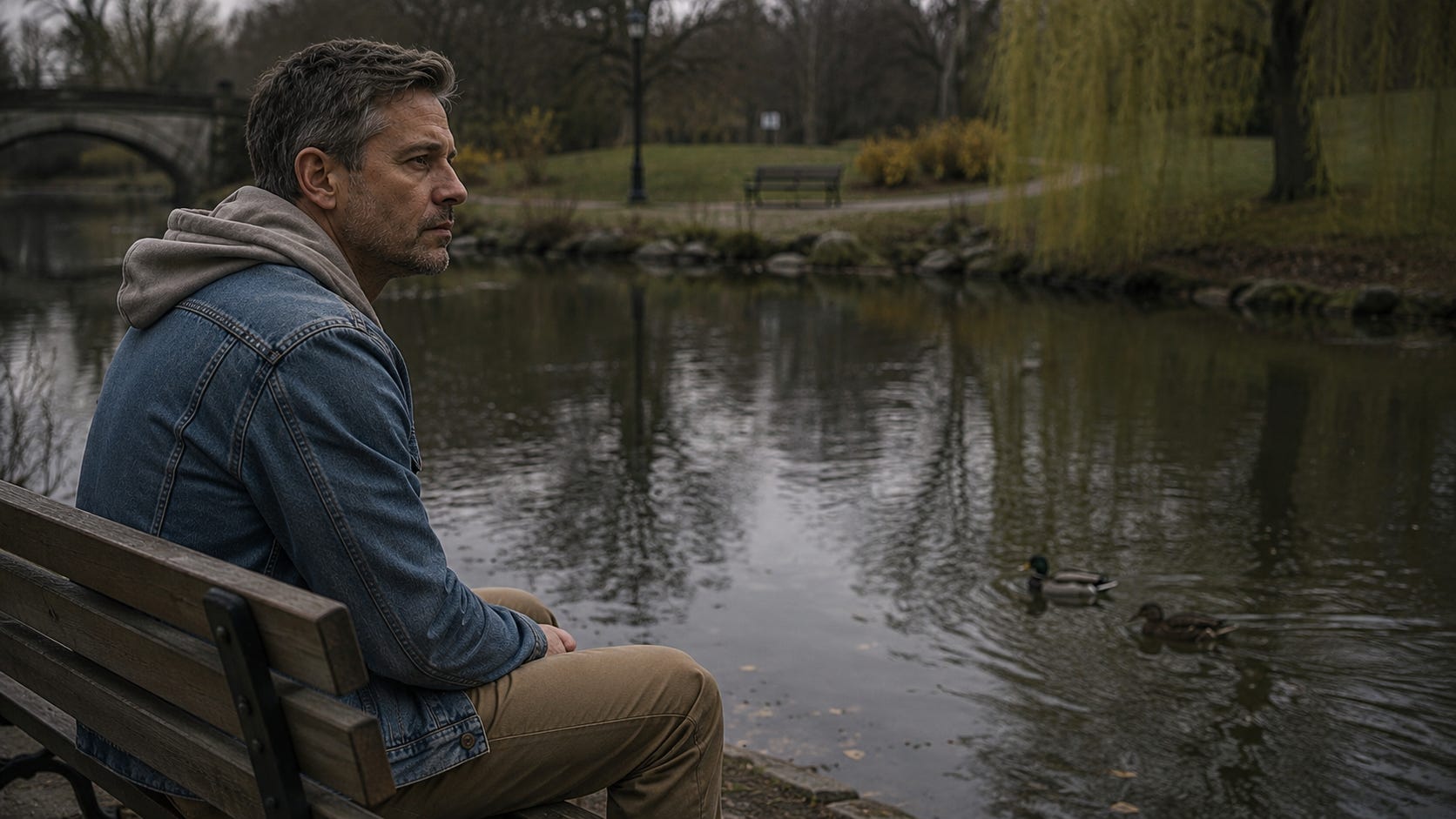
Song: Stranger on a Bench
Elias had not meant to speak to anyone.
He had gone to the park because his head was too full and his room felt used up. Too much reading, too much thinking, too much circling. His project notes had dissolved into underlined sentences and half-formed arguments. Nothing was landing. Everything felt slightly stale.
He sat on a bench near the pond and watched two ducks move through the grey-green water with insulting ease.
The old feeling was there again — not dramatic, not even especially painful, just the familiar sense of being sealed inside himself. As if life were happening right there in front of him, but through a pane of glass. He could see it, understand it, even describe it, but not quite join it.
A thought came, as thoughts do:
You should be meditating.
Another followed:
Or Inquiry. Or something useful.
Then:
Or maybe just go home.
Instead he stayed where he was.
A man lowered himself onto the far end of the bench with the slow care of someone negotiating with his own knees. He was older, maybe late seventies, wearing a beige cap and holding a paper cup of coffee with both hands.
For a minute or two they said nothing.
Wind moved lightly through the trees. Somewhere behind them a child shouted. A dog barked, then barked again with greater conviction.
Then the man said, without looking at Elias, “Those ducks seem calmer than the rest of us.”
Elias smiled before he could stop himself.
“They’ve probably accepted the situation.”
The man laughed, a dry, surprised sound, as if laughter had escaped him by accident.
“That must be nice,” he said.
There was nothing special in the exchange. Two lines. Barely a conversation. And yet something in Elias softened immediately.
Not because the man had said anything profound.
Because the bubble had thinned.
That was the only way he could describe it afterward. The little sealed world of “me in here, life out there” lost some of its pressure. The moment no longer felt like his afternoon with his heaviness and his problems. There was just the pond, the ducks, the old man with coffee, the shared amusement, the breeze.
Simple.
Unmanaged.
Alive.
The man took a sip, grimaced slightly, and said, “Too hot when they give it to you, too cold by the time you can drink it.”
Elias laughed again. “That’s basically life.”
The man turned then and looked at him properly.
“You’re either very young or very tired to know that already.”
“Both,” Elias said.
That made the man nod, as if something had been confirmed.
They began to talk.
Not deeply, not in the way people imagine meaningful conversations ought to go. No confessions, no dramatic life stories. Just ordinary things at first. The weather. The council’s strange choice of plants near the path. The number of dogs in the park compared to twenty years ago. But there was a strange ease to it, an intimacy without weight.
Elias noticed that while he was listening, the old self-concern kept slipping its grip.
When the man spoke about his late wife, not sentimentally but as if mentioning weather patterns still active in the air, Elias felt his chest tighten with tenderness. When he described how, after she died, strangers had sometimes been easier to talk to than friends because they did not already know who he was supposed to be, Elias felt something ring inside him.
That line stayed.
Strangers had no ready-made Elias to reflect back at him. No role. No history. No accumulated self-image to maintain. For a few moments, speaking to this man, he did not feel like a person carrying the usual bundle of identity. He felt less fixed.
More like life meeting life.
The man said, “Funny, isn’t it? You can spend years building a life and then one day a stranger on a bench feels more real than half the conversations you’ve had all month.”
Elias looked out at the pond.
“Yes,” he said. “It is.”
What he did not say was that something else had become visible too: how much of his suffering depended on continuity. The story of himself. His past, his patterns, his worries, his project, his unfinished becoming. Yet here, in this small exchange, none of that had much weight. Not gone exactly. Just not central.
The old man finished his coffee and crumpled the cup slowly.
“Well,” he said, standing with effort, “good luck with being very young and very tired.”
“Good luck with the ducks,” Elias said.
The man smiled and walked off toward the path, one hand in his pocket, shoulders slightly bowed.
Elias stayed on the bench a while longer.
The pond was unchanged.
The ducks were still ducks.
The project was still waiting at home.
The mind would still resume its commentary soon enough.
And yet something had shifted.
Not because the stranger had fixed anything.
Not because conversation was a technique.
But because, for those few minutes, the usual enclosure of self had relaxed. The boundary had become more porous. There had been less management, less self-reference, less trying to become.
Just contact.
Just this.
He thought then that perhaps one reason people enjoy talking to strangers more than they expect is that strangers temporarily interrupt the burden of being oneself. Not by erasing the self, but by loosening the performance of it.
With friends, family, colleagues, the old identity comes preloaded.
With a stranger, something fresher is possible.
Not always.
But sometimes.
And in that freshness there can be a tiny taste of what awakening points to: the falling away of the heavy, repeated story of “me,” leaving life free to meet itself more directly.
A gust of wind scattered ripples across the pond.
One of the ducks dipped its head completely under and came up shining.
Elias stood, stretched, and started walking home.
He could already feel thought gathering again — the project, the schedule, the unfinished tasks, the old vague dissatisfaction. But the afternoon no longer belonged to it entirely.
Some little opening remained.
A stranger on a bench.
A joke about ducks.
A few minutes without the full weight of himself.
Nothing dramatic.
But enough to show that the bubble was thinner than it seemed.
Investigation: Why talking to strangers can matter in awakening
The surface claim is simple: people often enjoy talking to strangers more than they expect.
But within an awakening frame, something deeper may be going on.
1. The ordinary prediction
The mind predicts:
awkwardness
effort
social risk
nothing much of value
So it tends to avoid spontaneous contact.
Why?
Because the self-system prefers the familiar. It likes known roles, known outcomes, known identities. A stranger is unpredictable.
2. What actually happens sometimes
When a real, simple conversation with a stranger occurs, there can be:
freshness
curiosity
less role maintenance
less history
less repetition of the usual self-story
This can feel surprisingly alive.
Not because strangers are magical.
Because the usual identity structure may not be as active.
3. Stranger as interruption
With people who know us, interaction is often loaded with continuity:
who I have been
who they think I am
what is expected of me
our established emotional positions
With a stranger, that continuity is thinner.
There is less accumulated self to defend, perform, or manage.
So for a moment, experience may be less organized around “me and my story” and more around simple contact:
hearing
responding
noticing
relating
This can become a small moment of dis-identification.
4. The awakening relevance
Awakening, in the way we often speak of it, is not primarily about becoming special or spiritual. It is about the loosening of the assumed central self and the recognition of immediate life as it is.
A spontaneous conversation with a stranger can occasionally support that because it reveals:
how much identity is habitual
how much aliveness returns when role relaxes
how fresh contact can be when the old narrative is not heavily loaded
So the conversation is not “the practice.”
It is more like an accidental doorway.
5. Why it feels better than predicted
Part of the reason may be this:
The mind predicts based on self-protection.
The actual conversation may be lived from something simpler than self-protection.
Prediction says:
“This could be uncomfortable.”
Reality sometimes shows:
“This is just life meeting life.”
That gap matters.
6. Questions to explore
What self-image becomes active before speaking to a stranger?
What is being protected?
In the actual moment of simple contact, is that self-image still central?
Does the conversation feel fresh because there is less past in it?
Can direct human contact reveal how much of ordinary suffering depends on maintaining a narrative self?
7. Clean formulation
Talking to strangers can sometimes be unexpectedly enjoyable not only because the conversation is pleasant, but because it briefly loosens the usual self-structure. Without the heavy continuity of role, history, and expectation, there may be a fresher kind of contact. In awakening terms, such moments can reveal how much aliveness returns when the burden of “me” softens, even briefly.
8. Practical edge
This is not about forcing sociability.
It is about noticing something:
Sometimes a simple human exchange quietly punctures the sealed world of self-concern.
And in that puncture, life feels immediate again.
This is probably what happens when I'm together with my demented friend, just connection, precious hours. It's good to see that. Thank you.
"The mind predicts based on self-protection." and the dynamics of 'self concern' - not heard of this before. These sounds real in experience. More to look and discover. ❤️ Vince