

Song: Nobody wakes up like you
There is no standard nervous system, history, temperament, set of conditions, or way awakening must express itself. One person becomes quieter; another more animated. Seeking may collapse suddenly or fade awkwardly. Self-sense may remain strong or become faint. Old conditioning may roar or barely whisper. Comparison can reveal possibilities, but the moment another person’s experience becomes the ruler against which this experience is measured, description has quietly become prescription. Then something perfectly natural begins looking deficient.
Short story: Two tables by the sea
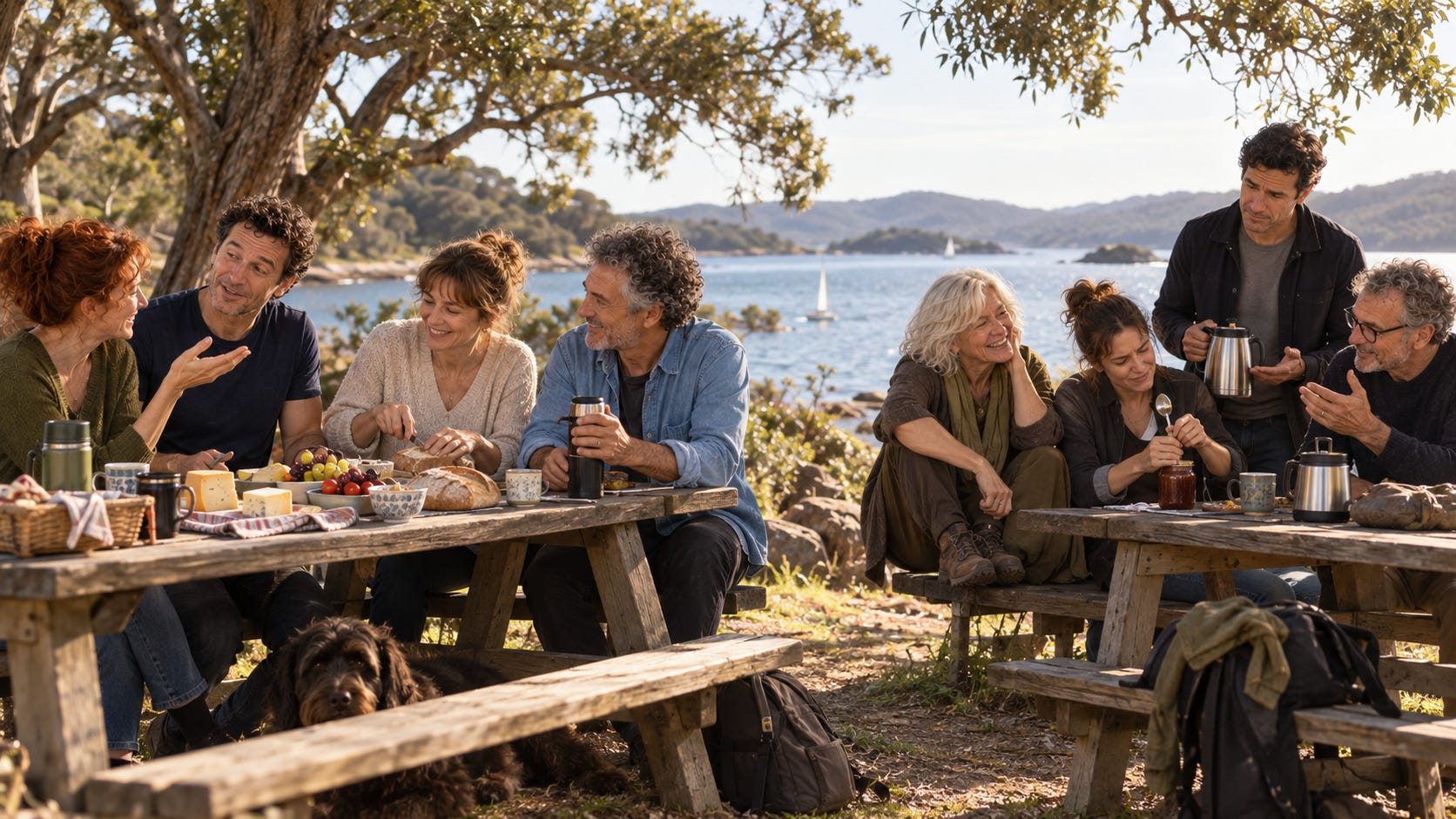
By the third gathering, the eight of them had stopped behaving like one new group.
They had become two old groups temporarily occupying the same picnic area.
Naomi noticed first.
The original four had taken the table nearest the water.
Not deliberately.
Elias was unpacking coffee.
Clara was cutting bread.
Daniel was complaining that Naomi had brought three kinds of cheese and no knife suitable for any of them.
Naomi was telling him that civilisation had survived worse.
Nobody had assigned these roles.
They had simply resumed being themselves together.
Twenty metres away, the newer four had claimed another table.
Maeve was sitting on it rather than at it.
Tess was trying to open a jar by hitting the lid with a spoon.
Ravi was explaining that hot water would expand the metal.
Jonah was standing between them holding the kettle and looking uncertain about whether intervention was required.
Naomi watched for a moment.
“They have a different ecosystem.”
Elias looked over.
“Good.”
Tess hit the jar again.
Maeve said, “I think it’s frightened now.”
Ravi took the jar.
“There’s a mechanical reason this works.”
Tess handed him the spoon too.
“For backup.”
Jonah looked towards the other table.
Naomi was laughing.
Clara had already produced lunch.
Daniel was pouring coffee.
Elias was doing almost nothing.
They seemed easy together.
Jonah felt something small tighten.
Maeve noticed.
“What?”
“Nothing.”
“Good. Those are usually interesting.”
Jonah nodded towards the other four.
“They look…”
“Older?”
“Settled.”
Maeve followed his gaze.
The old group were now arguing about whether Daniel had taken the good mug.
“They look settled?”
“You know what I mean.”
Maeve did.
That was the problem.
Jonah watched Elias.
Older.
Calm.
Almost no apparent self-consciousness.
Then Naomi.
Loose.
Alive.
Comfortable in her body.
Clara.
Emotionally open without looking overwhelmed.
Even Daniel seemed relaxed inside his analysis.
Jonah looked back at himself.
Six months after awakening and still defensive at work.
Still occasionally jealous.
Still hurt by criticism.
Still capable of waking at three in the morning convinced that something had gone wrong.
Maeve said:
“You’re doing arithmetic.”
“What?”
“Six months versus however long they’ve been at it.”
“I wasn’t.”
“You had the face.”
“What face?”
“The spiritual spreadsheet face.”
Tess looked up.
“I’ve seen Ravi do that.”
“I do not have a spreadsheet face.”
“You absolutely do.”
At the other table Daniel was watching Ravi explain jar physics.
“He reminds me of me.”
Naomi said:
“Oh God. Don’t tell him.”
“I mean the analytical tendency.”
“Yes.”
“The need to understand mechanisms.”
“Yes.”
“The way thought can turn Inquiry into—”
Naomi held up her hand.
“Daniel.”
“What?”
“You’re comparing again.”
“I’m identifying similarities.”
“Of course.”
Daniel looked back at Ravi.
“But there clearly are similarities.”
“Yes.”
“So comparison can be useful.”
“Absolutely.”
Daniel waited.
Naomi bit into a piece of cheese.
“That’s it?”
“What else do you want?”
“I thought you were going to tell me comparison is bad.”
“No. Cheese is good. Comparison is useful. Knives are useful. You still shouldn’t stab Ravi with one.”
Eventually the jar opened.
Not through Ravi’s hot-water method.
Tess twisted it after he handed it back.
Everyone stared.
“I loosened it,” Ravi said.
Maeve nodded solemnly.
“History will remember your sacrifice.”
The groups merged for lunch.
Not evenly.
The old four sat together without thinking.
The new four did the same.
Eight people.
Two rhythms.
Tess noticed.
“Are we segregated?”
Everyone looked down.
She was right.
Maeve laughed.
“We’ve invented spiritual tribalism in three meetings.”
Naomi picked up her plate and moved beside Tess.
“There. Integration.”
Daniel moved next to Ravi.
“Predictable,” Naomi said.
Clara sat beside Jonah.
Also predictable.
That left Elias and Maeve facing one another.
Maeve looked at him.
“So apparently you’re my equivalent.”
“Why?”
“We’re both old.”
“Compelling.”
“And allegedly awake.”
“Dangerous evidence.”
“And everyone expects us to say wise things.”
Elias nodded towards Tess.
“She doesn’t.”
“I like her.”
Conversation wandered.
That was when Ravi made the mistake.
It was not a serious mistake.
Nobody was injured.
He simply asked Elias:
“After the shift for you, did seeking disappear immediately?”
Elias thought.
“No.”
“How long?”
“I don’t know.”
“Weeks? Months?”
“Probably both.”
Ravi frowned.
“That doesn’t make sense.”
“Most accurate things don’t when you insist on a timeline.”
Daniel smiled.
Ravi continued.
“Was there still a felt sense of being located behind the eyes?”
“Yes.”
“For how long?”
Elias looked at him.
“Ravi.”
“Yes?”
“What are you going to do with the answer?”
That stopped him.
Tess looked delighted.
Maeve looked sympathetic.
Ravi sighed.
“I suppose compare it.”
“To what?”
“My experience.”
“And if mine was different?”
“I’d wonder what that means.”
“And if mine was the same?”
“I’d probably feel reassured.”
Elias nodded.
“So either way I become a measuring device.”
Ravi rubbed his forehead.
“Comparison’s a bitch.”
Maeve raised her cup.
“Now you’re learning.”
Jonah said quietly:
“I do it too.”
Clara looked at him.
“With Maeve?”
“With everybody.”
He hesitated.
“I thought after seeing through self there’d be less self-sense.”
Maeve shrugged.
“There might be.”
“There hasn’t been much.”
“Okay.”
“And sometimes I hear someone say theirs disappeared almost completely.”
“Okay.”
“And then…”
“You fail the exam.”
“Yes.”
Maeve put down her cup.
“Whose exam?”
Jonah laughed softly.
“I know.”
“No. Don’t ‘I know’ it. Look at the stupidity of it.”
Her tone wasn’t harsh.
Almost affectionate.
“You have your nervous system. Your childhood. Your relationships. Your fears. Your habits. Your particular Tuesday afternoons. Then you hear somebody else’s report and suddenly their Tuesday becomes the standard for yours.”
Jonah looked out at the water.
“That’s exactly what I do.”
Ravi said:
“But surely there are common characteristics.”
“Of course,” Elias said.
“So comparison has some validity.”
“Yes.”
Ravi waited for the contradiction.
None came.
Elias continued:
“If somebody says awakening made them physically levitate, I’d probably remain curious.”
Tess smiled.
“If someone says no actual owner can be found, that may be worth looking at.”
Ravi nodded.
“But?”
“No but.”
Maeve leaned in.
“Comparison’s not the bitch.”
Everyone looked at her.
“What is?” Tess asked.
“The ruler.”
She picked up Daniel’s butter knife.
“Suppose this is twenty centimetres.”
Daniel corrected her.
“About seventeen.”
Maeve looked at him.
“Thank you, Daniel.”
She laid it beside Tess’s forearm.
“Now imagine deciding Tess’s arm is defective because it isn’t seventeen centimetres.”
Tess looked concerned.
“I’d hope not.”
“Same problem.”
Maeve pointed towards Jonah.
“Someone says their self-sense vanished.”
Towards Ravi.
“Someone says seeking stopped overnight.”
Towards herself.
“Someone says fifteen years later they barely think about awakening.”
Then Elias.
“Someone else says something completely different.”
She put down the knife.
“Useful reports.”
She tapped it.
“Terrible rulers.”
Clara had been quiet.
She said:
“I did something similar with Naomi for years.”
Naomi looked surprised.
“You did?”
“You seemed much more embodied than me.”
“I was?”
“To me.”
Clara continued.
“So whenever I got caught in emotional stories, I thought I was doing this badly.”
Naomi’s face softened.
“I compared myself to you.”
“What for?”
“Because you felt things so directly.”
They stared at each other.
Daniel laughed.
“This is excellent.”
Both women looked at him.
“You were each using the other as evidence of deficiency.”
Clara smiled.
“That does sound like us.”
Tess looked around.
“I’m the only one who isn’t doing this.”
Seven faces turned towards her.
She reconsidered.
“All right. What am I comparing?”
Maeve answered immediately.
“Your ignorance.”
“My what?”
“You think Ravi knows more.”
“He does.”
“He knows more concepts.”
“That’s knowledge.”
“Yes.”
“And Elias has been doing this longer.”
“Yes.”
“And Jonah has already awakened.”
“Apparently.”
Tess looked around the table.
“So?”
“So notice what happens when you conclude they therefore have better access to what is happening here than you do.”
Tess became quiet.
That landed.
A gull dropped from somewhere above and stole half of Daniel’s sandwich.
Daniel shouted.
Naomi laughed.
Ravi jumped.
Tess ducked.
Jonah froze.
Clara gasped.
Maeve applauded.
Elias watched the gull leave.
Eight responses.
One gull.
Tess looked around.
Then started laughing.
“There.”
“What?” Jonah asked.
“Same event.”
Eight bodies.
Eight histories.
Eight reactions.
Nobody had selected theirs.
Maeve smiled.
“Better than a lecture.”
Daniel looked at his missing sandwich.
“I preferred the lecture.”
They stayed another two hours.
The two group rhythms never disappeared.
The original four had history.
Their jokes landed quickly.
They knew when Daniel was disappearing into theory.
They knew when Clara needed space.
They knew Naomi’s laughter could sometimes cover tenderness.
They knew Elias’s silence was not necessarily wisdom.
Sometimes he simply had nothing to say.
The newer four had a rougher rhythm.
Maeve punctured solemnity.
Ravi supplied solemnity again.
Tess asked questions nobody had prepared for.
Jonah hovered between relief and concern, still learning what six months after awakening was supposed to look like—and slowly discovering that supposed to might be the problem.
Neither group was better.
They were becoming themselves.
As they packed up, Jonah approached Elias.
“One question.”
“Go on.”
“Do you think I’m where I should be six months after awakening?”
Elias looked at him.
“No.”
Jonah’s face fell.
Then Elias smiled.
“I don’t think there is a where-you-should-be.”
Jonah laughed.
“That’s annoying.”
“Good.”
Ravi joined them.
“So there really is no map?”
Elias considered.
“There are maps.”
“But?”
“They show where somebody else walked.”
Ravi looked towards the path back to the cars.
Eight people already taking slightly different routes around a puddle.
Same destination.
Different steps.
Maeve called from ahead:
“Stop trying to become Elias!”
Ravi shouted back:
“I wasn’t!”
Tess yelled:
“You had the face!”
And both groups laughed.
Separately.
Together.
Not quite one thing.
Not needing to be.
Long story: Eight weather systems
The first unmistakable difference between the groups appeared during rain.
They had arranged a weekend afternoon at a rented cottage near the coast.
The forecast said showers.
The sky said otherwise.
At two seventeen it opened.
Not rain.
A wall.
Water hammered the roof.
The deck vanished behind grey.
The garden became a shallow lake.
The power went out.
For three seconds nobody moved.
Then eight different histories took over.
Daniel reached for his phone.
“No reception.”
Naomi went to the window.
“This is magnificent.”
Clara checked whether the back door was leaking.
Elias found candles.
At the other end of the room Ravi asked whether there was a circuit breaker.
Jonah began moving cushions away from the window.
Tess opened the front door.
Maeve shouted:
“Close that!”
Tess laughed into the rain.
“I wanted to see it.”
“You can see it through the enormous transparent invention beside you.”
Tess closed the door.
Within five minutes the old group had fallen into its familiar choreography.
Daniel assessed.
Clara attended.
Naomi experienced.
Elias responded to whatever needed doing.
Not rigidly.
Not always.
But enough to have become a group character.
The newer four were less synchronised.
Ravi wanted a plan.
Tess wanted to investigate the storm.
Jonah wanted to make sure everybody was comfortable.
Maeve wanted everyone to stop behaving as if temporary darkness constituted a national emergency.
Their edges rubbed.
That too had become character.
Maeve watched the old four.
“You lot have rehearsed.”
Naomi turned from the window.
“For years.”
“It shows.”
Tess looked between the groups.
“Are we dysfunctional?”
“Definitely,” Maeve said.
Ravi protested.
“We’ve met three times.”
“Exactly. We haven’t had time to become professionally dysfunctional.”
The lights remained out.
They gathered in the living room.
Candles altered everything.
Faces became softer.
Outside, thunder moved over the coast.
Someone found wine.
Someone else found tea.
The event could have become atmospheric.
Ravi made it theoretical instead.
“I’ve been thinking about what Elias said.”
Maeve groaned.
“Of course you have.”
“The maps showing where somebody else walked.”
“Yes.”
“I understand the point, but traditions exist because there are recognisable patterns.”
Elias nodded.
“Certainly.”
“Stream entry. Kensho. No-self. Nondual perception. Different traditions describe developmental regularities.”
“They do.”
“So surely there are meaningful comparisons.”
“Yes.”
Ravi looked suspicious.
“You agree?”
“Why wouldn’t I?”
Maeve leaned toward Tess.
“He’s disappointed when nobody fights.”
Ravi continued.
“Then where exactly does comparison become a problem?”
Jonah answered before Elias could.
“When I use it to hurt myself.”
Everyone turned.
Jonah shrugged.
“That’s what happens here.”
He looked at Maeve.
“You talk about awakening becoming ordinary.”
“Yes.”
“Mine isn’t.”
“Okay.”
“You barely seek.”
“Yes.”
“I still sometimes check.”
“Okay.”
“You don’t seem worried that you might lose it.”
“Not lately.”
“I am.”
Maeve nodded.
“And then I think your experience proves mine is incomplete.”
“There.”
Jonah stopped.
Maeve said:
“That’s the moment.”
Tess frowned.
“But isn’t his experience incomplete?”
Silence.
Jonah looked at her.
She immediately looked horrified.
“I don’t mean defective.”
Maeve grinned.
“Please continue.”
“Everyone’s experience is incomplete because it’s still happening.”
Elias smiled.
Tess continued, encouraged.
“Maeve’s isn’t finished either.”
“Correct.”
“Fifteen years isn’t the end.”
“God, I hope not.”
“So comparing Jonah’s six months to Maeve’s fifteen years is weird anyway.”
“Yes.”
“But even comparing his six months to somebody else’s six months doesn’t work because they aren’t the same person.”
Maeve raised her glass.
“She’s irritatingly efficient.”
Daniel said:
“There are still useful benchmarks.”
Tess looked at him.
“For what?”
“For identifying whether a claim is coherent.”
“Example?”
“If somebody says they’ve seen through a separate controller but still believes there is literally a little person inside the skull making thoughts—”
“Fair.”
Daniel continued.
“Or if insight produces no change whatsoever in assumptions or reactions over time, it may be reasonable to question what was actually seen.”
Jonah looked uneasy.
Maeve noticed.
“Daniel.”
“What?”
“You just created an exam and Jonah enrolled.”
Daniel looked at Jonah.
“Oh.”
Jonah laughed.
“She’s right.”
This was the difficulty.
The moment anyone described a common feature, someone else turned it into a requirement.
A report became a benchmark.
A benchmark became a sequence.
A sequence became a curriculum.
A curriculum became:
I am behind.
Ravi knew this mechanism intimately.
He had spent decades moving between maps.
At one point he had believed he needed a kundalini event.
Later, he decided that was unnecessary.
Then he believed perceptual nonduality must stabilise.
Then that seemed too experiential.
Then no-self.
Then effortless being.
Then embodiment.
Then trauma integration.
Every time one requirement died, spiritual literature supplied another.
He said this aloud.
Maeve listened carefully.
“So what were you really collecting?”
Ravi thought.
“Criteria.”
“For?”
“Knowing when it had happened.”
“And what was wrong before it happened?”
Ravi stared at the candle.
There was the older question beneath all the newer ones.
“I suppose I believed I was unfinished.”
Nobody replied.
Rain hit the roof.
Across the room Clara watched Jonah.
His face had changed at the word unfinished.
She recognised it.
Not from awakening.
From relationships.
She had spent years comparing the intensity of her feelings with other people’s.
Someone seemed calm.
She must be too emotional.
Someone grieved for years.
Perhaps she had not loved enough.
Someone moved on quickly.
Perhaps she was stuck.
Someone set boundaries easily.
Perhaps she was weak.
Same machinery.
Different subject.
She said:
“Comparison doesn’t even require awakening.”
“No,” Naomi said.
“It’s just particularly vicious there because nobody really knows what they’re comparing.”
Daniel laughed.
“That’s true.”
Clara continued.
“I can compare two bank balances. At least the units are clear.”
“Dollars,” Tess said.
“But what unit measures awakening?”
Everyone became quiet.
Maeve eventually said:
“Lumens?”
Jonah laughed.
Ravi said:
“Ego kilograms.”
Naomi added:
“Self-sense per square metre.”
Elias said:
“Daniels.”
Daniel looked offended.
The room dissolved.
When the laughter subsided, Maeve said:
“That’s the absurd bit.”
“What?” Jonah asked.
“We compare things for which no common unit exists.”
She pointed around.
“Your childhood isn’t mine.”
To Ravi:
“Your thirty-four years of seeking aren’t Tess’s three months.”
To Tess:
“Your lack of spiritual vocabulary isn’t Elias’s quiet.”
To Jonah:
“Your remaining self-sense isn’t evidence against somebody else’s lack of it.”
She turned to the old group.
“And don’t imagine your group is the mature version of ours.”
Naomi raised both hands.
“I wasn’t.”
“Daniel was.”
Daniel sighed.
“I was considering developmental parallels.”
“Exactly.”
Tess looked at the original four.
“I do think your group feels different.”
Clara nodded.
“It should.”
“Why?”
“We know each other.”
Naomi added:
“We’ve annoyed each other longer.”
Daniel said:
“There’s accumulated context.”
Elias said:
“History.”
Tess looked at her own group.
Maeve, whose humour she was beginning to trust.
Jonah, whose uncertainty she liked more than confident spiritual talk.
Ravi, who irritated and fascinated her.
Herself, still unsure why she kept coming.
Their group did not yet have ease.
But it had something else.
Edges.
Unexpected collisions.
Questions that had not settled into shorthand.
She realised she didn’t want them to become the old group.
She wanted to find out what this group became.
That mattered.
The rain continued.
Power did not return.
They made food by candlelight.
Again the group characters emerged.
The old four cooked like a family that had already survived several bad meals together.
Naomi improvised.
Daniel corrected measurements.
Clara tasted everything.
Elias washed as they went.
The new group was chaos.
Maeve ignored the recipe.
Ravi read it carefully.
Tess substituted ingredients.
Jonah tried to mediate.
At one point Maeve tipped chilli into Ravi’s saucepan.
He stared.
“That wasn’t in the recipe.”
“No.”
“How much did you add?”
“I don’t know.”
“How are we going to reproduce it?”
Maeve looked appalled.
“Why would we want to?”
Tess clapped.
Dinner was excellent.
Not uniformly.
Ravi’s rice was slightly undercooked.
Naomi’s sauce was too salty.
Maeve’s chilli was wonderful.
Daniel admitted nothing.
They ate in candlelight while rain softened outside.
Jonah looked around.
Two groups.
One meal.
Nobody had done it the same way.
Something about that felt embarrassingly obvious.
After dinner he found Maeve on the deck.
Rain had become fine mist.
He stood beside her.
“Can I tell you something stupid?”
“My speciality.”
“I keep waiting to become like you.”
Maeve did not answer immediately.
“Which part?”
“The ease.”
“What ease?”
“You don’t seem concerned about whether you’re awake.”
“No.”
“You don’t seem to care how you’re doing.”
“I care how I’m doing.”
“You know what I mean.”
“Yes.”
Jonah sighed.
“It feels like if this matures properly, I should eventually be like that.”
Maeve looked at him.
“What were you like before awakening?”
“More anxious.”
“Than me?”
“I don’t know.”
“More self-monitoring?”
“Yes.”
“More sensitive to criticism?”
“Yes.”
“More conscientious?”
“Probably.”
“So why would seeing through ownership turn your nervous system into mine?”
Jonah said nothing.
Maeve continued.
“You’ve imagined awakening removes the owner, then standardises the vehicle.”
He laughed.
“That’s good.”
“It’s ridiculous.”
She leaned against the railing.
“My awakening didn’t even make me like me.”
“What?”
“It took years to discover what expression looked like here without so much management.”
She smiled.
“I became louder.”
Jonah looked surprised.
“I thought awakening made people quieter.”
“Comparison’s a bitch.”
Inside, Ravi and Elias were having their own version.
Ravi said:
“I envy your not-knowing.”
Elias laughed.
“My what?”
“You seem comfortable not having answers.”
“Sometimes.”
“I want that.”
“There’s the comparison again.”
“Yes.”
“But also notice something.”
“What?”
“You’re trying to acquire my ease with not knowing as another form of knowledge.”
Ravi stared.
Then laughed bitterly.
“That is deeply annoying.”
“Probably why you heard it.”
Ravi looked towards Tess, who was helping Clara dry dishes while telling a story with large hand gestures.
“She doesn’t seem burdened by all the knowledge.”
“She has different burdens.”
“Yes.”
“I doubt Tess experiences being Tess as easier than you experience being Ravi.”
That had never occurred to him.
From the outside, Tess looked free.
No decades of doctrine.
No spiritual map.
No burden of achievement.
But perhaps from inside Tess there were fears he had never had.
No stable framework.
Fear of wasting life.
Fear of choosing badly.
Fear that there was no coherent self to guide any of it.
Again:
description from the outside.
Experience from the inside.
Not commensurable.
Meanwhile Tess was asking Clara:
“Were you ever jealous of Naomi?”
Clara almost dropped a plate.
“Why?”
“You look at her sometimes.”
Naomi called from the sink:
“I want to hear this.”
Clara laughed.
“Yes.”
“Of what?”
“Her ease in her body.”
Naomi stopped washing.
“You never told me that.”
“It felt stupid.”
“I envied you.”
Clara stared.
“What for?”
“You could articulate feelings I couldn’t even locate.”
They both looked stunned.
Tess grinned.
“Oh, this is good.”
Clara said:
“We were comparing opposite deficiencies.”
“Apparently.”
Tess shook her head.
“Comparison really is a bitch.”
From the deck Maeve shouted:
“That’s copyrighted.”
The next morning the power returned.
Nothing dramatic happened.
No one woke transformed.
No one became less conditioned overnight.
Daniel still wanted coffee before conversation.
Ravi woke early and meditated.
Tess slept late.
Maeve snored loudly enough that Jonah initially thought the refrigerator had restarted.
Clara went for a walk.
Naomi stood outside barefoot in damp grass.
Elias made toast.
Eight different mornings.
None more awakened.
None less real.
Before they left, Tess found a whiteboard in a cupboard.
She wrote:
HOW AWAKENING SHOULD LOOK
Then underneath:
Maeve: ?
Jonah: ?
Ravi: ?
Tess: ?
She added the original four.
Eight question marks.
Daniel looked over her shoulder.
“I can fill in some characteristics.”
Tess drew a large line through the board.
“No.”
“Then why write it?”
“To cross it out.”
Maeve entered.
“Oh, she’s becoming theatrical.”
Tess capped the marker.
“I think I finally understand what everyone means.”
Ravi said:
“Careful.”
She laughed.
“I don’t mean the awakening stuff.”
“What then?”
“We can share what happened.”
“Yes.”
“We can ask whether something similar is happening.”
“Yes.”
“We can even learn from similarities.”
“Yes.”
“But the second I say therefore this should be happening to me, I’ve invented a problem.”
Nobody spoke.
Tess looked worried.
“Did I oversimplify?”
Maeve shook her head.
“No.”
Ravi stared at the crossed-out board.
Jonah looked relieved.
Daniel looked thoughtful.
Clara smiled.
Naomi put an arm around Tess.
Elias opened the door.
Outside, the storm had passed.
The world had not become uniform.
Puddles lay in different shapes.
Branches had fallen in some places and not others.
One side of the road was already dry.
The sea beyond it was still rough.
Eight people stepped outside.
Each foot landed somewhere different.
Investigation: Whose awakening are you having?
Bring to mind somebody whose awakening, clarity, spirituality or apparent ease impresses you.
Don’t analyse them.
Notice your response.
Admiration?
Hope?
Longing?
Envy?
Relief?
Discouragement?
Now complete the sentence:
If this were really happening here, then I would be more like them in ________.
Less thought?
Less fear?
Less self-sense?
More love?
More presence?
More bodily openness?
Less seeking?
More certainty?
There it is.
The ruler.
Now ask something very simple:
Where did that requirement come from?
Did direct experiencing reveal it?
Or did somebody describe what happened to them?
Maybe their report is completely accurate.
That isn’t the question.
The question is:
When did their description become your prescription?
Don’t answer quickly.
Look.
Try Jonah’s comparison.
Someone says:
“After awakening, my sense of being located behind the eyes disappeared.”
Fine.
Right now perhaps a strong sense of location appears here.
Does that sensation contain the message:
awakening hasn’t happened correctly?
Or does thought add that?
Separate them.
Location sensation.
Thought about location sensation.
Judgment.
Comparison.
Which is actually here first?
Try Ravi’s comparison.
Someone says:
“Seeking stopped instantly.”
Seeking still happens here.
What follows?
Then I haven’t seen it.
Does seeking itself make that claim?
Or does another thought compare two biographies and construct a conclusion?
Could seeking simply be what’s happening in this organism under these conditions?
Not something to approve.
Not something to preserve.
Just:
this is what’s happening.
Try Tess’s comparison.
Someone knows far more spiritual language than you.
Notice the assumption:
They must be closer.
Closer to what?
Can knowledge describe something without producing it?
Can someone know less about the theory and nevertheless see something directly?
Don’t swing to the opposite conclusion that ignorance is superior.
That would merely reverse the ruler.
Now compare two people you know well.
One worries easily.
One doesn’t.
One gets angry fast.
One withdraws.
One cries.
One freezes.
One thinks.
One moves.
Would you expect the same insight to erase those histories and produce identical organisms?
Why?
Think of two trees.
Same species if you like.
One grew against wind.
One in shelter.
One in shallow soil.
One beside water.
If both receive sunlight, do they become the same shape?
Awakening need not be made mystical here.
Conditions differ.
Expression differs.
Now notice something subtler:
Do you compare yourself only with people who seem further along?
Try someone who seems less clear than you.
What happens?
Superiority?
Relief?
At least I’m past that.
Same ruler.
Different end.
Can comparison build both deficiency and superiority out of exactly the same mechanism?
Look.
Now abandon the scale for a moment.
Not forever.
Comparison is useful.
It tells us whether one cup holds more water than another.
Whether one approach reduces suffering more reliably.
Whether a particular claim is worth questioning.
The invitation is not:
Never compare.
It is:
Notice when comparison stops describing difference and starts manufacturing a deficient self.
Feel that distinction.
Finally:
Right now, without reference to anybody else’s report—
what is actually happening here?
Thought?
Self-sense?
Ease?
Seeking?
Contraction?
Curiosity?
Nothing special?
Can this be investigated before deciding where it places you on the awakening ladder?
Don’t answer with a stage.
Don’t decide whether it is advanced.
Don’t improve it.
Look.
This nervous system.
This history.
These conditions.
This moment.
If discovery happens here,
why should it look exactly like discovery happened there?
“Useful reports. Terrible rulers.” That really landed. Other people’s experiences can show us possibilities, but the moment we turn them into standards, comparison starts creating problems that may not have been there at all.