

Song: Fresh
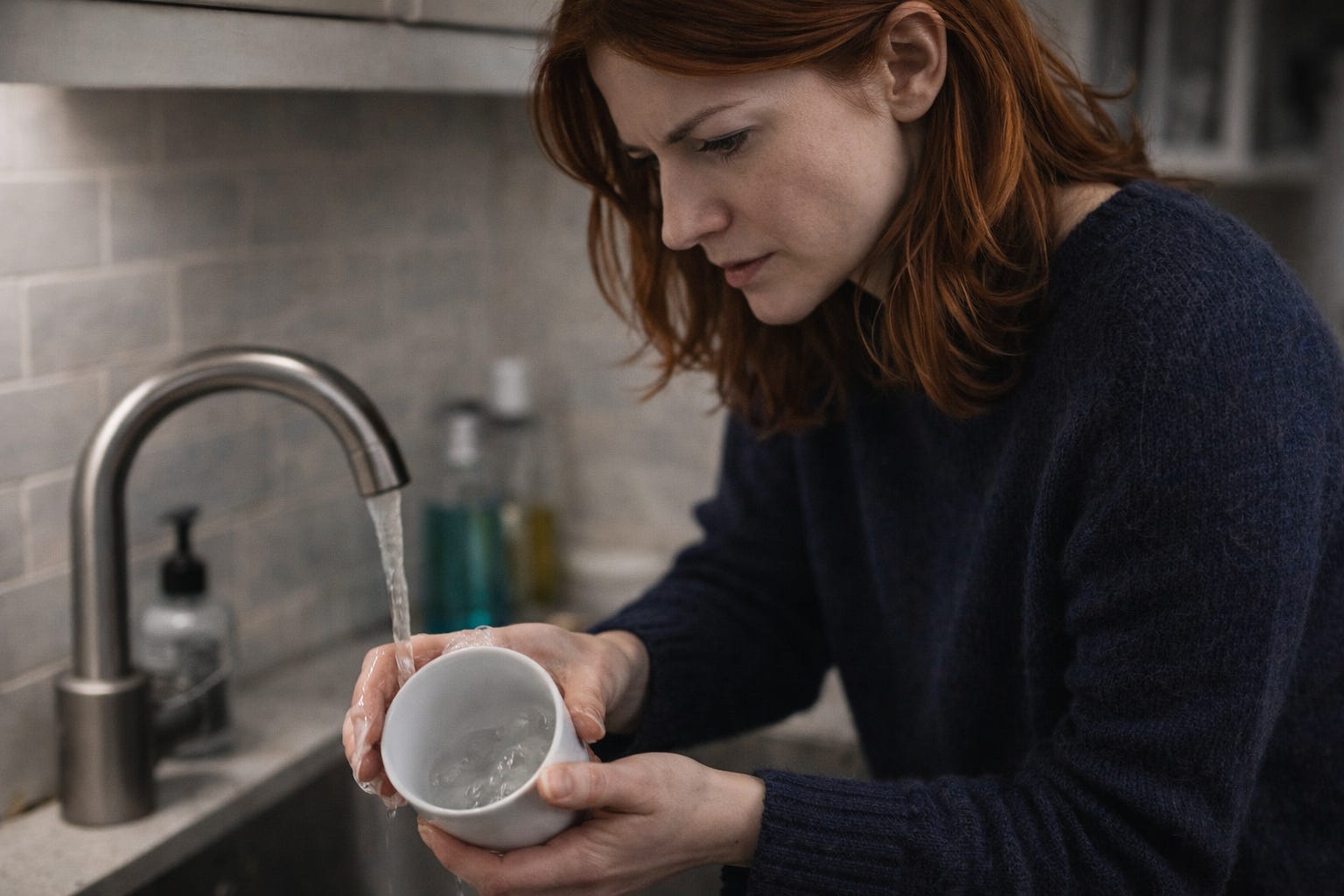
Clara first noticed it while rinsing a cup.
Not as an insight. Not as a revelation. More as a slight fault in the usual machinery.
Water ran over her fingers. Light caught the curve of the white ceramic. Somewhere outside, a bin truck changed gears. These were ordinary enough. But what was less ordinary was the sudden absence of the usual storyline wrapping itself around the moment.
For a second there was no “morning,” no “before work,” no “I’m still upset about yesterday,” no “later I need to call my sister.” There was just water-coolness-glinting-sound-breathing.
Not even “just.” Even that came a fraction late.
Then thought returned, quick as ever.
That was interesting.
What was that?
Was that presence?
Was that what people mean?
And with those thoughts, the old arrangement came back online: Clara here, life happening now, carrying a past, moving toward a future, trying to understand.
But something had been seen. Or perhaps more accurately, something had briefly been unhidden.
All day she kept testing it.
At her desk, while opening email:
typing-seeing-pressure in the neck-faint hum of fluorescent light.
Walking to the car:
heat on the face-footsteps-keys in hand-birdcall.
Lying in bed that night:
sheets against the shin-breath in the chest-thoughts rising and falling in the dark.
Whenever she looked before the labels formed, experience was startlingly fresh. Not fresh in the sense of exciting. Fresh in the sense of not arriving from anywhere. It did not seem to be moving out of a past and into a future. It simply appeared — complete, immediate, uncarried.
That was what disturbed her.
Because the mind did not live that way at all.
The mind insisted on linkage. On sequence. On continuity.
This feeling is because of what happened at lunch.
This tension is left over from childhood.
This argument means something about tomorrow.
This mood has a history.
This reaction has a cause.
All of that may have had practical truth in one register. Clara was not stupid. She knew memory mattered. Conditioning mattered. Learning mattered. Trauma mattered. Culture mattered. The organism did not appear out of nowhere each second like a goldfish.
And yet, in direct experiencing, none of that history was present in the way thought made it seem.
History appeared only as present thought, present image, present sensation, present interpretation.
That was the strange thing.
On Wednesday, Naomi called and asked if Clara wanted to meet for tea.
They sat by the harbour under a pale, windy sky. Cups warmed their hands. A gull hopped near the railing, watching for crumbs.
Clara told her what had been happening.
“It’s like…” She stopped, trying to find words that didn’t immediately distort it. “It’s like actual experience doesn’t have a past. It doesn’t arrive dragging anything behind it. It’s just… appearing. Fresh. But then memory steps in and says what it is, where it came from, what it means, what it will lead to.”
Naomi nodded slowly.
“And the memory feels like access to reality?”
“Yes,” Clara said. “Exactly. But it’s not clean access. It’s already interpreted. It’s already shaped by whatever I’ve learned to notice and whatever I’ve been taught matters.”
Naomi smiled. “So the story says it’s showing you what is real, but it’s actually giving you a version.”
“A version,” Clara repeated.
The gull gave up and moved on.
For a while they sat without talking.
Wind. Clink of spoon. Salt smell. Passing footsteps. Laughter from a table behind them.
Clara looked again.
Before she called it “wind,” what was it? Coolness on the cheek, movement through hair, sound against the umbrella canvas.
Before she called it “memory,” what was it? An image appearing now. A bodily tug appearing now. A mood colouring perception now.
Before she called it “my life,” what was there?
Not much she could own, strangely.
Colour. Pressure. sound. movement. thoughting. sensing. aliveness.
Verb more than noun.
Happening more than thing.
She felt a sudden ripple of fear.
If experience is this fresh, this uncarried, then what happens to identity?
The thought landed hard enough to tighten the stomach.
And almost immediately another layer formed:
This fear means I’m close to something important.
Or maybe it means I’m destabilising.
Maybe I’m dissociating.
Maybe I’m finally seeing.
Naomi laughed softly, as if reading her face.
“There it is again,” she said.
“What?”
“The commentary trying to turn the living into a conclusion.”
Clara laughed too then, relieved by how quickly the mechanism had shown itself. The fear was real enough as sensation — fluttering, tightening, heat around the ribs. But what it meant was not contained in the sensation itself. Meaning rushed in afterward, borrowing old concepts, old warnings, old hopes.
That evening, driving home, she stopped at a red light and looked at the windshield glowing with reflected sunset.
For a few seconds, there was no journey.
Not because the car wasn’t moving through space, and not because clocks had ceased to function, but because direct experiencing was not presenting itself as a river carrying a self from then to later. There was only the red light, hands on the wheel, the hum of the engine, orange sky on glass, breath, pulse, seeing.
Fresh again.
Not disconnected exactly. But not connected in the thick narrative way the mind insisted.
The apparent continuity of life seemed to depend on remembering and retelling. Useful, perhaps essential for functioning. But actual experiencing itself seemed innocent of that continuity. It did not announce, “I come from the past.” It did not declare, “I am on my way to the future.” It did not even say, “I am Clara.”
It simply appeared.
And disappeared.
And appeared.
Later, at home, she found an old photo album in the hall cupboard. As she turned the pages, emotions rose easily: tenderness, embarrassment, grief, longing. A younger face at the beach. Her father squinting into sunlight. A Christmas table no longer possible.
It would have been easy to say: the past is here.
But when she looked more carefully, what was here was not the past. What was here was image-now, feeling-now, thought-now, interpretation-now.
The past had no independent entry. It arrived only as present experiencing shaped by memory.
And memory, she could see, was not neutral. It highlighted some things, dimmed others, rearranged importance, reinforced identity. It was soaked in learned perspective — family perspective, cultural perspective, defensive perspective, hopeful perspective.
Not false exactly.
But not pure.
Near midnight she sat on the edge of the bed with the album beside her and let the day settle.
The old mind still wanted to make doctrine out of it:
Only the present is real.
Experience is all there is.
Time is illusion.
Self is narrative.
But even those felt a little too heavy, a little too finished.
What seemed truer was simpler and less secure:
Actual experiencing is the only thing directly given.
It appears fresh, not carrying a past or future inside itself.
Continuity is largely supplied by memory and story.
Memory gives access, yes, but access already coloured by interpretation.
And interpretation is trained.
She switched off the lamp.
Darkness gathered in the room, though even “darkness” was already one step after the fact.
There was the hum of the heater. Weight of the blanket. The small internal weather of the body. A thought half-forming, then dissolving.
Nothing needed linking.
Nothing needed becoming.
Just this living verb, arriving without history, vanishing without residue, then arriving again.
Fresh.
Investigation: What is actual, if anything?
Your framing can be explored very directly.
1. Start with the distinction
There is a difference between:
what is actually present
and the story about what is present
The claim here is not merely “live in the present.” It is more radical:
The only thing directly actual is current experiencing.
Not “the present” as a chunk of time, but experiencing itself.
That means the basic materials are things like:
seeing
hearing
sensing
thinking
feeling
imagining
remembering
These are not nouns in the deepest sense. They are happenings. Verbs.
2. Test whether experiencing contains time
Look closely.
In immediate experience, can you find:
a past?
a future?
a transition from past to present to future?
Or do you only find:
current image
current sensation
current thought
current remembering
current anticipating
This matters.
What is called “memory” is happening now.
What is called “anticipation” is happening now.
What is called “continuity” is inferred now.
So the investigation is:
Does experiencing itself arrive with temporal structure, or is temporal structure largely imposed by thought?
3. Freshness
One of the strongest clues is the felt freshness of direct experience before narrative gets hold of it.
A sound does not arrive saying:
“I am the result of what happened three seconds ago.”
A sensation does not arrive saying:
“I belong to the story of your life.”
A thought may say these things. But the raw appearing itself does not.
That is what you mean by freshness.
Not novelty.
Not excitement.
Freshness as unmediated givenness.
4. But what about connection?
Here we have to be careful.
At the level of direct experience, each appearance seems fresh and self-given.
At the level of ordinary functioning, there is clearly pattern, conditioning, memory, learning, nervous system continuity, language continuity, and social continuity.
So rather than saying “there is no connection,” it may be more precise to say:
The connection is not directly found inside current experiencing itself. It is constructed, inferred, narrated, and remembered.
That keeps the inquiry honest.
5. Memory as access
Memory is interesting because it feels like a doorway to what has been.
But when inspected closely, memory is not the past itself. It is:
an image appearing now
a feeling appearing now
a thought appearing now
an interpretation appearing now
So memory may be the only practical access we have to what we call “past,” but it is never clean access.
It is already shaped by:
selective attention
emotional salience
defensive patterning
language
cultural framing
identity maintenance
learned perspective
So memory does not simply retrieve. It also reconstructs.
6. Interpretation taints access
“Tainted” is strong, but useful if carefully understood.
Interpretation is not a minor add-on. It conditions almost everything:
what is noticed
what is ignored
what is named
what is remembered
what is believed significant
what is felt to be “me”
So what seems like direct contact with reality is often already filtered through training.
A child taught that anger is dangerous will remember and interpret conflict differently from a child taught that anger is normal.
A person shaped by shame will read bodily activation differently from a person shaped by trust.
A culture that prizes achievement will encode “wasted time” differently from one that prizes relational presence.
So perspective does not merely colour experience after the fact. It partly organizes it.
7. Questions to test directly
Try these one at a time:
What is present before naming?
Is there anything actual apart from current experiencing?
Does a sound contain a past and future, or only thought about them?
Is memory the past, or a present event interpreted as past-related?
Is anticipation the future, or a present event interpreted as future-related?
Can continuity be found, or is it mostly inferred?
What in experience is raw appearing, and what is commentary?
What in experience feels unquestionably real because it is immediate, and what feels real because it has been interpreted repeatedly?
8. A clean formulation
Here’s a concise version of your point:
The only thing directly given is current experiencing. This experiencing does not present itself as moving from past to future; it appears freshly, as happening. What we call continuity is largely supplied by memory, narrative, and interpretation. Memory may provide access to what is called the past, but that access is reconstructed through learned perspective and is therefore never free of interpretation.
9. Practical edge
This is not merely abstract.
If this is seen clearly, then:
regret is seen as present remembering plus interpretation
anxiety is seen as present anticipation plus interpretation
identity is seen as narrative continuity built from selective memory
emotional certainty becomes less absolute because one sees how quickly meaning is added
The freedom is not in denying history.
It is in seeing that history does not arrive unfiltered.
And the deepest release may be this:
Actual life is happening now, but not as a “now” wedged between past and future. It is simply happening.