

Song: Enough
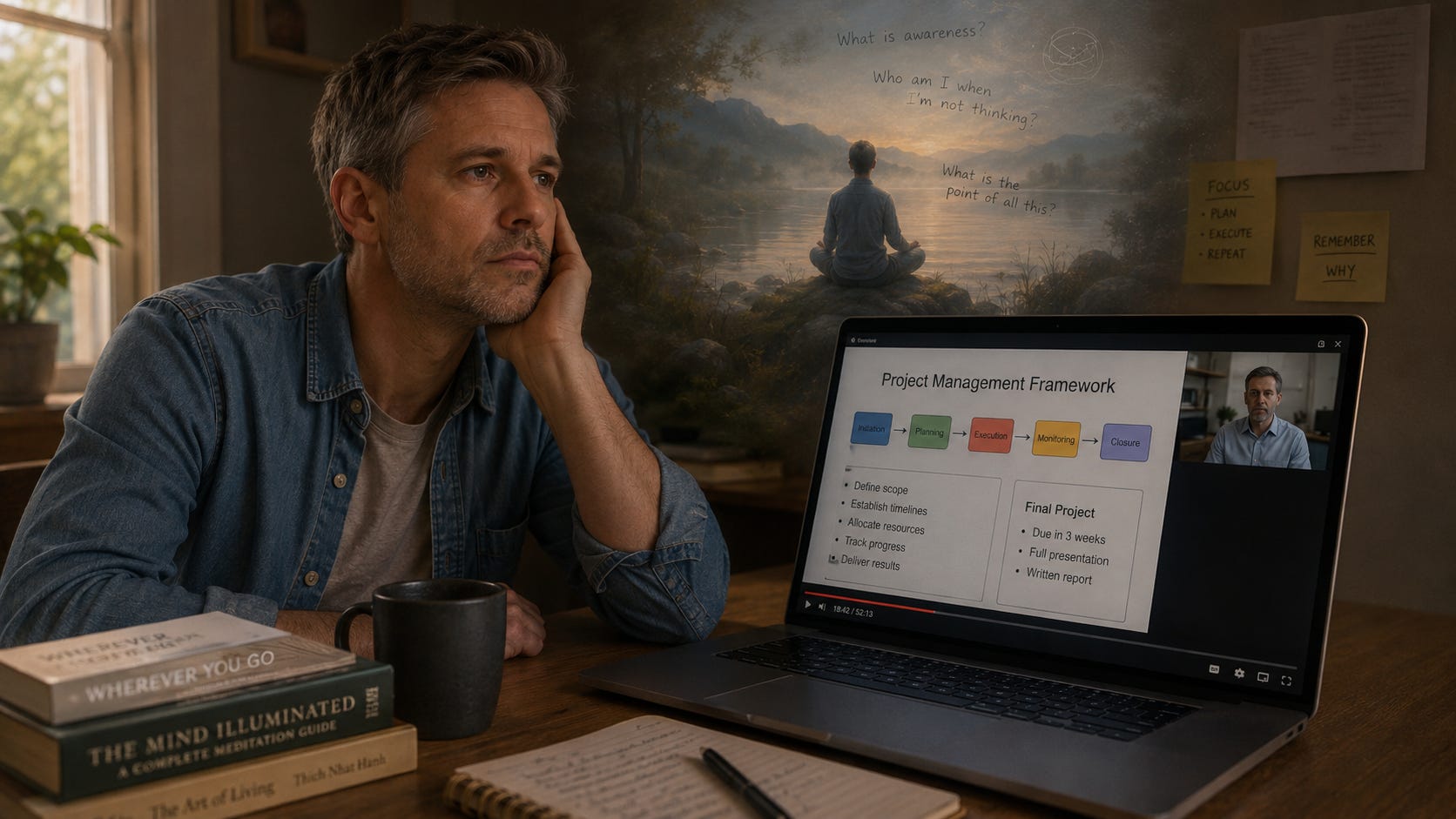
Elias was halfway through an online lecture when he stopped listening.
The professor’s voice was still moving through the laptop speakers — something about frameworks, timelines, deliverables, the final project due in three weeks — but Elias had drifted just beyond the words. Not into sleep, exactly. Into that dull, airless state where the mind keeps functioning but nothing in it feels connected to life.
He stared at the shared screen.
Boxes.
Arrows.
Bullet points.
A color-coded rubric.
He should have been taking notes. Instead, he was thinking about meditation.
Not meditation itself, really. More the whole exhausted pile of associations the word had gathered over the years.
Sit still.
Watch the breath.
Notice thoughts.
Come back.
Who am I?
What is aware?
Look for the self.
Rest as presence.
He’d heard it all. Tried most of it. Ten years, on and off. Retreats, apps, videos, books, guided tracks with soft piano and calm male voices speaking as if they had secret access to a door he kept somehow failing to walk through.
And what had it done?
Sometimes it made him calmer for fifteen minutes.
Sometimes it made him more irritated.
Sometimes it made him feel like he was doing life wrong in a quieter voice.
He closed the laptop halfway.
The apartment was warm. Afternoon light rested on the edge of the table. A coffee cup with a faint ring at the bottom sat beside a pile of readings he had highlighted but not absorbed. His final project notes were spread across the table in untidy stacks — actual work, real deadlines, things requiring decisions.
He should have been doing that.
Instead he was having one of those old internal arguments again.
Maybe you’re not disciplined enough.
Maybe you’re resisting the practice that would help you most.
Maybe if you’d done it properly, sincerely, consistently, you’d be different by now.
Maybe everyone else is getting something you’re not.
Then another voice, drier and more tired, answered:
Or maybe it just doesn’t work for you.
That thought landed with surprising relief.
He leaned back in the chair and looked toward the window. A bus passed below. Someone laughed in the street. Somewhere in the next apartment a cupboard door closed too hard.
Maybe it just doesn’t work for you.
He didn’t mean all meditation was fake. He wasn’t trying to become one of those brittle people who mock anything inward because they are afraid of disappointment. He just meant this: if a method had been part of your life for a decade and mostly left you feeling inadequate, frustrated, and faintly scammed, perhaps the honest response was not to redouble your faith.
Perhaps the honest response was to stop pretending.
That evening he met Daniel at a café near campus.
Daniel arrived late and unapologetic, dropped into the chair opposite him, and said, “You look like you’ve been trying to solve something that doesn’t want solving.”
Elias smiled in spite of himself. “I’m over it.”
“Over what?”
He stirred his coffee, though it didn’t need stirring.
“All of it. Meditation. Inquiry. Sitting around trying to watch thoughts or ask who’s aware or whatever. I’ve done some version of this stuff for years. Ten years, maybe. And honestly? I don’t know if it’s done anything except make me feel like there’s always some better state I should be getting to.”
Daniel nodded once, but didn’t rush in.
Elias kept going.
“I’m in school. I’ve got an actual project to finish. I’ve got readings, bills, deadlines, group work, ordinary life. And part of me is thinking — what if I just stop all this spiritual effort? What if I just try to be a decent person, do my work properly, read good books, be honest, care about people, and leave the rest alone? Is that enough?”
He looked up.
The question sounded both earnest and embarrassed in the air.
Daniel sat back.
“Yes,” he said.
The simplicity of it caught Elias off guard.
“Yes?”
“Yes. That may be enough.”
“But what if I’m giving up on something important?”
Daniel shrugged slightly. “Maybe you’re giving up on something false.”
Elias felt the old defensiveness rise.
“So meditation is bullshit?”
“I didn’t say that.”
“It feels like a scam sometimes.”
“Sometimes it is sold like one.”
That made Elias laugh, unexpectedly loud enough that the couple at the next table glanced over.
Daniel smiled.
“Look,” he said, “something can be real and still be oversold. Something can help some people and be deadening for others. Something can begin as a useful practice and become a subtle form of self-rejection. You’re not obligated to keep doing a thing just because sincere people recommend it.”
Elias stared into his cup.
That was the part he hadn’t let himself admit: that continuing had become a kind of moral performance. He no longer trusted the practice, but he trusted his distrust even less. So he kept one foot in, just enough to remain respectable in the world of people who talked about awakening and awareness and ego and all the other words that had once seemed luminous and now mostly felt worn smooth by repetition.
“What if I’m just lazy?” he said quietly.
Daniel shook his head.
“Maybe. Or maybe you’re tired of pretending resonance where there isn’t any.”
That one went straight in.
Because that was it, really.
It didn’t resonate.
Not in the live sense.
Not in the blood.
Not in the body’s yes.
He had forced himself into so many practices because he thought maturity meant staying loyal to things that felt dry. As if difficulty itself were proof of depth. As if boredom and deadness were signs that the ego was being challenged.
Sometimes they were.
But sometimes boredom was just boredom.
And deadness was just deadness.
And the organism was saying, in the only language it had, not this way.
When he got home that night, he didn’t meditate.
He didn’t journal about why he wasn’t meditating.
He didn’t do an Inquiry on the one who resists practice.
He didn’t watch a video called Why Resistance Is the Gateway.
He made pasta.
He opened his project notes.
He read three pages of a book he actually liked.
He texted his sister back.
He stood at the sink afterward, washing the bowl, and for a brief second there was just warm water on the hands, plate edge, kitchen light, breath.
Nothing spiritual about it.
Nothing branded.
No method.
Just life, unadorned.
And strangely, it felt cleaner than much of what he had called practice.
The next few weeks were not dramatic. No awakening descended because he stopped trying to awaken. He still got anxious. Still procrastinated. Still lost an hour to pointless scrolling and then cursed himself for it. Still worried about whether he was wasting his life in some subtle, irretrievable way.
But something had changed.
He was no longer pretending devotion to what felt hollow.
That gave him back a little dignity.
He finished his project in fragments, badly at first, then better. He walked in the evenings without turning the walk into a mindfulness exercise. He read novels again. He called his mother. He noticed that kindness came more easily when it wasn’t tied to self-improvement. He noticed that some of the deepest moments of quiet arrived not while trying to become more conscious, but while forgetting to manage himself for a while.
One Sunday morning he was sitting on a bench near the river, book closed in his lap, watching light move on the water.
No mantra.
No technique.
No search.
A gull stepped sideways near the edge of the path, absurd and self-serious. A bicycle clicked past. Wind moved through the reeds.
He thought: maybe the problem was never that meditation failed. Maybe the problem was that he kept treating himself as a project.
The thought settled gently.
He had spent years assuming that somewhere just beyond present frustration there was a better, calmer, wiser Elias he ought to be constructing. Meditation had often been folded into that project. Inquiry too. Even goodness, sometimes.
But sitting there by the water, with the ordinary morning completely itself, he felt the possibility that life did not need to be continuously converted into a path.
Perhaps being here mattered more than optimizing here.
Perhaps reading a good book with full attention, finishing the assignment that needed finishing, speaking honestly, apologizing when necessary, loving where he could, and not pretending certainty — perhaps that was not second-rate.
Perhaps that was life.
And perhaps a person could stop chasing methods that felt dead without betraying anything real.
He sat a while longer.
Then opened the book and began reading again, not as avoidance, not as philosophy, just because the sentence on the page was good and the morning was wide and for once he was not trying to turn either of them into evidence for or against his spiritual worth.
It was enough.
Not forever.
Not as a conclusion.
Just enough for that morning.
And because it was enough, it was strangely beautiful.
Investigation: When practice does not resonate
What is being described here is not simple laziness or cynicism. It is often a genuine crisis of honesty.
A person has spent years with meditation, Inquiry, or other formal spiritual practices. They were told the practices were transformative, necessary, profound, or foundational. But over time, one of several things happens:
nothing much changes
any changes are minor compared to the promises made
the practices become dry, effortful, and self-conscious
the practices begin to feel like another way of judging oneself
the person notices that the whole thing no longer feels alive
At that point a painful question appears:
If this doesn’t resonate and doesn’t seem to bear fruit, do I keep going out of faith — or do I admit it may not be for me?
That is an important question.
1. Not all methods fit all organisms
A practice that opens one person may flatten another.
Some people genuinely benefit from:
silent meditation
breath-based attention
Inquiry
devotional practice
ritual or retreat settings
Others find that these become:
dissociative
performative
repetitive
subtly coercive
another layer of self-monitoring
This does not prove the practices are false. It only means they are not universally suitable.
2. “Ten years and no result” matters
This should not be brushed aside.
Sometimes people are told:
you’re doing it wrong
the ego is resisting
the results are too subtle for you to see
just continue
the breakthrough comes when you stop expecting results
Sometimes that may be true.
But sometimes it functions as a closed system protecting the method from honest evaluation.
If a person has sincerely practiced for ten years and feels little genuine transformation, that experience deserves respect. It is not automatically evidence of personal failure.
3. Practices can be oversold
Meditation and Inquiry are often presented as if they reliably produce:
peace
clarity
awakening
freedom from suffering
ego dissolution
emotional resilience
That can happen for some people.
But practices can also become:
another project of becoming
another ideal to fail at
another authority structure
another source of shame
So the skepticism — “is this a scam?” — may not be wholly wrong. The deeper truth may be:
Even real practices can be marketed, taught, and internalized in misleading ways.
4. The hidden assumption
Often beneath the frustration lies an assumption:
If I am serious, sincere, and worthy, I will resonate with spiritual practice.
That assumption itself may be false.
A person may be sincere and still not resonate.
A person may be thoughtful and still find formal practice deadening.
A person may live deeply without a structured path.
5. The alternative question
Instead of asking:
Should I force myself to keep doing this?
A more honest question may be:
What actually brings clarity, honesty, aliveness, kindness, and reality into this life?
That might include:
reading deeply
being in nature
making art
meaningful conversation
careful work
therapy
bodily movement
silence without formal technique
ordinary ethical living
6. “Is being a good person enough?”
This question has moral and existential weight.
It is often asked with hidden shame, as if ordinary goodness were somehow inferior to spiritual advancement.
But perhaps the cleaner view is this:
A humane, thoughtful, responsible, honest life is not a consolation prize. It is not second-class because it lacks a formal spiritual structure.
If formal practice deepens that life, fine.
If it does not, loyalty to the practice is not inherently noble.
7. Important distinction
Rejecting a practice is not the same as rejecting truth.
Sometimes walking away from a dead method is a movement toward greater truthfulness.
Not:
“I refuse depth.”
But:
“I refuse to keep pretending that this is alive for me when it isn’t.”
That distinction matters.
8. Questions for Elias
What exactly feels dead or false in the practice?
Is the frustration with the method, the marketing around it, or the self-image tied to it?
Has the practice brought anything subtle that is being overlooked?
Is the desire to quit an act of avoidance, or an act of honesty?
What forms of depth or sincerity already exist in ordinary life without being called “practice”?
What if clarity is not elsewhere, and not dependent on loyalty to a method?
9. A grounded formulation
Here is the cleanest version:
Frustration with meditation or Inquiry does not necessarily mean resistance to truth. It may reflect a genuine mismatch between the method and the person, or a healthy refusal to continue investing in practices that feel lifeless, overpromised, or subtly shaming. A thoughtful, ethical, engaged life is not lesser because it lacks formal spiritual routines. What matters is not faithfulness to a method, but whether something is actually real and alive.
This dpeaks to me in many ways. ❤️
The list of practises made me laugh, we often try to do too much and expect too much!