

“The Small Red Light”
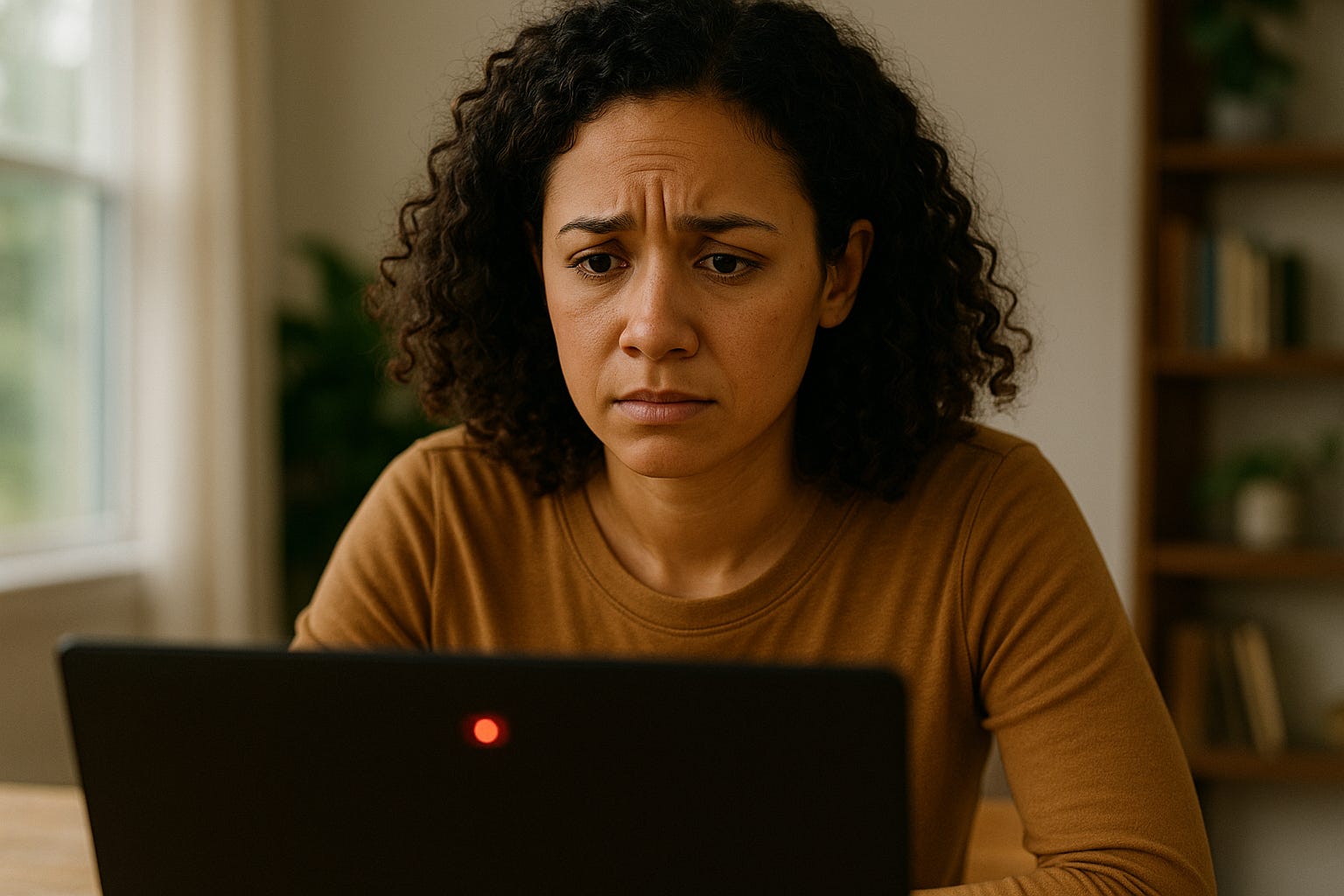
Naomi logged in a few minutes early, as she always did.
Habit more than intention.
The meeting room was still empty, just her name floating in a grey rectangle. Below it, the camera icon waited — neutral, patient, unmistakably expectant.
She didn’t turn it on.
Not yet.
She adjusted her chair, became suddenly aware of her shoulders, her jaw, the way her face felt when she wasn’t doing anything. The thought came quickly, as if rehearsed:
If I turn it on, I’ll have to hold my face.
She noticed how accurate that felt.
It wasn’t shyness exactly.
Or fear of being judged.
It was the anticipation of work.
When the camera was on, her body entered a subtle but relentless task:
keep the eyes soft
look engaged, but not intense
smile lightly, but not too often
nod, but don’t over-nod
sit upright, but casually
don’t drift, don’t freeze, don’t disappear
None of it explicit.
All of it constant.
The room began to fill. Faces appeared, one by one, neatly framed, already composed. Naomi watched them without yet joining the grid, felt a faint pressure in her chest build — not panic, just fatigue arriving early.
Someone said, “Hey Naomi, good to see you,” even though they couldn’t see her yet.
She hovered her mouse over the camera icon.
The small red light.
As if on cue, her body responded — a shallow breath, a slight tightening under the ribs, the familiar readiness to perform being okay.
She paused.
For once, she didn’t push past it.
Instead, she stayed with the sensation. Not the story — not what does this say about me? — but the physical truth of it: the mild strain, the inward pull, the effort bracing itself in advance.
This is exhausting, she realised.
And I haven’t done anything yet.
The meeting began. Voices layered over one another. Naomi listened, camera still off, and noticed something surprising: she was present. Fully.
She followed the discussion easily. She cared. She understood. She even spoke — her voice steady, clear, unburdened.
No one questioned her presence.
And without the visual self to manage, her body softened. Breath dropped lower. Her face rested. She wasn’t arranging herself for anyone.
For the first time in a while, participation didn’t cost energy — it freed it.
Halfway through, someone asked gently, “Naomi, do you want to turn your camera on?”
She considered it, honestly.
Not out of obligation.
Not out of defiance.
She checked the body again.
Still tight.
“No, I’m okay like this,” she said. “I’m here.”
And she meant it.
Nothing broke.
No connection was lost.
No one withdrew.
If anything, she felt more available — because she wasn’t split between listening and managing.
When the meeting ended, Naomi sat quietly for a moment, screen dark.
She noticed the simple aftereffect: no ache in her face, no buzzing in her head, no urge to recover. Just normal tiredness, the good kind.
She smiled — not for anyone else, just because it rose naturally.
It wasn’t that she didn’t want to be seen.
It was that sometimes, not being seen was the most honest way she could stay.
And that, she realised, wasn’t withdrawal at all.
It was care.
“Still Here”
A week later, Naomi joined the same meeting.
Same link.
Same grey room.
Same camera icon waiting patiently in the corner of the screen.
This time, the anxiety didn’t show up first.
What appeared instead was memory — not conceptual, but somatic. Her body remembered the relief of the previous meeting: the ease in the shoulders, the steady breath, the surprising clarity that came when she stopped managing how she looked.
She stayed camera-off again as people gathered.
And something subtle happened.
Because she’d already trusted the body once, there was no edge this time. No bargaining. No inner debate. Just presence, uncomplicated.
She listened.
She spoke.
She existed.
About ten minutes in, as she responded to a question, she noticed something else entirely:
the same quality of attention she’d had before — maybe even deeper.
No split.
No self-monitoring.
And then, almost as an afterthought, a quiet recognition surfaced:
If presence is already here… the camera can’t change it.
She didn’t rush.
She didn’t turn it on to prove anything.
She waited until the impulse came without tension.
A few minutes later, while someone else was speaking, she clicked the camera on.
The image appeared — her own face, relaxed, unarranged, not performing a version of engagement. No practiced smile. No lifted eyebrows. Just the face that happens when nothing is being defended.
Something unexpected followed.
The room softened.
Not dramatically — but perceptibly.
The conversation slowed slightly.
People paused more naturally between sentences.
One man leaned back in his chair.
Someone else exhaled audibly and smiled — not at Naomi, but in response to the tone of the room.
Naomi felt it instantly:
this wasn’t costing her anything.
She wasn’t “on.”
She was just visible.
And because she wasn’t managing her expressions, there was nothing subtly demanding regulation from others. No pressure to mirror, to keep things upbeat, to maintain a rhythm.
Her stillness gave permission.
Later, when someone spoke nervously, Naomi simply listened — openly, unguardedly. She didn’t nod excessively or perform reassurance. She didn’t disappear either.
The person slowed mid-sentence.
“Oh… sorry,” they said, laughing quietly. “I think I’m rambling.”
Naomi smiled — a real smile, small, unmanufactured.
“It’s okay,” she said. “I’m following you.”
The relief on their face was immediate.
After the meeting ended, Naomi stayed seated for a moment.
The body was calm.
No residue.
No buzz.
No fatigue.
She noticed the clean truth of it:
The exhaustion was never about the camera.
It was about self-management.
And when that management dropped, the medium didn’t matter.
Camera off had taught the body safety.
From that safety, camera on became just another way of being here — not a demand, not a drain.
She closed her laptop with a gentle click.
Presence, she saw now, isn’t private or public.
It doesn’t live behind screens or inside them.
And sometimes, when one person stops performing,
others finally get to rest too.