

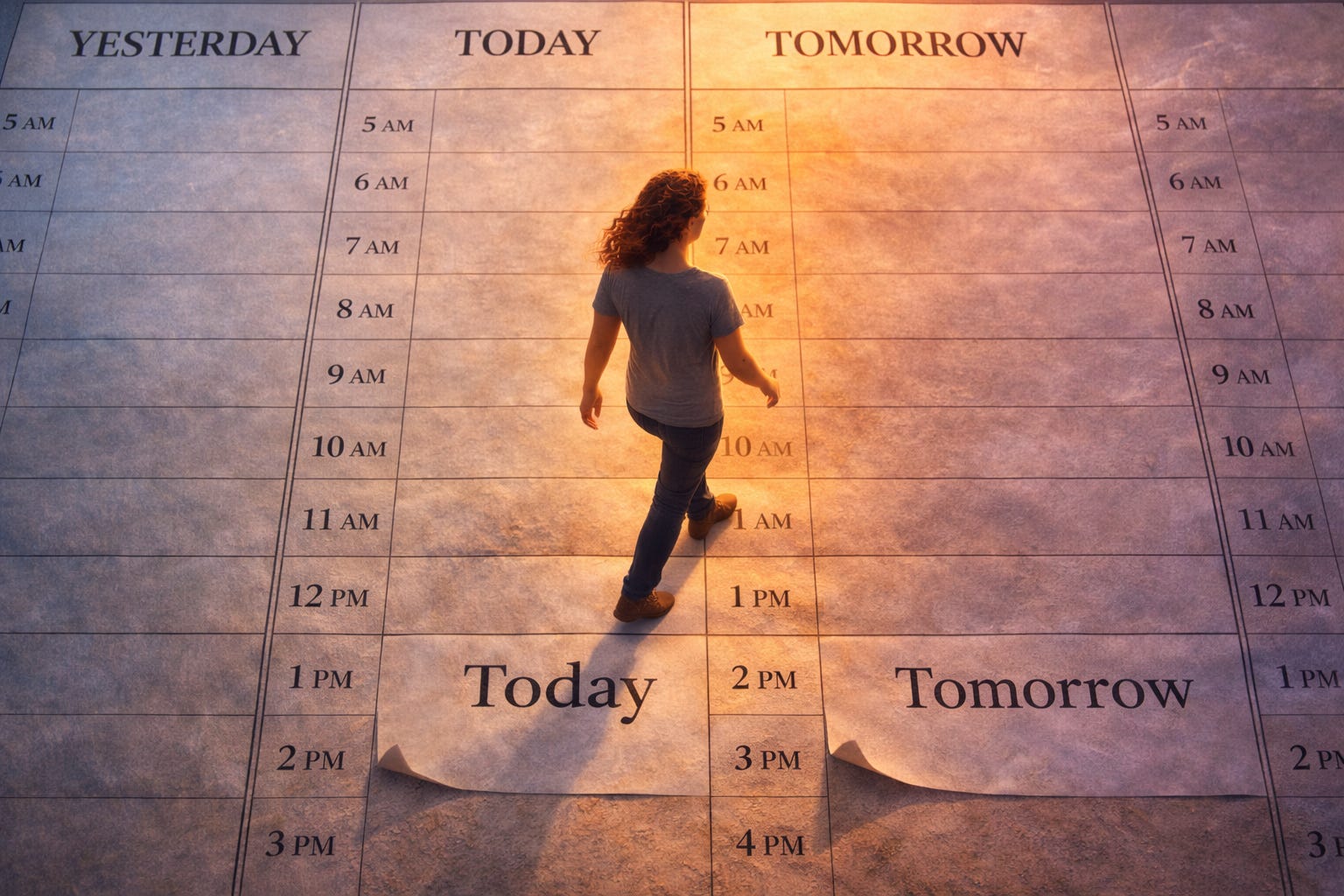
SONG — “Always New”
She used to feel like she was moving through time.
From yesterday into today.
From today toward tomorrow.
Life felt like a line she was travelling along, carrying memory behind her and plans ahead of her like luggage.
One afternoon she noticed something small.
She was standing at the sink, rinsing a cup. As she turned the tap off, there was a brief gap — not dramatic, not mystical — just a flicker where nothing referenced anything else.
No past.
No next.
Just the sound of water stopping.
And then the mind came rushing back in:
Okay, what’s next?
But that gap lingered in her curiosity.
She started noticing it everywhere.
The instant before a thought formed.
The moment a sound ended.
The split second between steps.
Each time, the same thing revealed itself:
there was no continuation.
Only appearance.
The idea of flow came later — stitched together by memory.
The sense of continuity was a story applied after the fact.
Right now wasn’t travelling.
It was appearing.
Again.
And again.
And again.
Fresh each time.
She realised then that NOW wasn’t a location on a timeline.
It wasn’t sandwiched between anything.
It was the only thing ever showing up — endlessly new — while the mind kept drawing lines through it and calling those lines “my life.”
Nothing was moving forward.
Everything was simply arriving.
INVESTIGATION — “Is There Actually Continuity?”
This investigation isn’t philosophical.
It’s observational.
1. Look for the seam
Right now, try to catch:
the end of a sound
the end of a breath
the end of a thought
Ask:
What comes after it — experientially?
Is there a bridge?
Or just another appearance?
2. Notice how continuity is constructed
Ask:
How do I know this moment follows the previous one?
The answer is almost always:
memory
labeling
narrative
But memory appears now.
Labeling appears now.
Continuity is inferred — never experienced directly.
3. Examine the freshness
Look closely at sensation:
this pressure
this colour
this sound
Ask:
Is this recycled — or brand new?
Even familiar sensations are appearing for the first time.
This breath has never happened before.
4. Find “now”
Try to locate NOW as a point.
Ask:
Where exactly does NOW begin or end?
You won’t find edges.
Because NOW isn’t a slice of time.
It’s simply what’s happening — without borders.
5. The quiet recognition
Time feels continuous because the mind connects appearances.
But experience itself is discontinuous —
a series of fresh arrivals with no visible thread.
Life isn’t moving through time.
Time is a story told about what’s already gone.