

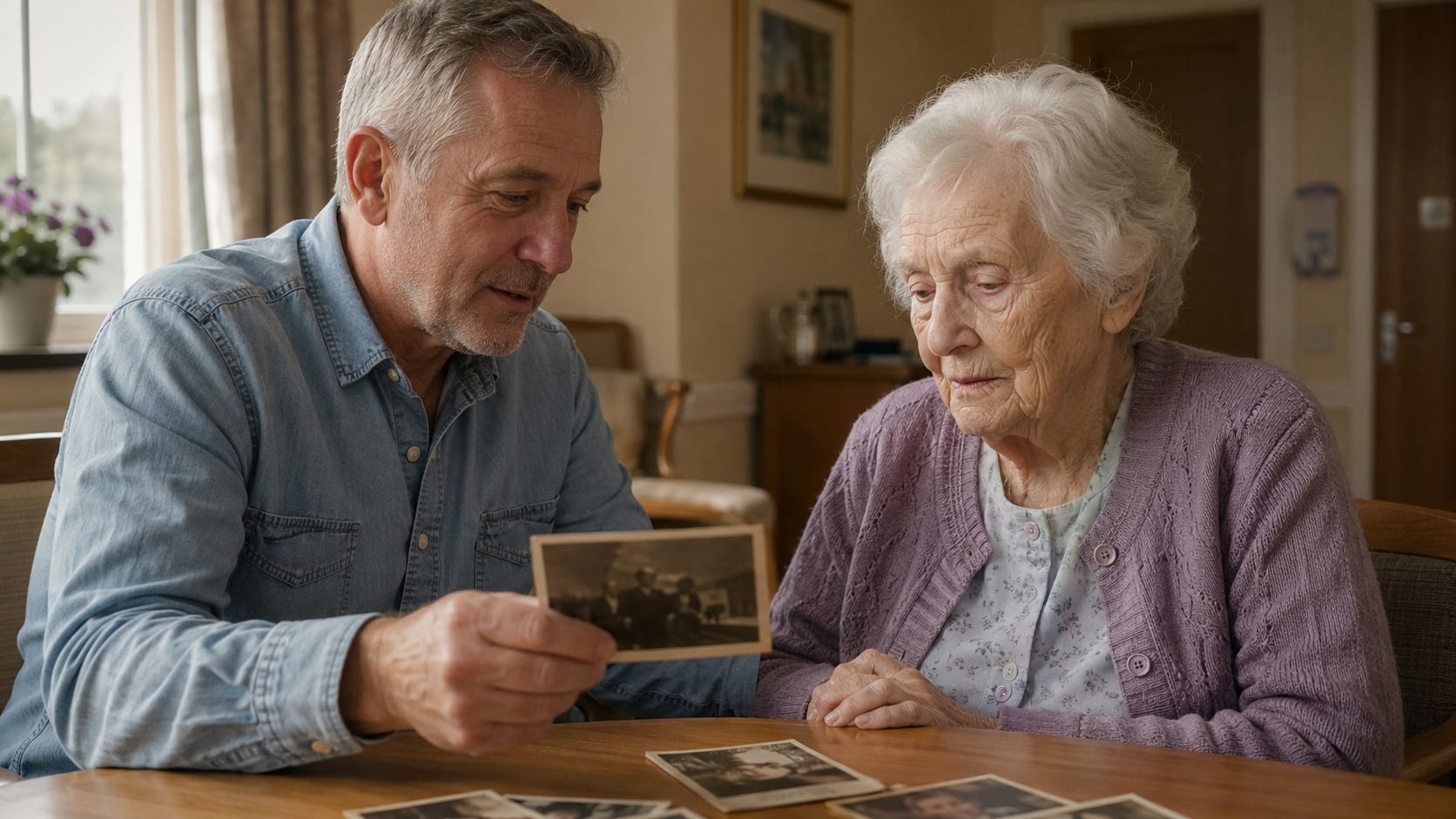
When words, explanations, identity, and even memory begin to fail, relationship does not necessarily disappear. Something simpler can remain—warmth, touch, kindness, being-with. We call it love, while admitting the word barely reaches it. The discussion of hugs, bonding, the limits of language, and sitting wordlessly holding a mother’s hand in dementia all point there.
The especially powerful turn here is not “love is the answer,” but “perhaps love is what becomes obvious before we turn experiencing into an answer.”
Song: Before the Word Love
Elias had been visiting his mother (who was experiencing dementia) every Wednesday for almost two years.
At first he had tried to keep their old relationship alive.
He brought photographs.
“Do you remember this?”
Sometimes she did.
Often she didn’t.
He told stories about his childhood.
“You used to take us to the beach here.”
She would study the photograph carefully.
“That’s nice,” she would say.
“You were there.”
“Oh.”
He reminded her of names.
People.
Places.
Birthdays.
The house they had lived in.
The dog they had owned.
The holiday when the car broke down halfway to Brisbane.
Occasionally something lit behind her eyes.
Mostly the words disappeared before they reached anywhere.
Elias found this unbearable.
It felt as though his mother were being erased sentence by sentence.
She had once known everything about him.
Not literally everything, of course.
But she knew the family language.
The names behind the names.
If Elias mentioned Uncle Frank, he did not need to explain Uncle Frank.
If he said, “Remember Christmas at Margaret’s?” an entire world could unfold.
Now he would say:
“Margaret.”
And his mother would smile politely.
As though Margaret were someone Elias had met on the bus.
Each visit became a test.
What remained?
How much had been lost?
Was she still his mother if she no longer remembered being his mother?
Was he still her son if the word son no longer connected to anything?
One Wednesday he arrived exhausted.
He had not slept well.
Traffic had been terrible.
He had forgotten the photographs.
And, for reasons he could not explain, he had no energy for another examination.
His mother was sitting near the window.
She looked at him as he entered.
Her face brightened.
Not with recognition exactly.
Something else.
Pleasure.
“Hello,” Elias said.
She smiled.
“Hello.”
He sat beside her.
For several minutes neither spoke.
Usually Elias would have filled the silence.
How are you?
Did you have lunch?
Do you remember Clara?
How was your morning?
Do you know who I am?
That last question had never been spoken aloud.
But it was present at nearly every visit.
Do you know who I am?
That day it did not arise.
His mother’s hand rested on the arm of the chair.
Elias placed his hand over it.
She turned her palm upward and held his fingers.
Then she smiled.
That was all.
No name.
No relationship.
No history.
No proof.
Elias sat there.
His mother occasionally looked towards the window.
A bird moved across the lawn.
Someone pushed a trolley along the corridor.
A nurse laughed in another room.
His mother squeezed his hand.
Elias felt tears coming.
Not the tears he usually had after visiting.
Those had been grief for what was disappearing.
These were different.
Something enormous was present precisely where everything he had thought necessary was absent.
She did not need his biography.
He did not need hers.
She did not need to know the word son.
He did not need her to perform mother.
The relationship did not have to explain itself.
There was warmth.
Skin against skin.
Her face.
His face.
Breathing.
A hand holding another hand.
For the first time in months Elias was not asking:
What is left of her?
He was simply there.
And she was simply there.
Although even that sounded wrong afterward.
Because during the moment, there had not seemed to be two separate people performing the activity called being together.
There was just—
this.
He stayed almost an hour.
They spoke perhaps twenty words.
When he left, his mother said, “That was lovely.”
Elias walked into the car park and cried.
A few days later, Clara noticed something different in him.
They were sitting with Naomi and Daniel after the meeting.
“You’re quiet,” Clara said.
“I’ve been thinking about words.”
Daniel smiled.
“That usually means trouble.”
Elias told them about his mother.
When he finished, Naomi was crying.
Clara said, “Do you think she knew who you were?”
Elias considered the question.
“I don’t know.”
“Does that bother you?”
“It used to.”
“And now?”
He looked at his hands.
“I’m beginning to wonder whether recognising my story about us was less important than I imagined.”
Clara frowned.
“But surely knowing you’re her son matters.”
“Practically? Yes.”
“No, I mean emotionally.”
Elias paused.
“What if she didn’t know I was her son and still loved me?”
Clara looked surprised.
“Can she love you without knowing who you are?”
“That’s exactly what I’m wondering.”
Daniel said, “Maybe she liked having her hand held.”
“Yes.”
“That doesn’t necessarily mean love.”
“No.”
“So how do you know it was love?”
Elias smiled.
“I don’t.”
Daniel laughed.
“Excellent. We’ve solved it.”
But Naomi stayed serious.
“Maybe that’s the problem with the word,” she said.
“What?”
“We say love, and immediately we think we know what we’re talking about.”
Clara nodded slowly.
Romantic love.
Parental love.
Friendship.
Attachment.
Affection.
Desire.
Devotion.
Compassion.
All bundled into one word.
Naomi continued.
“Maybe the word is pointing towards something much simpler than all the stories we attach to it.”
Elias remembered his mother’s hand.
“I think so.”
Clara asked, “What?”
“I don’t know.”
Daniel groaned.
“We’re making excellent progress tonight.”
Elias laughed.
“I mean it. The experience was clearer than anything I could say about it.”
He searched anyway.
Warmth.
Acceptance.
Tenderness.
No need to defend.
No need to become anything.
No separation for a moment between giving and receiving.
Every phrase felt too small.
“Maybe kindness,” Clara suggested.
“Part of it.”
“Connection?”
“Part of it.”
“Safety?”
“Perhaps.”
“Belonging?”
“Maybe.”
Naomi said, “What if we’re doing exactly what you were doing with your mother?”
Elias looked at her.
“Trying to make it survive by giving it names.”
“Yes.”
The room became quiet.
Daniel finally said, “So language is useful until it starts pretending it contains the thing.”
Elias looked at him.
“That’s good.”
“I have one every six months.”
The next week they met outside.
There were six of them sitting beneath a large tree.
Carol had brought tea.
Bracken lay stretched on the grass near Elias’s feet.
The conversation had become complicated.
Someone had asked whether awakening meant becoming more loving.
Then someone else had asked what love was.
Within minutes they had constructed a philosophical disaster.
Was love biological attachment?
Was it an emotion?
Was it unconditional acceptance?
Was attachment different from love?
Could there be love without relationship?
Was love possible without a self?
Elias listened.
Eventually Clara laughed.
“What?”
Naomi asked.
“We’re discussing love so thoroughly that I can’t feel any.”
Everyone laughed.
Bracken woke, stood, walked across the circle, and pushed his grey muzzle into Clara’s lap.
She scratched behind his ears.
He leaned his entire weight against her knees.
Nobody spoke for a moment.
Carol said, “There.”
Clara looked up.
“What?”
“That.”
Clara smiled.
“Bracken?”
“No. Whatever just happened before we explained it.”
Elias watched Clara’s face soften.
Bracken had no theory of love.
He had never read a book about attachment.
He had no philosophy of relationship.
He did not need Clara to understand him correctly.
He leaned.
She touched him.
Warmth moved.
That was enough.
Elias said, “Maybe love is easier to notice when we stop asking it to explain itself.”
Months later his mother had deteriorated further.
Words were almost gone.
One afternoon Elias arrived and she showed no visible recognition.
He sat beside her.
She stared towards the window.
He took her hand.
Nothing happened.
A minute passed.
Then another.
The old grief stirred.
She doesn’t know me.
The sentence hurt.
He noticed what came with it:
the history,
the boy he had been,
the mother she had been,
the assumption that love required the continuation of both characters.
Then his mother turned her hand slightly.
Her fingers closed around his.
No smile this time.
No words.
Just pressure.
Elias stayed.
At some point his attention moved away from the question of whether she knew him.
The room became very simple.
Light.
Breathing.
A hand.
Warmth.
A distant television.
The rise and fall of his mother’s chest.
Nothing needed translation.
Elias realised that throughout his life he had imagined love as something travelling between people.
I love you.
You love me.
My love goes from here to there.
But sitting beside his mother, that picture felt increasingly inadequate.
There seemed to be no parcel travelling between two separate locations.
There was simply loving.
Or even that was too much.
There was holding.
Warmth.
Softness.
Tears.
Breathing.
This.
The mind wanted to say:
This is love.
Then another recognition came.
Even that sentence arrived afterward.
The word love was not the experience.
It was a little sign erected after the event.
Like a sign beside the ocean saying:
WATER.
Accurate enough.
And absurdly insufficient.
His mother opened her eyes.
For a few seconds she looked directly at him.
Perhaps she recognised him.
Perhaps not.
Elias no longer needed to know.
She smiled.
He smiled.
And before either could make anything of it—
there was nothing missing.
Investigation: Before Love Becomes a Word
We usually experience love through stories.
My mother.
My husband.
My daughter.
My friend.
My dog.
The person I have known for thirty years.
These stories are not wrong.
They organise relationship.
They carry memory.
They make practical human life possible.
But occasionally something exposes a deeper question:
Does love depend upon the story?
1. We often confuse recognition with love
Someone says:
“I know you.”
They remember our birthday.
Our history.
Our preferences.
Our wounds.
They understand our jokes.
This feels intimate.
And it is.
But what happens when memory disappears?
Does love disappear with it?
Dementia provides a powerful investigation because the conceptual scaffolding of relationship may begin to collapse.
The name may disappear.
The relationship may disappear conceptually.
The shared history may disappear.
Yet warmth can remain.
A hand reaches.
A face brightens.
A body relaxes beside another body.
What is that?
We may call it love.
But the experience appeared before the label.
2. Language cuts life into pieces
Language says:
mother,
son,
friend,
lover,
dog,
stranger.
Then:
love,
fear,
grief,
connection.
Useful distinctions.
But direct experiencing is not naturally divided into these neat boxes.
Warmth does not announce:
“I am maternal affection.”
A hand being held does not say:
“This represents thirty years of relational history.”
Those meanings are added.
The event comes first.
The story comes second.
3. Words are pointers, not containers
Consider the word:
love.
Four letters.
And inside it we attempt to place:
a mother holding a baby,
two old friends laughing,
someone sitting beside a dying partner,
a dog placing its head in a lap,
sexual intimacy,
compassion for a stranger,
grief after loss,
the warmth of holding a confused elderly mother’s hand.
Obviously the word cannot contain all of that.
It points.
Poorly.
Beautifully.
Usefully.
But it remains a pointer.
4. Love may become clearer as explanation weakens
This sounds paradoxical.
We imagine that understanding improves relationship.
Often it does.
But there are moments when explanation falls away and something more direct becomes visible.
No analysis.
No defence.
No role.
No requirement to say the correct thing.
Simply being-with.
A long hug can communicate something hundreds of sentences cannot.
Not because hugs contain secret information.
Because the experience itself does not require translation.
5. This may explain our openness with animals
Animals frequently remove much of the conceptual machinery.
The dog does not need your biography.
It does not ask whether you have healed enough.
It does not require you to defend your worldview.
There can simply be:
touch,
warmth,
play,
company.
The absence of explanation allows something already present to become obvious.
Animals do not manufacture love.
They may reveal how little love requires.
6. Love may not be an emotion
Emotions change.
Warm affection comes and goes.
Irritation appears.
Resentment appears.
Grief appears.
Fatigue appears.
If love is identical to a pleasant emotional state, then love disappears every time irritation comes.
Yet care often continues.
Food is prepared.
A hand is held.
Someone stays beside a hospital bed.
The dog is walked in the rain.
Perhaps love is not merely one particular feeling.
Perhaps it is closer to the absence of resistance between life and life.
That remains an interpretation.
But it is worth looking.
7. What if love isn’t travelling between two people?
The conventional picture is:
I → love → you
There is a sender.
A receiver.
Something called love travels between them.
But look directly during a deeply loving moment.
Can you locate the boundary where giving stops and receiving begins?
A long embrace.
Holding a hand.
Sitting silently beside someone.
There may simply be warmth and contact.
The division into:
me loving you
may be the later description.
The event may be simpler.
8. The failure of words can be an opening
When words start feeling inadequate, that is not necessarily a problem.
It may mean experiencing has become more obvious than the descriptions.
Instead of trying harder to explain:
stay near the experience.
What does a hug actually feel like?
Pressure.
Warmth.
Breath.
Softening.
Maybe tears.
What does love actually feel like before the word love?
Look.
There may be no final answer.
Good.
9. Inquiry
Think of someone or some animal you love.
Before remembering why you love them, notice what happens in the body.
Then remove the story experimentally.
Not permanently.
Just for a moment.
No name.
No role.
No history.
No:
my partner,
my child,
my mother,
my friend,
my dog.
What remains?
Perhaps warmth.
Perhaps tenderness.
Perhaps nothing noticeable.
Perhaps grief.
Whatever appears is enough.
Then investigate:
Does love require the sentence “I love you” to exist?
Does it require knowing who the other person is?
Does it require being understood?
Does it require reciprocity?
And finally:
Before the word love appears, what is actually happening?
Don’t answer too quickly.
The absence of an answer may be closer than the answer.
10. Clean formulation
Personal love is usually wrapped in language, memory, identity, and relationship: “my mother,” “my partner,” “my friend.” But occasionally those structures weaken—through silence, animals, deep intimacy, illness, dementia—and something remains that does not require explanation. Warmth. Holding. Kindness. Presence. We call it love, but the word comes afterward. Perhaps love is not something produced by the story of two separate people. Perhaps the stories temporarily become quiet enough for something more fundamental to show itself.
tears to my eyes again. so perfect. thank you again